


 Francais
 Deutsch
 Italiano
Refine Your Search
Ohio-State-football stock footage and images
- Showing 17005 to 17010 of 24492 results more
more Hide
Hide
Field Artillery Battalion of 92nd Infantry Division (Colored), in Mantes-Gassicourt, France during World War II
United States Army Field Artillery Battalion of 92nd Infantry Division (Colored), "Buffalo Soldiers," equipped with tractor-drawn 8-inch Howitzers, in Mantes-Gassicourt, France during World War 2. African American soldiers of fire control group observe town below, from vantage point on overlooking hill. One of them looks through a periscopic binocular telescope. Others look through ordinary binoculars. Closeup of a Master Sergeant looking through binoculars. Camera pans across the valley, town, and agricultural fields below. Camera focuses briefly on Collegiate Church of Our Lady of Mantes (Notre Dame de Mantes) in Mantes-la-Jolie and then shifts to battery of 8 inch howitzers firing from camouflaged positions in foliage. Gun crews step away as each howitzer fires, and then rush back to reload and fire again. (Note: These batteries are likely from the 795th or the 999th Field Artillery Battalion)
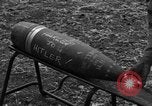
African American soldiers of Field Artillery Battalion of 92nd Infantry Division operate a 8-inch howitzer during WW2
United States Army Field Artillery Battalion of 92nd Infantry Division (Colored), "Buffalo Soldiers," equipped with tractor-drawn 8-inch Howitzers, in Mantes de Gassicourt, France during World War 2. Opening scene shows an 8-inch howitzer shell on a stand. It has the words: "Harlem to Hitler" written on it in chalk. A gunner screws a fuse into its nose. Closeup of the shell and chalk message. Four soldiers then pick up the shell and walk it towards the breech of their 8-inch howitzer. Cloeup of the gun breech as gunner locks breech and then unlocks and opens it for the camera. Scene shifts to gun crew member communicating on field telephone. Camouflage netting is visible behind him. Next, a gun crew member is seen holding his ears as if to protect against the noise of a gun firing. Change of scene shows members of gun crew relaxing near their 8-inch howitzer, near a grove of trees. New scene shows brief glimpse of a shell exploding in hill above Mantes. (The tower of the Mantes Notre Dame cathedral is seen in lower left of the shot.) (Note: These scenes probably show members of the 795th or the 999th Field Artillery Battalion)
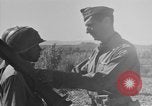
U.S. Army 92nd Infantry Division African American soldiers receive Combat Infantryman Badges from General Mark Clark,during World War II.
United States 92nd Infantry Division consisting of African American soldiers in Italy during World War II. General Mark W. Clark awards badges to several African American soldiers of 370th Regimental Combat Division of 92nd Infantry in Italy. He presents soldiers with Combat Infantryman Badges, during World War 2. Troops lined up in formation behind those being recognized. Atop a hill, in the background, the Village of Peccioli (Pisa) can be seen.
Soldiers of U.S. 110th Infantry Regiment, 28th Infantry Division advance through Hurtgen forest, Germany, during World War II
United States 28th Infantry Division (Keystone Division) near Vossenack, Germany, in November, 1944, during World War 2. Soldiers of 110th Infantry Regiment advance through the Hurtgen forest near Vossenack. They take cover behind trees and fire at an unseen enemy. Soldiers lying prone on the field as they fire. Soldiers carry M1928 field packs, canteens and M1 Garand rifles. One soldier fires an M-1 rifle from the prone position behind a tree.

Allied headquarters in Germany and people being informed through notices.
Allied Military Government ( AGM ) activities in Germany very soon after end of World War II in Europe. The cover of a book titled ' Handbook of military government in Germany '. The text indicates rules of governance in Germany. Closeup of street signs on building at corner of Wilhelmstrasse and Kaiserplatz in Düren Germany. Building of AGM headquarters in Germany. U.S. Army soldiers on a balcony of a government building remove a Nazi flag and setup a United States flag in its place. Men and women killed due to Nazi atrocities. Military Policemen question the Nazis. German citizens milling about on a street. They are being informed about Allied laws and orders through notices and other means. German citizens read an Allied notice. A court hearing being conducted for persons accused of impersonating Allied officals. A man disposes of weapons which are illegal and for which possession is punishable by death, according to the narrator.
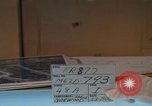
Viet Cong industrial sites and railway yards are seen in North Vietnam via aerial reconnaissance photos.
United States Air Force in south East Asia during the Vietnam War. Aerial reconnaissance photos of target areas in North Vietnam. A man holds pictures and points at them. Pictures of surface to air missile sites, damaged bridges across rivers, MIGs in revetments, petroleum, oil and lubricant storage areas. Pictures of major railway yards and industrial sites in North Vietnam.
CRITICALPAST.COM: About Us | Contact Us | FAQs - How to Order | License Agreement | My Account | My Lightboxes | Shopping Cart | Advanced Search | Featured Collections | Website Terms & Conditions | Privacy Policy ©2026 CriticalPast LLC.
License Agreement |
Terms & Conditions |
Privacy Policy
©2026 CriticalPast LLC.