


 Francais
 Deutsch
 Italiano
Refine Your Search
Ohio-State-football stock footage and images
- Showing 17335 to 17340 of 24492 results more
more Hide
Hide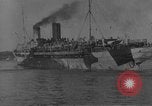
Belgian soldiers who had been fighting against German and Austrian forces, in Russia, in World War I, arrive by ship in Bordeaux, France.
The French line ship, SS Lorraine, in camouflage paint, seen backing into port at Bordeaux, France, on June 24, 1918. Belgian troops of the ACM Corps (Autos-Canons-Mitrailleuses, Belgian armored unit) disembark. They are seen as they walk down a gangway from the ship, in combat uniforms and steel helmets, and carrying their weapons and personal gear. (Note: Soldiers of this armored unit from Belgium fought alongside the Imperial Russian army against German and Austrian troops in 1915 in Russia, during World War 1, before the 1917 Bolshevik revolution, after which they were stranded in hostile territory. They left Vladivostok for the United States on the SS Sheridan, and docked at San Francisco on May 12, 1918. They were warmly greeted as they proceeded across the U.S. to New York city, where they participated in the Memorial Day Parade. After leaving New York City, aboard the SS La Lorraine, they reached Bordeaux on June 24 1918.)

Take off of the General Motors GM A-1 'Bug' missile from a launching automobile in Muroc, California.
A review of research and development in guided missiles by the United States Air Force from 1919 to 1948. General Motors power-driven bomb (GM A-1 Bug), number 9 on tail, in Muroc, California. Technicians work on the same. The bomb is raised into position for attaching to the launching automobile by means of a hoist on a truck. The missile is nick named the 'Bug'. Technicians work at the automobile being driven beneath the suspended missile. The missile is radio controlled. The automobile specifically built for the launch of the missile is powered by two 165 HP Cadillac engines attached to a single drive shaft. Attaching the 'bug' missile to the launching car. The tractor and the hoist are removed. The automobile is driven across terrain at Muroc. A testing station for testing radio control section of aircraft during test. A technician checks over the radio equipment and shows television camera and equipment used for test. The automobile start at a high speed across the launching strip. Take off of the missile from the automobile. 'Bug' missile in flight. Views from a control aircraft beside the GM A-1 Bug while the Bug is in flight. (World War II period).
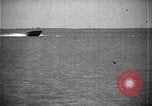
A-3 water missile moves across water in the European Theater.
A review of research and development in guided missiles by the United States Air Force from 1919 to 1948. Type A-3 water born missile move across water. The missile is a radio controlled motor launch. A-3 radio controlled motor launch maneuvers about on the water surface.
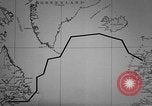
U.S. Coast Guard operations in Greenland prior to U.S. involvement in World War II. Cryolite mine. German weather station
Chart showing U.S. Coast Guard routes across the North Atlantic during World War Two. Scenes of the rugged Greenland landscape. Views of the Greenland Cryolite mine. A U.S. Coast Guard Cutter berthed at the pier near the mine. Greenlanders working in the open pit cryolite mine with jackhammers and steam shovels. U.S. Coast Guard officers seated, conferring with Danish Naval officer. James K. Penfield, first United States consul in Greenland looks on and interjects a comment, while pointing at a map. Supplies being transferred to a Greenland small boat. Two German meteorologists pose by their small weather station. German flag seen in background. View inside the German weather station, shows instruments, clip boards, weather maps, and radio equipment.
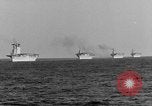
U.S. Navy ships in the Pacific. U.S. warship, in Atlantic, alerts convoy about surface raider. British destroyer fires depth charge
A line of aircraft carriers at sea in the Pacific Theater. U.S. sailors stroll on deck of warship, in the sunshine. An American Destroyer, USS Flusser (DD-368) underway. United States naval officers consult a navigation chart aboard ship. An American sailor signals with semaphore flags. A U.S. warship in the North Atlantic. U.S. sailor (radioman) alerts all ships in a convoy to presence of a German surface raider, and gives its position as Longitude 23:45 West and Latitude 63:14 North (vicinity of Iceland). A British sailor (a Leading Telegraphist - radio operator) aboard a British warship, acknowledges " OK USA, OK USA, thank you very much." Ships in convoy seen. British Destroyer HMS Amazon (D39) launches depth charges. A Royal Navy Commander looks through binoculars. The British Destroyer HMS Anthony (H40) steams past. (World War II period).
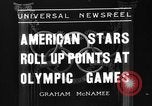
Scenes from various sports and winners in the 1936 Olympic games in Berlin, Germany.
The Olympics in Berlin, Germany. Athletes from many countries competing. Views of exterior of Olympic Stadium in Berlin, and interiors with Olympic flame burning. U.S. captures the men's track and the field title with a total of 203 points to 80 for Finland. A large crowd gathers to watch the events. People cheer and applaud. Men watch through binoculars. Cameramen record the event. Events shown include: Womens Discus, Mens Discus, Marathon, Mens 110 meter hurdle race final (with Forest Towns winning followed by Don Finlay and Fritz Pollard), and a relay race in which Frank Wykoff wins for the United States, breaking the world record of 39.8 seconds. Also shown are Field Hockey, and Diving. Winners shown include the first ever gold medal by a Korean, Sohn Kee-chung, in the marathon. He was running for Japan after Japan's 1910 annexation of Korea. Also British India in Field Hockey is shown playing, University of Michigan diver Richard Degener who won Gold in springboard diving, and Gisela Mauermayer who won the Gold for Germany in women's discus. In Men's Discus, U.S. Gold Medal winner Ken Carpenter from USC is shown, along with Gordon Dunn who won the silver medal in men's discus.
CRITICALPAST.COM: About Us | Contact Us | FAQs - How to Order | License Agreement | My Account | My Lightboxes | Shopping Cart | Advanced Search | Featured Collections | Website Terms & Conditions | Privacy Policy ©2026 CriticalPast LLC.
License Agreement |
Terms & Conditions |
Privacy Policy
©2026 CriticalPast LLC.