


 Francais
 Deutsch
 Italiano
Refine Your Search
Ohio-State-football stock footage and images
- Showing 17377 to 17382 of 24492 results more
more Hide
Hide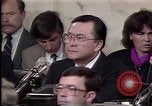
U.S. Joint Congressional Hearing on Iran-Contra affair
U.S. Marine Lieutenant Colonel Oliver North testifies before a Joint Congressional Committee formed to investigate the Iran-Contra affair in the United States. The hearing is called to order by Senator Daniel K. Inouye, Chairman ot the Senate Select Committee On Secret Military Assistance to Iran. Congressman Bill McCollum raises an issue regarding the relationship of the Joint Committee viz-a-viz standing committees of Congress that are interested in pursuing their own investigations. He asks Congressman Lee H. Hamilton, Chairman of the House Select Committee to Investigate Covert Arms Transactions with Iran, whether the Joint Committee needs to approve those related standing commttee activities. Chairman Hamilton expresses the opinion that standing committees do not require such approval. Mr. McCollum argues, however, citing House Resolution 12. Chairman Hamilton agrees to discuss it further with him, but urges the Joint Committee to proceed with its hearing.
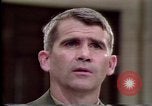
U.S. Marine Lt. Col. Oliver North is questioned by John Nields during Iran-Contra hearing before Joint Congressional Committee
U.S. Lieutenant Colonel Oliver North testifies before a Joint Congressional Committee formed to investigate the Iran-Contra affair in the United States. Mr. John Nields, Counsel for the Committee, asks Lt. Colonel North about the President's knowledge regarding the deal, and his meeting with the President regarding the same. Mr. Nields further questions the witness about the documentation and memorandums written by him, absence of the President's initials on them, and their approval by the Security Council. Nields then discusses the Admiral's letter dated 7th April 1986, regarding the recommendation to prepare a paper for the President. Lastly he questions the Lt. Col about the shredding of the memorandums on 21st November 1986.
General Jonathan Mathew Wainwright returns back to the U.S. after World War II and receives the Congressional Medal of Honor.
U.S. Army General, Jonathan Mathew Wainwright, home from Bataan and Corregidor, and Japanese prisons, reviews a parade in San Francisco and Washington DC and receives the Congressional Medal of Honor from U.S. President Harry S. Truman. General Wainwright exits an airplane in San Francisco. A crowd stands on both sides of a road. The General is greeted by the western defense commander, and by his sister, Mrs. Frederick Mears. They ride in a convertible car and wave at a large parade crowd along Market Street in San Francisco, gathered to welcome him back to the United States. Next scene shows his arrival by airplane in Washington DC, where he meets his wife for the first time since she left the Philippines in 1941. A military motorcade with General Wainwright crosses Memorial Bridge from Arlington into Washington DC. Huge "Welcome" sign and bunting arches all the way across Memorial Bridge, with the Lincoln Memorial in the background. Posters on poles read "Welcome Home Skinny" (his nickname). Large crowd gathers at the Washington Monument to celebrate General Wainwright. Next, on the White House lawn, President Truman presents the Congressional Medal of Honor to the General in Washington DC.
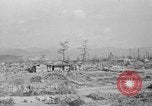
Devastation in Hiroshima and Nagasaki following atomic bomb attacks in World War 2, and view of atomic bomb blast over Nagasaki
Devastated area in north eastern Hiroshima following August 6, 1945 atomic bomb attack in World War 2. Simple shacks and buildings are being built using rubble material after the devastation of Hiroshima. Damage at Higashi station. Newspaper headlines about the atomic bomb attack on Hiroshima, and the warning to Japan by the President of the United States. A map of Japan shows the location of Nagasaki. Scenes of Japanese workers in arms factories building torpedoes and munitions, some wearing kokumin-fuku worker uniform. Workers in an assembly line munitions factory of Mitsubishi. A map shows a torpedo plant in the north and a steel and an arms plant in the south, then plots the center point between them as the U.S. target for the "Fat Man" atomic bomb attack. View of the atomic bomb explosion over Nagasaki on August 9, 1945, as seen from the B-29 bomber "Bockscar" (sometime called Bock's Car or Bocks Car). Mushroom cloud rises up to the sky. Wing of the B-29 bomber in the foreground. An aerial view of rubble and destroyed buildings in Nagasaki following the atomic bomb attack. Destroyed Mitsubishi steel plants beside the sea.
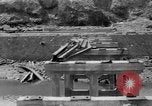
Damaged city and an undamaged road following atomic bomb explosion in Nagasaki, Japan.
World War II damage in Nagasaki, Japan after the atomic bomb attack. A damaged bridge in Nagasaki. The north street of Nagasaki undamaged due to its lower height from that of the explosion. People and truck on a road. Damaged houses. Survivors busy with restoration of their homes. View of an atomic bomb explosion (this is a domestic United States testing blast).
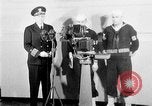
The Norden bomb sight is revealed to the U.S. public for the first time during World War II
The making of a public information film about the Norden bomb sight, during World War 2. Opening scene shows a Norden bomb sight on a pedestal, at the Museum of Science and Industry, in Radio City, Manhattan, New York City. It is flanked by U.S. Navy Captain, Irving Entwhistle and Shore Patrolman, Boatswain's Mate 2nd Class. Orville T. Payne. Another shore patrolman stands behind the bomb sight. The trio waits to begin. Then Captain Entwhistle begins to speak about the significance of the bomb sight to the war effort. The filming is interrupted and takes up again, focusing solely on Captain Entwhistle, as he continues to talk about the bomb sight, but is quickly interrupted, again, by the film director (heard, but not seen). The captain begins, repeating his scripted talk again. Scene shifts to Captain Entwhistle, now standing with hands on the bomb sight. He describes its operation as he maneuvers the sight. He notes the bomb sight's ability to take over control of the bomber's course to the precise drop point. Entwhistle, then looks up and comments: "Is that enough?" He then continues with his talk, but is interrupted, again. Next, Entwhistle picks up again, repeating part of his talk, while the camera pans over the bomb sight. Captain Entwhistle, states that, the instrument "is an automatic pilot, as well as a sight." He rotates the sight various ways for the camera, and asks: "'Want some more?" Scene changes, now showing Harold Barth, President of the Norden company, standing with Captain Entwhistle, who rotates the sight around on its pedestal, while chatting with him. (Microphones do not pick up the conversation.) Mr. Barth leans forward and peers through the sight. Next, in a closeup, the Captain manipulates the sight, while talking to Barth (sound not recorded). Mr. Barth and Captain Entwhistle, take turns looking through the sight. Closeup of the Captain looking through the sight, and manipulating its controls.
CRITICALPAST.COM: About Us | Contact Us | FAQs - How to Order | License Agreement | My Account | My Lightboxes | Shopping Cart | Advanced Search | Featured Collections | Website Terms & Conditions | Privacy Policy ©2026 CriticalPast LLC.
License Agreement |
Terms & Conditions |
Privacy Policy
©2026 CriticalPast LLC.