


 Francais
 Deutsch
 Italiano
Refine Your Search
Ohio-State-football stock footage and images
- Showing 1831 to 1836 of 24493 results more
more Hide
Hide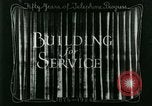
Statistics showing the growth of the Bell System from 1876 to 1926 in the United States.
A documentary titled 'Building for Service' in the United States. In 1878 there were fewer telephones in the United States as compared to later years. Alexander Graham Bell, the inventor of the telephone, in his forecast to the Electric Telephone Company writes that telephone cables could be laid underground or suspended overhead connecting with wires to buildings of any kind. A man could speak to another man at a distant place by this means. A graph showing the growth of the Bell System in the number of telephones, from 2 million in 1876 to 16 million in 1926. Thousands of people have worked in streets and on mountains in laying telephone facility, to bring the inventor's forecast to reality. A graph showing physical property of the Bell System from year 1911 through 1925.

Postage stamps printed commemorating the 50th Anniversary of Motion Picture Industry in the United States (WW2)
Motion Picture postage stamps printed in the United States during World War II. Chairman of the War Activities Committee George J. Schaefer and Assistant Postmaster General Ramsey Black looking at postage stamps rolling off presses. The postage stamps printed at the Bureau of Engraving in Washington to commemorate the 50th Anniversary of the Motion Picture Industry. The men looking at the stamps. Close view of a stamp which depicts a group of U.S. Soldiers in the South Pacific watching a movie. Men standing in a line outside a counter at the New York Post Office collect the stamps. A stamp with 'United States of America' written across the top and '3c, postage' and '50th Anniversary of Motion Pictures' written across the base of the stamp. The first letters bearing New York cachet are stamped. Men stamping the letters. An envelope with a stamp. A signboard behind men at a counter reads 'New York, N.Y., Cachet Applied Here'. Schaefer holding a framed sheet of stamps is flanked by New York Post Master General Goldman and Post Master General Frank Walker. The Chairman expresses his thanks to the Post Master General during his speech at a function in New York. Hollywood stars gathered at a post office to express their thanks. Maria Montez, a motion picture actress, autographs on a giant envelope addressed to the Postmaster General Frank Walker expressing their thanks for his appreciation. A group of stars holding the envelope. Maria Montez with the envelope.

USAAF cargo aircraft C-82 Packet, loaded with troops and tanks, takes off from an airfield in the United States (WW2)
A cargo aircraft in the United States during World War II. United States Army Air Force cargo aircraft C-82 Packet on an airfield. Troops and tanks moving into the aircraft on a ramp. An officer standing beside the ramp. An army tank moving on the ramp entering the aircraft. Several army personnel beside the aircraft on the airfield. The fuselage and the wings of the aircraft in view. The aircraft takes off from the airfield.
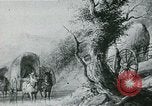
Construction of transport ways, cotton plantations and mechanized spinning and weaving industry in the United States.
A picturization of American people moving to the western territory of Louisiana which is bought by the United States under the Presidency of Thomas Jefferson. A map shows the path of construction of roads accessing farm lands. Farmers leading their herds of cattle to a market in the east. A great canal dug from the west. A map shows waterways linking rivers to the eastern states. The Erie Canal or the Big Ditch through which goods and people move to the farming land. Boats on the canal. People moving on a bridge. Trains moving on a rail road. Several ships at a harbor. Steam boats on rivers. Aug. 17, 1807: 'Fulton's Folly' Steams up the Hudson River. Cotton grown on plantation farm fields in the south. Workers at the cotton plantations. Horse carriages carrying cotton moving at a harbor. Mechanized spinning and weaving industry.
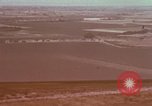
A USAF B-58 Hustler aircraft flies low over deserts and mountains and lands at Edwards Air Force Base in the United States.
A film about the low angle flying ability of United States air Force B-58 Hustler aircraft in the United States. A B-58 aircraft in flight over lush green fields in New Mexico while on its way to Edwards Air Force Base. A pilot at the controls in the cockpit of the aircraft. Aerial view of mountains. The aircraft in flight over Vandenberg Air Force Base. The aircraft flies over a lake. The B-58 in a low flight over mountains and deserts. It flies low over the Edwards Air Force Base. The aircraft carries a free fall bomb pod while in flight. The aircraft lands at Edwards Air Force Base. The aircraft taxis and comes to a stand still. The pilot gets off the B-58 aircraft.

Japanese children in American schools sing loyalty songs and some children in the Japanese schools in the United States.
Japanese people and Japanese Americans in the United States before the attack on Pearl Harbor during World War II. Two actors talk about Japanese and American population. The chairman of Oahu Citizens Committee for Home Defense speaks about the loyalty of the Japanese American towards the United States. Japanese children sing American loyalty songs in schools. A Japanese girl stands. A Japanese boy salutes. The two actors talk about Japanese children going to the American schools as well as to the Japanese schools. A Japanese school in the U.S. A teacher teaches the students in a class. Japanese children sing in Japanese.
CRITICALPAST.COM: About Us | Contact Us | FAQs - How to Order | License Agreement | My Account | My Lightboxes | Shopping Cart | Advanced Search | Featured Collections | Website Terms & Conditions | Privacy Policy ©2026 CriticalPast LLC.
License Agreement |
Terms & Conditions |
Privacy Policy
©2026 CriticalPast LLC.