


 Francais
 Deutsch
 Italiano
Refine Your Search
Ohio-State-football stock footage and images
- Showing 18481 to 18486 of 24492 results more
more Hide
Hide
Ships underway and planes fly overhead as small craft are towed by a larger boat as seen from the carrier Independence
A ship and boats underway in sea. Two planes fly overhead. Planes in formation overhead s seen from the United States Navy aircraft carrier Independence (CVL-22). A line of smaller craft being towed are also seen. World War 2 period.
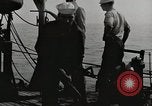
Views of planes dive bombing coast line as seen from Navy aircraft carrier Independence in Pacific Theater
A ship underway in sea as explosions occur at the coast. Planes fly over the United States Navy aircraft carrier USS Independence (CVL-22). Planes are seen dive bombing the coast. (World War II period).
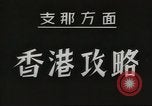
Japanese invasion of Hong Kong during World War II.
View, from Japanese Seaplane tender/troop carrier, Kamikawa Maru, of several gunboats following behind her during approach to Hong Kong in World War 2. Aichi E13A Japanese float plane (Jake) is partially visible on ship's catapult. Japanese troops assemble on deck of ship and are inspected by officers. A float plane is catapulted. The Japanese troops enter assault boat, carrying rising sun naval ensigns. The float plane taxis past troops in their boat. The troops wave to their shipmates who wave back from the Kamikawa Maru. Assault boats underway with gunboats following. Naval guns firing from twin turret aboard Japanese warship. Heavy guns firing from battleship. Aichi E13A plane overhead. Japanese warships in bay below. Aerial view of smoke rising in Hong Kong from naval barrage and bombing. Japanese troops taking fortified positions, running past barbed wire obstacles, and climbing a steel crane at the port with a sign reading "Babcox and Wilcox Ltd, 5 tons at 30 ft and 2- 1/2 tons at 45 ft ." Smoke billowing in the air as Japanese troops run along a rooftop.Smoke rising from a virtual sea of flames. Scene shifts to later after fires have been extinguished. Senior Japanese officers inspect the state of the port and facilities. Sunken British ship, at pier, in camouflage paint. Surrendered British sailors, and some soldiers, held in a large open square.
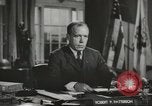
American Undersecretary of War speaks to difficulties facing Allies in confronting Germany and Japan in World War II
Undersecretary of War, Robert Porter Patterson, Sr. speaks about a report from the General staff outlining the needs for combating Germany and Japan in World War 2. He cites Operation Husky, the invasion of Sicily, as an example of what will be needed. He continues to narrate in the background as an animated map appears showing the buildup of supplies and Allied forces in North Africa; Allied air forces flying 60 thousand sorties over Sicily and, the direct amphibious assault using 3,200 vessels. Map also depicts opposing forces of 12 (“unwilling”) Italian Divisions and 3-1/2 German Divisions. View of Allied troops carrying some of their 31 thousand casualties on stretchers from field ambulances. Allied medics attending to the wounded. Some are seen lying on stretchers in a row on the ground near a wall. Interior of a field hospital where surgeons and other medical personnel treat the wounded. Animated map shifts to Europe with Germany at its center, showing , in contrast to Sicily that was only an “outpost,”, the heavily fortified perimeter of Axis controlled areas; the axis industrial might; and the disposition of 300 German Divisions (mostly on the Eastern front) defending the region. Next, the map illustrates Japan’s defended regions in the Pacific Image returns to Undersecretary Patterson i n his office, speaking of the Allied offensives planned for next year (1944), and emphasizing their challenge and difficulty. Scene shifts to General Jonathan Wainwright and his garrison at Corregidor, in the Philippines, surrendering to Japanese forces in 1941. Japanese military camera pans over the Americans being taken prisoner. Other Americans and Filipinos are seen being marched together under guard. Scene shifts to classic views of the Japanese attack on Pearl Harbor, Hawaii, on December 7, 1941. View of Japanese soldiers executing two Chinese civilians in 1937. Dangling bodies of persons hung by Nazis during Operation Barbarossa in Russia, in 1941 A Russian soldier comforts a little girl as he escorts her across a snowy landscape. Time bomb left by German forces retreating from Naples, Italy, in 1943, blows up a Post office building . Views of damage to building and bodies of victims. American Military Police assisting a victim. American soldiers carrying an injured civilian on a litter. Scene shifts to British Foreign Minister, Anthony Eden, Soviet Foreign Minister, Vyacheslav Molotov, and U.S. Secretary of State, Cordell Hull, entering a hall in the Spiridonovka Palace, during the 1943 Moscow Conference in Russia. Close-up of the American, Soviet, and British flags on a table. View of many delegates seated around the table. Close-up of Molotov, Eden, and Hull signing conference document.
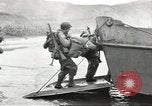
American Amphibious Task Force 9 at Adak and Kiska in Aleutian Island, Alaska
United States Amphibious Task Force 9 soldiers wade through water and board Landing Craft Vehicle Personnel (LCVP) at Adak in Aleutian Island, Alaska and craft pull away from the beach. LCIs (Landing Craft Infantry) head beach wards and soldiers disembark from landing craft tanks and wade through water to land at Kiska. Two ships in harbor, two others in distance. Men on a ship tie a net around a crate with "Army dog" marked on it. Crate hoisted over side of the ship and lowered to awaiting barge. (World War II period).
American barges off the coast of Kiska in Aleutian Island, Alaska
United States barges approach against the coastline of Kiska, Aleutian Island in Alaska. A landing craft lowered by a crane of a ship into the sea.
CRITICALPAST.COM: About Us | Contact Us | FAQs - How to Order | License Agreement | My Account | My Lightboxes | Shopping Cart | Advanced Search | Featured Collections | Website Terms & Conditions | Privacy Policy ©2026 CriticalPast LLC.
License Agreement |
Terms & Conditions |
Privacy Policy
©2026 CriticalPast LLC.