


 Francais
 Deutsch
 Italiano
Refine Your Search
Ohio-State-football stock footage and images
- Showing 18949 to 18954 of 24492 results more
more Hide
Hide
U.S. soldiers seated in a jeep drive across a pontoon bridge over the Kyll River in Birresborn, Germany.
United States soldiers in Birresborn, Germany during World War II. The soldiers walk across a pontoon bridge constructed by them over the Kyll River. Two soldiers seated in a jeep drive across the bridge. Other soldiers walk on the bridge.
U.S. soldiers cross a pontoon bridge constructed by them on the Kyll River in Birresborn, Germany.
United States soldiers in Birresborn, Germany during World War II. The soldiers cross a pontoon bridge constructed by them over the Kyll River. A train at a railroad station in the foreground. The soldiers seated in a jeep driven across the bridge.
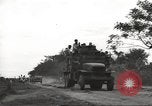
U.S. POWs, rescued from a Japanese prison camp, en route to American lines and an evacuation hospital in Nueva Ecija, Philippines (WW2)
United States prisoners of war, rescued from Cabanatuan Prison Camp by 6th Battalion Rangers, Alamo Scouts, and Filipino guerrillas in Luzon, Philippines, during World War II. The liberated prisoners aboard trucks and Jeeps en route to U.S. lines and the 92nd Evacuation Hospital. Trees and houses along the sides of a road in Guimba, Nueva Ecija. Soldiers and medics seated along with the former prisoners.
U.S. troops surrender before the Japanese in Manila, Philippines.
Invasion of Manila, Philippines by Japanese troops during World War II. Japanese airplanes bomb Corregidor. Antiaircraft artillery is fired from the island. Japanese airplanes fly in formation. Japanese troops land. Smoke from bombardment and firing in the area. United States troops surrender. U.S. prisoners of war stand near Japanese soldiers as death march begins. U.S. Army General Jonathan Mayhew Wainwright arrives at the surrender conference. The American flag is lowered from a flag pole and the Japanese flag is hoisted.
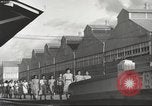
Filipino people going about their routine activities in the Philippines; Filipinos trained by American soldiers.
Part of a 1944 film showing scenes of Filipino people circa 1940, before World War 2. At opening, Filipino women are seen walking alongside a row of factory buildings. A factory room filled with Filipino women dressed in white caps and white uniforms engaged in production at individual individual work stations in a factory. A machine shop filled with Filipino men engaged in metal work. Several people at the window of an office, conducting business with a woman inside. A stock or commodities market office with quotes on tote boards. Women working alongside a moving production line. A woman operating a fabric processing machine. Filipino miners pushing hopper cars of mined ore across a bridge. Miners riding on an engine pulling a train of hopper cars filled with ore from a mine. Filipino longshoremen handling cargoes on a wharf. Scene shifts to an open field where a number of Filipino men are being trained to use firearms during World War 2. One is being coached by an American soldier as he works with a Browning M 1917 water cooled machine gun. Lines of Filipino men firing rifles under supervision of U.S Army trainers. A contingent of uniformed Filipino soldiers, led by an American soldier, marches past a sign, in an camp of tents, reading "A-T Company, 1st Filipino Infantry." Filipino soldiers at a tent camp, being instructed by an American soldier, using a large set of maps. Camera pans over a camp of many tents laid out in order. A formation of Filipino soldiers marches between tents. An American soldier opening his foot locker at his quarters. An illustrated portrait of General Douglas MacArthur. A formation in a field with a Filipino band playing and a Color Guard carrying the American and Filipino flags. A large group of Filipino children walking along a path. A Filipino boy lying on the floor in his home, reading a large book. Filipino school girls seated at benches next to tables. Women doing laundry at an outdoor pond. Next, an actor in khaki clothing sits in a tent and speaks as if addressing American soldiers regarding the Philippines. Among other things, he says,"These people aren't natives. They aren't beggars. They have cities and farms and industries.They have schools and courts and a Constitution. They also have pride and patriotism and self-respect. They love freedom They'll die for it." He cautions American soldiers about their behavior vis-a-vis Filipinos. He states that "Filipinos are American." He alludes to messages received from American and Filipino defenders in Fort Mills, at the fall of Corregidor on May 5, 1942. View of radio towers and worker in radio studio. Morse code messages heard as an American army radio operator with a headset transcribes the messages. Scene shifts to an amphibious invasion fleet attacking a Japanese held island in the Pacific.
A man interviews two prisoners of war which were liberated from a Japanese prison camp in the Philippines.
Liberated American prisoners of war in the Philippines during World War II. Patients lying on hospital beds. A nurse gives medicines to the patients. A man interviews two of the prisoners of war from the Cabanatuan camp. One of the soldiers talks about the Bataan Death March. He states that they marched for three days and three nights. Food and water was not given to them. They were transported to prison camps in boxcars and some of the prisoners died and some were killed. Sergeant Donald Smith also talks about the conditions in the prison camps and treatment received from the Japanese.
CRITICALPAST.COM: About Us | Contact Us | FAQs - How to Order | License Agreement | My Account | My Lightboxes | Shopping Cart | Advanced Search | Featured Collections | Website Terms & Conditions | Privacy Policy ©2026 CriticalPast LLC.
License Agreement |
Terms & Conditions |
Privacy Policy
©2026 CriticalPast LLC.