


 Francais
 Deutsch
 Italiano
Refine Your Search
Ohio-State-football stock footage and images
- Showing 19729 to 19734 of 24492 results more
more Hide
Hide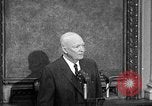
U.S. President Dwight Eisenhower answers a query on Communist menace in Cuba during a press conference in Washington DC.
U.S. President Dwight Eisenhower's 175th press conference in Washington DC, United States. One of the pressmen asks the President that a note delivered to the Cuban Government had a discussion on the menace of communism. He asked the President as to why it was included in the note. The President says that he thinks Communism to be a very obvious subject to bring up whenever there is a troubled area where it might take hold. Everybody knows that the Communists like to fish in troubled waters and there are certainly troubled waters in Cuba. He says that he thinks it wouldn't have been right if anything had not been mentioned to call attention to the seriousness of the Communist menace.
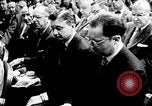
U.S. President Dwight Eisenhower answers a query on the spirit of Camp David during a press conference in Washington DC.
U.S. President Dwight Eisenhower's 175th press conference in Washington DC, United States. One of the pressmen asks the President that in the discussions about a date for an East-West summit conference with General Secretary of the Communist Party of the Soviet Union Mr. Nikita Khrushchev the point arises to preserve the momentum at the end. The Russians talk about the need to preserve the spirit of Camp David. He asks the President what he would like to maintain -- the spirit of Camp David or the momentum. The President says that he has heard of the expression the spirit of Camp David but he does not know what it means. He says that whenever he and Mr. Khrushchev spoke, they spoke in principle and in generality more. There was an agreement when they spoke about problems which the ministers will very likely take up. The President says he thinks that the spirit of Camp David must mean that they can talk together without being mutually abusive. About momentum, he says that that was a word used in discussions on development of foreign relations and agreements. If momentum is kept up it helps not to be rushing into things without being fully prepared.
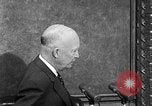
U.S. President Eisenhower answers a query on internationalizing the Panama Canal during a press conference in Washington DC.
U.S. President Dwight Eisenhower's 175th press conference in Washington DC, United States. President Eisenhower stands in front of a microphone before the newsmen during the press conference. One of the press women asks the President if he agrees to the internationalizing of the Panama Canal and whether he was considering building another canal in that area and if they did would they be able to hold it. Pressmen seated at the conference. The President says that the second question takes a lot of study but for the previous 14 years he has been in favor of building another canal, but that was something that he shall not recommend. Regarding the internationalizing of the Panama Canal he says that it is something he would not even think of at that moment. He says that they have got a treaty with Panama, the provisions of which have been obeyed and they have had a model relationship with Panama for the last 50 years. He says that he believes that a particular incident should not become a reason for breaking a relationship that has worked so well. View of the pressmen talking. The President talking to the officials and the pressmen.
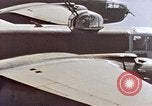
USAAF B-25 Mitchells bomb target areas along a coastline in Italy during the Italian Campaign of World War II.
United States Army Air Force medium bombers in Italy during the Italian Campaign of World War II. A USAAF B-25 Mitchell medium bomber in flight. Three B-25 Mitchells in flight. Dorsal gun turrets on the aircraft. The B-25s in flight. The aircraft drop bombs on target areas on a coastline. Aerial view of buildings. Several fields in view. Bombs dropped by the aircraft explode. Black smoke mushrooms from the explosions. Smoke rising from the bombed areas along the coastline. The B-25s in flight. 'Burma Bound' written on the side of an aircraft.
USAAF B-26 Marauder medium bombers drop bombs over target areas in Italy during the Italian Campaign of World War II.
United States Army Air Force medium bombers in Italy during the Italian Campaign of World War 3. Aerial view of an Italian city along a coastline. The control panel of a USAAF B-25 Mitchell medium bomber. A few USAAF B-26 Marauder medium bombers in a formation flight. Bombs dropped from the aircraft hit target areas in the city. Smoke rises after explosions in the bombed areas. Smoke mushrooming into the air from several target areas. Several B-26 aircraft in a formation flight.
A USAAF fighter aircraft at Alto Airbase in Corsica, France during World War II.
A U.S. Army camp in Corsica, France during World War II. The army camp is surrounded by trees. Farmers on an oxen-drawn wagon loaded with hay moving on a field. A bundle of hay on the field and a building in the background. The farmers are pitching hay. They stand on the hay bundles and look up at the sun. A farmer riding the oxen-drawn hay wagon along a road. Views of Alto Airbase. Two men walking beside burros carrying bundles on their backs. A United States Army Air Force P-47 Thunderbolt fighter aircraft parked on the air base. The oxen-drawn wagon moves from one side of the field to the other side. The farmers are pitching hay. One of them on the hay bundle on the field and the other on the hay in the wagon. Views of the two farmers pitching hay. The farmers looking up at the sun.
CRITICALPAST.COM: About Us | Contact Us | FAQs - How to Order | License Agreement | My Account | My Lightboxes | Shopping Cart | Advanced Search | Featured Collections | Website Terms & Conditions | Privacy Policy ©2026 CriticalPast LLC.
License Agreement |
Terms & Conditions |
Privacy Policy
©2026 CriticalPast LLC.