


 Francais
 Deutsch
 Italiano
Refine Your Search
Ohio-State-football stock footage and images
- Showing 20785 to 20790 of 24492 results more
more Hide
Hide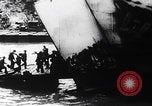
81st Infantry Division troops embark for Peleliu Island while others clear brush for landing strip during Battle of Angaur (WW2)
United States 321st Regiment, 81st Infantry Division board LSTs for Peleliu Island during the Battle of Angaur in World War II. A ship leaves the port while soldiers wait for another ship. Infantry troops clear the jungle while searching for Japanese snipers on Angaur Island. A soldier hacks away tree branches. 81st Infantry Division “Wildcats” troops clear away leaves, branches, and vegetation. Bulldozers clearing bushes, debris, and soil. A road roller with spikes flattens ground. A soldier spins the propeller of a Piper L-4 Grasshopper scout plane to start it. The plane taxiing and taking off from the newly built airfield.
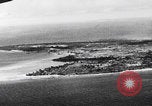
81st Infantry Division “Wildcats” troops advance through Bloody Gulch to Suicide Hill during the Battle of Angaur (WW2)
Aerial view of Peleliu Island during the Battle of Angaur in World War II. Map pointing to the location of Suicide Hill on Angaur Island. 81st Infantry Division “Wildcats” troops moving up a narrow gauge railway leading away from phosphate works into a narrow gorge called “Bloody Gulch”. Smoke from Japanese artillery is seen above the gorge. United States infantry soldiers advance along with tanks through Bloody Gulch. Tank operator talking through a radio microphone. Dramatized audio simulates tank communications while in Bloody Gulch. Infantry soldiers trail behind tanks. A tank is hit by Japanese artillery. Soldier runs past moving tanks. Wounded soldiers crawl and lay down in Bloody Gulch. Medics remove a casualty, running to avoid snipers. Infantry troops taking cover. Soldiers assemble a satchel charge. Soldiers run as explosion in front of tanks to clear the gulch. The second battalion resumes their advance. The second battalion splits up to start an encircling maneuver. Soldiers climbs while wearing flame thrower on his back. Machine gun fire towards Suicide Hill.
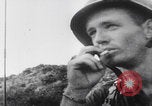
Tired 81st Infantry Division “Wildcats” soldiers resting and recuperating after the Battle of Angaur (WW2)
Faces of United States 81st Infantry Division “Wildcats” soldiers after the Battle of Angaur in World War II. A soldier smoking a cigarette. A tired soldier holding a rifle with bayonet. Soldier scoops food from GI ration and eats. A soldier chewing. A soldier sleeping at the foot of a tree. Medics dressing wounds of a heavily bandaged man. A young soldier eating while sitting on fallen tree trunk. An injured soldier with both eyes covered by bandages is led away. Soldier lying down. Medics evacuate injured patients. A soldier looks to the camera as medics treat his wounds. Soldiers sitting on top of a moving tank. Injured soldiers with dirty faces look to the camera. Logo that reads "Buy War Bonds--The Mighty 7th War Loan" superimposed over photo of the flag raising at Iwo Jima.
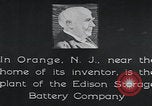
Workers manufacture Edison nickel-iron batteries at the Edison Storage Battery Company Building in West Orange, New Jersey
Manufacturing Edison batteries (also known as nickel-iron battery or NiFe battery) in West Orange, New Jersey, United States. View of the Edison Storage Battery Company Building (177 Main Street, West Orange, New Jersey, USA), the manufacturing facility for Edison batteries. Smoke emanates from vats. Motorized ceiling rack carries cylinders receiving nickel flake via electro plating. Aerial view of battery tube steel manufacture. Factory workers working in assembly lines to assemble batteries. The workers pack batteries for shipment. The four main parts of an Edison battery- negative plates (steel), container (steel), electrolyte (alkaline), and positive plates (steel)- on display. The steel positive plate and perforated steel tube which hold Nickel Hydrate on display. A finger touches the carbon steel ribbon that runs through a perforating machine to create battery tubes. A pen points to the perforation of the carbon steel ribbon. Machines nickel plate steel ribbons. Man places reels of steel ribbons in a tub. Men pushes the tubs into an automatic machine. A machine winding steel ribbons into tubes. Closer view of the steel tube showing its spiral pattern. Hand holding a steel tube. The manufacturing of nickel flake by an electro plating process. Metal sheet cylinders lifted out from vats of nickel. The cylindrical rolls of metal sheet are lowered to alternating vats of copper and nickel. Man unfolds a nickel-copper sheet. A machine cuts the nickel-copper sheet into small pieces. The copper in the nickel-copper pieces is chemically dissolved in a electro plating vat. The positive tubes are loaded with alternate layers of nickel hydrate and nickel flake. Man fits the tubes into a metal mold. Nickel hydrate and nickel flakes are fed into a machine. The man takes off the metal mold, taking the tubes. Cross section of a steel tube. Steel rings on a machine. Man counts the 8 steel rings of the tube. A woman mounts the tubes and presses them into a permanent position in a nickel-plated steel grid. A finished positive plate. A man mounts positive plates on the pole piece. He screws them into place. View of the negative plate, showing its perforated steel pockets holding iron oxide. Machines fold the perforated steel ribbons into Negative Pockets. A worker inserts Negative Pockets into a metal mold. A machine fills the Negative Pockets with iron oxide. Worker mounts the Negative Pockets in a nickel-plated steel grid. A machine secures the Negative Plates by a pressure of 120 tons. The Negative Plates are equidistantly spaced on the negative pole piece. Worker assembles the positive and negative plate groups together. A woman inserts additional insulation between each plate. The container is made of a nickel-plated steel sheet folded and welded to form one piece. Workers carefully inspect and insulate the assembled elements before the elements are permanently sealed in the container. Workers wearing goggles fill the finished battery cells with alkaline solution. Man closes the Filler Cap of the battery cell. Two terminals are seen on top of battery cell. Quality control inspectors check the finished products. A Weston DC voltmeter. A man dips battery cells into an insulating preservative compound. He places the battery cells in trays. Another man connects the cells in trays.
View of Thomas Alva Edison’s West Orange factory; various inventions by Edison
An Edison phonograph playing a record. American inventor Thomas Alva Edison and his wife Mina Miller Edison at the porch of a house. Edison taking his hat off. Edison punching his timecard in timeclock as he arrives in his office. View of Thomas Edison’s West Orange Laboratory (211 Main St, West Orange, NJ 07052, United States) in New Jersey. Thomas Edison shakes hands with an employee inside his factory. Edison watches his employees working. A hole being drilled. A lathe machine scrapes a block of metal. Wheels of belt driven machines moving inside a factory. Cylinder phonograph playing ‘Mary had a Little Lamb’. Illustration depicting Thomas Edison with gramophone by Poyet. A wax cylinder phonograph playing music. Still image of a male opera singer and an orchestra perform in a recording studio. A glowing lightbulb.
Early filmmaking in Thomas Alva Edison’s Black Maria studio; Edison showing lightbulbs
A wall clock hanging on top of a window. Camera shows American inventor Thomas Alva Edison’s laboratory. Glass laboratory bottles and tubes on display. Footage circa 1920 of Thomas Alva Edison showing early lightbulbs to colleagues. A carbon filament light bulb lights up. Camera moves closer to show the glowing carbon filament inside the lamp. Early filmmaking in the United States. A man cranks a Kinetograph, the first movie camera invented by Edison. A belly dancer performs in one of Edison’s early films. A film rolling. A boxing match filmed by Thomas Edison. A cameraman records the boxing match inside Edison’s Black Maria film studio in West Orange, New Jersey. Exteriors of the Black Maria studio showing the turntable and wheels underneath. 19th century women wearing summer dresses strolling in film captured by Edison. Cameramen sent by Edison films people on the beach and in amusement park rides. Edison having lunch with other inventors Henry Ford Sr., Harvey Firestone Sr., and Alexander Graham Bell. View of Edison’s study. A light bulb is turned off.
CRITICALPAST.COM: About Us | Contact Us | FAQs - How to Order | License Agreement | My Account | My Lightboxes | Shopping Cart | Advanced Search | Featured Collections | Website Terms & Conditions | Privacy Policy ©2026 CriticalPast LLC.
License Agreement |
Terms & Conditions |
Privacy Policy
©2026 CriticalPast LLC.