


 Francais
 Deutsch
 Italiano
Refine Your Search
Ohio-State-football stock footage and images
- Showing 20929 to 20934 of 24493 results more
more Hide
Hide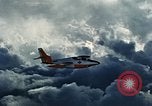
A U.S. Navy T2J-1 Buckeye trainer aircraft recovers from stall and roll.
A U.S. Navy T2J-1 Buckeye trainer aircraft recovers from a stall and roll. The aircraft flying over clouds. The pilot gets indications of an approaching stall: actuation of the rudder shaker, moderate airframe buffeting; and the stall occurs. The pilot recovers from the stall by decreasing the angle of attack, adding power, reducing drag, and leveling off at a comfortable flying speed. The recovery is delayed and spin occurs. The pilot reduces power to ideal rpm and applies full opposite rudder. The rate of spin increases. The pilot continues to hold the controls in recovery position. The rotation stops and the plane recovers in nose down attitude. The pilot neutralizes the rudder, eases the stick back in a smooth pull out to a level attitude. The aircraft rolls over the clouds.
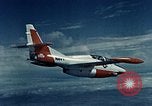
Approach and landing of a U.S. Navy T2J-1 Buckeye trainer aircraft.
Approach and landing of a U.S. Navy T2J-1 Buckeye trainer aircraft. The plane flying over clouds. Let down: The pilot extends the speed brakes, experiences nose up pitch, changes longitudinal trim, and dumps excess fuel. Diagrammatic representation of approach procedure including speed, angle, power and descend of aircraft. The pilot extends speed brakes, reduces power, slows down, extends gear and flaps, slows down on the downwind leg, adjusts power and goes over the landing check off list. He commences turn off, establishes angle and approaches the runway. He then takes a wave off: smoothly applies full power, retracts speed brakes, rolls into wing level attitude, accelerates to safe flying speed and flies parallel to the duty runway. Landing: The pilot holds aircraft speed and attitude, descends to deck, touches down and reduces power to idle. He applies aerodynamic braking by holding the nose wheel off runway. Touches the nose wheel down, uses rudder to maintain directional control, applies brakes, slows to normal taxi, retracts speed brakes, opens canopy and returns to the line. The pilot raises the canopy after a complete standstill. The plane captain at the wheels, removes the 3 landing gear safety pins. Once he gives the signal, the pilot turns off the power control, engine master, and DC power control switches. He then turns off all electrical equipment, removes oxygen mask, shuts off oxygen shut off and fuel shut off valves. The pilot and co-pilot descend from the aircraft and walk away.
Hydraulic, fuel and electrical system of a U.S. Navy T2V-1 SeaStar.
Aircraft system as well as normal and emergency operating procedures of the U.S. Navy T2V-1 SeaStar. A T2V-1 taxis on the airstrip. Hangars in the background. Wing span, fuselage length, height and gross weight of the plane. Diagrammatic representation of the plane's hydraulic system. The plane in flight as the landing gear opens up. Diagram of the plane's fuselage system. Total fuel load. The pilot turns on the tip tank fuel dump switch on the plane's control panel. Fuel dumped from the plane. Diagram of the plane's tanks. Diagrammatic representation of the plane's electrical system including the AC / DC systems. Diagram of the boundary layer control system.
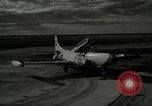
Pre-flight procedures including exterior and cockpit inspection of the U.S. Navy T2V-1 SeaStar.
Pre-flight procedures of the U.S. Navy T2V-1 SeaStar. Exterior inspection: Two airmen approach the plane to conduct a normal walk around inspection which includes highly important and unique inspection points. The airmen manually retract and extend the leading edge wing flap to check for freedom of movement. They inspect the ram air orifices in the nose of each tip tank, speed brake, fuel dump outlet, boundary layer control orifice, position of snubber piston, main hydraulic reservoir, and upper left fuselage. Interior inspection: The pilot in the cockpit. He inspects the engine, aircraft performance, navigation and fuel controls. He checks the electrical, navigational, air conditioning and lighting controls on the right panel and console. Pre-start Cockpit Check: The pilot adjusts the tip tank switches, oxygen supply valve, main fuel shut off switch, battery generator switch, flight instrument power switch, cabin pressure and temperature switches.
Normal operating procedures including start, take off, stall and landing of the U.S. Navy T2V-1 SeaStar.
Normal operating procedures including start, take off, stall and landing of the U.S. Navy T2V-1 SeaStar. Start: The plane on the runway. A crewman arrives with the air impingement car. He inserts the pipe into the air impingement inlet. The crewman gives a signal when the air impingement hole is secure. The pilot adjusts the battery operator switch and turns on the ignition. He moves the throttle to ignite and then to idle position. The exhaust gas temperature gauge. The pilot signals the crewman to disconnect the air impingement starter and adjusts the instrument power switch. Post-start Cockpit Check: The pilot checks the RMI for alignment, adjusts S2 compass controller, annunciator panel touch button, fire detector test switch, fuel quantity indicator button. He checks the communication, navigational, annunciator and left panel. He goes through the take off check list, moves the plane into position, advances throttle, inspects the tachometer, exhaust temperature, releases brake and taxis to the end of the runway. The plane taxis, pilot applies brake and rudder control and takes off. He raises the nose wheel, retracts the landing gear and flaps after take off. The plane in flight over clouds. Stall occurs. The attack angle gauge. Landing procedure: View of the runway. The pilot begins the let down, reduces power, extends the brake, lowers landing gear and flaps, and continues to reduce speed. Diagram of the runway depicting approach. The plane approaches the runway, touches down and lands.
Emergency operating procedures including ejection and landing of the U.S. Navy T2V-1 SeaStar.
Emergency operating procedures of the U.S. Navy T2V-1 SeaStar. The aircraft in flight. Simulation of ejection procedure. Pilot in the cockpit and view of gauges and flight controls. Pilot places his feet in the stirrups, sits erect in the seat with head braced against head rest. He pulls the emergency bail out cord, disconnects oxygen hose at the mask connection, and pulls down face curtain handle firing the canopy and ejecting the seat. He pulls the auxiliary canopy jettison handle and turns on the canopy open switch. In case this procedure fails, the pilot demonstrates a back up including adjustment of canopy interlock release handle, pulling of the face curtain to eject the seat through the canopy. Air start: The pilot moves the throttle to off position. View of altimeter as pilot lowers the plane to maximum altitude for an aircraft and assumes a glide. He drains the tail pipe of residual fuel and places the plane in a shallow dive. He adjusts the battery generator switch and holds position. Landing: A stylized illustration of the landing pattern depicts adjustment of glide path and approach. The plane approaches the runway, maintains speed, decreases altitude, retracts landing gear and flaps, and touches down.
CRITICALPAST.COM: About Us | Contact Us | FAQs - How to Order | License Agreement | My Account | My Lightboxes | Shopping Cart | Advanced Search | Featured Collections | Website Terms & Conditions | Privacy Policy ©2026 CriticalPast LLC.
License Agreement |
Terms & Conditions |
Privacy Policy
©2026 CriticalPast LLC.