


 Francais
 Deutsch
 Italiano
Refine Your Search
Ohio-State-football stock footage and images
- Showing 21109 to 21114 of 24493 results more
more Hide
Hide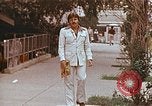
Circus comes to town. Preparations for the Ringling Brothers Barnum and Bailey circus show in various cities
Arrival of the Ringling Brothers Barnum & Bailey Circus in Nashville Tennessee. Documentary show host speaks in Spanish as he walks down a sidewalk, describing the circus. Preparations for the circus show. A train arrives carrying the circus. Elephants, clowns, circus performers, and handlers unloading equipment and animals from the train. Scenes in Waterloo, Iowa: Elephants linked trunk-to-trunk walking down the city street. Automobile traffic moves on the streets followed by elephants and horses. The elephants pass by bank building with sign "Waterloo Savings Bank". Exterior and interior views of a stadium or arena and preparations. Workmen setting up the circus stage inside the arena.
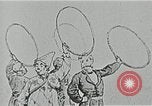
History of the circus in North America, and scenes of early circus circa 1920s and early 1930s arriving and performing in a town
History of the circus in North America. Scenes of drawings, sketches, still photographs, and newspaper clippings regarding the circus. Cites George Washington donating a horse to the circus. Discussion of18th Century English circus organizer, John Bill Ricketts, and a newspaper clipping promoting his circus in Philadelphia, Pennsylvania. Sketch of his circus hall in Philadelphia. Scenes and information about P.T. Barnum and the famous elephant Jumbo, and singer Jenny Lind, known as "the Swedish Nightingale." Drawing of men with rings standing on stools. Drawing of a cab in front of a building. Promotional sign for the Central Park Menagerie and International Circus Company. Vintage footage with scenes of a Ringling Brother Barnum and Bailey circus train arriving in a city circa late 1920s, pulled by a steam locomotive. Circus performers. Crowds of circus visitors milling near a Side Shows entrance sign. A clown inflating the clothes of another clown to a giant size. Chimpanzee rides an elephant and a donkey stands near its foal. Lions, hippos, giraffes, dogs in the circus. Large crowd present during the circus viewing elephant, horse and lion show of the circus. Scenes of the circus parade processing around the big top tent. A tamer handling a female lion (tamer appears to be Clyde Beatty). A male lion walking on high wire parallel tightrope.
Movement of the circus from town to town, and the business of operating a circus
Taking down the tents and packing up a circus. Ringling Brothers Barnum and Bailey circus workers and local workers disassemble the tents and stages, load wagons and with help from elephants and bulldozers they pack up before heading to a new city. These scenes appear to be 1950s-196s. The circus train moving at speed. Following scenes appear to be early 1970s: Circus managers seated at a table planning a circus act. Scenes of the decorated performers in a real circus. Clowns performing. Circus managers viewing a potential new act involving trapeze,cycles, and acrobatic feats. Performers practicing without an audience.
Use of radioactive chemicals in experiments leading to use of fluoride in dentistry.
Testing procedures that led to advent of fluoride treatment in dentistry for prevention of cavities. A boy brushing his teeth. In a laboratory, teeth that had been made radioactive at the Oak Ridge National Laboratory, Tennessee, are subjected to mechanical brushing with stannous fluoride. A technician places a tooth in a Petri dish. He drops acid (akin to that produced by the human mouth which causes tooth decay) over the tooth, via a pipette. A woman technician using a Geiger counter, measures the amount of radioactive tooth dissolved by the acid. Experiment showed that the stannous fluoride reduced damage to the tooth caused by the acid.
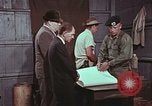
U.S. military activities to assure safe landing of aircraft in landing-zones
U.S. military training film excerpt about planning landing zones. Detachment Commander in meeting with officials. He wraps the map and men exit from the hut located in forest. A coded message carrying specifications required by Special Forces for air operations is written on a page. Map of landing-zone (LZ) is created on ground with various marks. Detachment Commander along with soldiers surrounds the map. Detachment Commander explains the landing operations to be carried out. Red chips are used to mark the stations on runway. Detachment Commander uses a stick to indicate these. RCL (Reception Committee Leader) is shown with blue chips. A soldier submits a document to an officer. Two other soldiers come to him. The officer gives the document. Detachment Commander receives a document brought by a soldier. Soldiers move on LZ and check the security. Men move on LZ. An aircraft approaches LZ. Two enemy soldiers see the air craft. One of them talks on phone. In an enemy base a soldier looks at a map. Another soldier notes down on a pad. Soldier at LZ see his watch. RCL burns a marker light lasting 4 minutes to signal the plane. The aircraft lands. Animation shows the pathway of landing taken by the aircraft on LZ. RCL man moving on runway signals approaching aircraft to parking area. Soldiers move to the parked aircraft. A signal is blown off as the aircraft takes off.
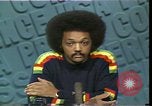
Patrick Borgan questions Jesse Jackson on Civil Rights protests of the 1960s versus 1970s approaches, during a press interview.
Jesse Jackson is interviewed in a press conference. Jesse answers Patrick Borgan of London Times on protesting peacefully with reference to 1968 and its riots and unrest vis-à-vis Civil Rights and racial equality for African Americans. Judith Randal of New York Daily News and Henry McGee of Newsweek Magazine are also present. Bill McCrory of Voice of America is the moderator. Jackson discusses the purposes of the protests of the 1960s, and explains that the vision toward the goal of equality takes time and has curves, rather than being a straight line. He implies that some people because satisfied with the gains from the 1960s, but that there is more to do, and that moral depravity and a lack of good ethics is the current obstacle in the 1970s holding back progress.
CRITICALPAST.COM: About Us | Contact Us | FAQs - How to Order | License Agreement | My Account | My Lightboxes | Shopping Cart | Advanced Search | Featured Collections | Website Terms & Conditions | Privacy Policy ©2026 CriticalPast LLC.
License Agreement |
Terms & Conditions |
Privacy Policy
©2026 CriticalPast LLC.