


 Francais
 Deutsch
 Italiano
Refine Your Search
Ohio-State-football stock footage and images
- Showing 21451 to 21456 of 24493 results more
more Hide
Hide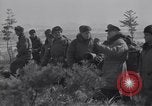
General Douglas MacArthur delivers a farewell address at a Joint meeting of Congress in Washington DC.
The life of U.S. General Douglas MacArthur from 1945 to 1951. General Douglas with other officers in Korea during the Korean War. Soldiers battle with the Chinese on the Korean Front. MacArthur in a jeep studies a map. A motorcade in San Francisco. Large crowds welcome MacArthur. MacArthur in an open car waves at the people. Mrs MacArthur in an open car with other women. MacArthur makes a speech expressing his gratitude towards his wife. The MacArthur family in an open car. Gen. MacArthur delivers a speech at the Joint session of Congress in Washington DC as he completes his 52 years of service, including famous line, "Old soldiers never die, they just fade away." The audience applauds. Sergeant Stuart Quinn of the U.S. Army talks about General MacArthur.
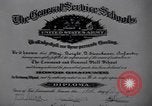
The military career of General Dwight D Eisenhower from 1926 to World War II
Film starts showing Dwight D. Eisenhower's diploma as honor graduate of the Army Command and Staff School, in 1926. Image of Major Eisenhower (in civilian clothes) Narrator says he was assigned to France, to prepare a guide book on American battlefields in Europe. Image of Eisenhower as a member of General Douglas MacArthur's staff in the Philippines, where MacArthur was Commander-in-Chief of the Philippine army. Glimpse of headquarters building there. MacArthur in his office helping the Commonwealth of Philippines work out a plan for its military defense. Image of Lieutenant Colonel Eisenhower in 1939, serving as Executive Officer of the 15th Regiment, at Fort Lewis, Washington, View of the Regiment's Headquarters building. Scene shifts to 1940, showing German forces invading Holland and Belgium. German tanks are seen in action. German Junkers 87 Stuka dive bombers and Heinkel 111 bombers drop bombs. After passing of the Selective Service draft act, President Franklin D. Roosevelt is seen at a public ceremony on October 29, 1940, where Secretary of War Henry L. Stimson drew from a bowl the capsule containing the first draft number of World War 2. Views of Lt. Col. Eisenhower as Chief of Staff of the Army 3rd Division and later as Chief of Staff of the Ninth Corps. Next, he is seen as Chief of Staff to General Walter Kreuger, who in 1941 led the Third Army in the most realistic maneuvers held by American troops (The Louisiana maneuvers). Views of American troops engaged in those maneuvers. Image of Eisenhower as a Brigadier General. Views of the Pearl Harbor bombing during Japanese attack on December 7, 1941.
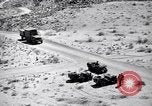
M-48 Patton tanks on maneuvers in desert. Field support and refueling
U.S. tank crews and support personnel on demonstration maneuvers in desert terrain. Support truck and personnel respond to tank out of fuel. They throw fuel cans down from truck and tank crew refuels from jerry cans using tank-installed hand-pump. After refueling, the tank moves out.
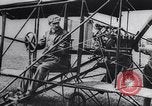
Historic, early aviation pioneers: Glenn Hammond Curtiss, Louis Bleriot, and Lincoln Beachey with their airplanes
American aviation pioneer Glenn Hammond Curtiss sits at the controls of his first aircraft. Two mechanics assist in starting the engines. The first Curtiss aircraft takes off. Louis Bleriot, who was the first to fly across the English Channel, sits at the control of his aircraft in France. Lincoln Beachey, the first man to perform aerobatics in an airplane, dives his first aircraft which is a Curtiss model. Spectators are lined at a fence and watch him flying.
Manufacture of the famed Liberty engine and U.S. Army Air Service in World War I
The Liberty L-12 engine. Scenes of its manufacture in American war plants. U.S. Air Service crews training in DeHavilland DH-4 aircraft. An airplane falling and crashed, with wreckage seen on ground. Head of the U.S. Army Air Service, General Patrick, and General Billy Mitchell, presenting medals to Captain Eddie Rickenbacker and other fliers of the U.S. Army 94th Aero Squadron, in France, during World War 1.
Various "firsts" in U.S. aviation history from 1918 through 1924; early history of flight and vintage flight scenes
Shows several aviation "firsts" accomplished by U.S. Army Air Service aviators in the period from 1918 through 1924. A close formation of biplanes in flight. President and Mrs. Woodrow Wilson chat with Major Fleet, Officer in charge, on the occasion of the first air mail flight, inaugurated on May 15,1918 between Washington DC and New York.The mail is loaded into the Curtis JN-4 aircraft. Pilot in the cockpit. The aircraft takes off and in flight. Air Service. Mention of aviators helping spot forest fires. Smoke rising from forest fires and mountain ranges. In 1920, U.S. Army Captain St. Clair Streett is seen with some of his Squadron who flew four De Havilland DH-4 aircraft 9,000 miles, from New York City to Nome, Alaska. Two of the men play with pet dogs. Their itinerary is painted on the side of one of the aircraft, along with the names of pilot and mechanic (C.E. Crumline and J.E. Long). In 1923 the first non stop coast-to-coast flight was made in the Fokker T-2 aircraft. . A sign on the aircraft reads 'Army Air Service non stop coast to coast'.First Lieutenants Oakley O.Kelly and John A. Macready board the aircraft, at Roosevelt Field, Long Island, New York, on May 2, 1923. Their Fokker T-2 in flight. Their arrival at Rockwell Field, on Coronado Island (San Diego) California. In 1924, Lt. Russell Maughan is seen boarding his P-1 Hawk airplane at Mitchel Field, on Long Island, New York, and taking off , bound for Crissy Field at the Presidio, San Francisco, California. His goal is the first dawn-to-dusk, coast-to-coast flight. Views of his P-1 Hawk airplane flying over Manhattan, New York City.
CRITICALPAST.COM: About Us | Contact Us | FAQs - How to Order | License Agreement | My Account | My Lightboxes | Shopping Cart | Advanced Search | Featured Collections | Website Terms & Conditions | Privacy Policy ©2026 CriticalPast LLC.
License Agreement |
Terms & Conditions |
Privacy Policy
©2026 CriticalPast LLC.