


 Francais
 Deutsch
 Italiano
Refine Your Search
Ohio-State-football stock footage and images
- Showing 21859 to 21864 of 24494 results more
more Hide
Hide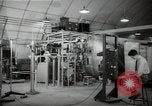
Research laboratory with heavy moveable walls of shielding brick around Steel tank structure
Research laboratory. Connections made through wires in the machine. Bulbs lighted in the plant. Equipment in the plant. A man observes through an instrument. Notable feature is heavy moveable walls of shielding brick, suggesting presence of radiation sources in the laboratory.
Training Movie about U.S. Navy air crewmen and gunners of TBF Avenger aircraft.
U.S. Navy Training film' Air Crewmen of the Navy'. A U.S. Navy pilot named Lieutenant Grant Evans, played by Hollywood actor Robert Stack, enters a building. 'KTWM' written on the building. He is interviewed. Both men sit across the table. He talks about air crew of the U.S. Navy. He describes his work. A Navy Grumman TBF Avenger aircraft is inspected. The Navy pilot meets his crew members. Other planes in the background. The men talk to each other. The air crew climbs the plane and takes off. The pilot reaches the 'Naval Air Gunners School'. The gunners are trained. U.S. Navy Captain presents U.S. Navy aircrew wings to the trainees. Planes in flight. Planes land on flight deck.
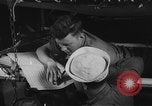
Navy aircrew operations during World War 2
Navy enlisted aircrew in their bunks aboard a ship. One reads a newspaper. Another reads a magazine and looks at a picture of a model and discusses it with other man. An emergency arises. Navy Grumman TBF Avenger planes are ready on the flight deck. The U.S. Navy pilots scramble and rush towards the planes. A flight of five aircraft takeoff and fly in formation towards the target. Reenactment of battles on ground between U.S. and Japanese forces. Navy aircraft bomb the Japanese forces. Japanese fire antiaircraft guns. Navy aircraft gunners fire at Japanese. The Aircraft piloted by Lieutenant Grant Evans, played by Hollywood Actor Robert Stack, is damaged by Japanese gunfire. As the aircraft and crew limp home, they are attacked by a Japanese fighter, but shoot it down and successfully return to land on their aircraft carrier. After recovering from his wounds, Lieutenant Grant Evans (Robert Stack) is interviewed in a building. Large numbers of Navy aircraft flying in formations.
Miners cleaning themselves and changing at 'Wash and Change House' in mines
Sanitary and hygienic practices in coal mine and other mining villages. Miners use shovels to dig. A `Wash and Change House` in the mine. Miners clean themselves and change there. Several mines do not have 'Wash and Change House'. The miners use water filled in tubs to clean themselves. The technique is called 'Tubbing'. A row of children walk behind a woman. A man uses 'Tubbing' to clean himself. The children watch him as the woman helps to clean his back.
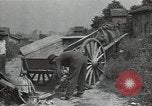
A man cleans the roads and flies sit on food
Sanitary and hygienic practices in mining villages. A man picks up filth from the road and puts it in a horse driven lorry. A man stands on his side while he cleans. Village houses in the background. A housefly in view. Houseflies sit on fish. Fish spoilage due to putrefaction. The flies sit on a bowl of fruits and other articles. The flies spread infections.
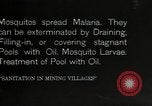
Mosquito larvae in water are destroyed by adding oil on water
Sanitary and hygienic practices in mining villages. A man adds oil on stagnant water bodies to prevent diseases like malaria by mosquitoes. Mosquito larvae seen in water. The people in mining villages use water from wells. A woman fills a bucket with ground water from a water pump hand-pump. Two children stand near her. A woman looks from the door of her home. Houses in a row.
CRITICALPAST.COM: About Us | Contact Us | FAQs - How to Order | License Agreement | My Account | My Lightboxes | Shopping Cart | Advanced Search | Featured Collections | Website Terms & Conditions | Privacy Policy ©2026 CriticalPast LLC.
License Agreement |
Terms & Conditions |
Privacy Policy
©2026 CriticalPast LLC.