


 Francais
 Deutsch
 Italiano
Refine Your Search
Ohio-State-football stock footage and images
- Showing 22159 to 22164 of 24494 results more
more Hide
Hide
Fliers are briefed in Ready Room of the USS Princeton (CV-37) during the Korean War
View inside pilot's Ready Room aboard the USS Princeton (CVA-37) during the Korean War. Intelligence officer discusses a map with a pilot from Fighter Squadron FS-191, who wears the "Satan's Kittens" patch on shoulder of his leather jacket. The pilot and intelligence officer also speak with two other fliers seated, who consult their own maps. Upon conclusion of briefing, the three fliers pick up their helmets and oxygen masks, and leave the ready room. A loudspeaker is shown, presumably in use. (Note: Squadron FS-191 is made up of former members of the Navy's "Blue Angels" demonstration team, which was dissolved when the Korean War broke out.)
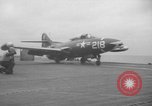
U.S. Navy F9F-2 Panther aircraft are catapulted from USS Philippine Sea (CVA-47) during the Korean War
Two F9F-2s of VF-112 are catapulted from the deck of the USS Philippine Sea (CV-47) during the Korean War. Deck crew seen attaching bridle under aircraft. Two F9F-2s, of VC-61, Unit C, are set on the catapult, given signals, and catapulted, successively.

Areas mined can be in river, harbor, channels and coastal water and various types of mines used are explained.
Characteristics and capabilities of Minesweeper ships. These ships are equipped for detecting, destroying, removing or neutralizing explosive marine mines. The ships underway at a sea. Animated map shows the locations of mines. Mines can be laid in river, harbor, channels and coastal water. Animated diagram show 'moored' and 'bottom' types of mines. Contact mines and influence mines are explained. The influence mines can explode by magnetic, acoustic and pressure influence. The Ocean Minesweepers are called as MSO, the Coastal Minesweepers are called as MCS, the Shallow Minesweepers are called MSL and Harbor Minesweepers are called as MSB.
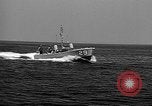
The Shallow Minesweepers are equipped for detecting and destroying explosive marine mines.
Characteristics and capabilities of (MSL) Minesweeper ships in World War 2. The Shallow Minesweepers are called MSL. These ships are equipped for detecting, destroying, removing or neutralizing explosive marine mines. A ship underway at a sea. A gas turbine engine of the Minesweeper ship in view. Haul of the ship is made of wood. Minimum magnetic machinery used in the Minesweeper ship. A man at controls of MSL. The crew on the ship consists of 4-6 men. The MSL is lowered from the mother ship. The mines are swept. Animated diagram shows the minesweepers operation. MSL equipment for moored mines is mechanical sweeping gear. Explosive cutters, bridle and hand operated winches in view. The sweep wires are rolled on drums. A towed body is used to maintain the sweep at desired position. A man operates the controls. An animated diagram shows the mechanism of sweeping. acoustic mine gear, device and support float in view. Men work on the MSL.
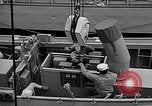
The Shallow Minesweepers carry out the minesweeper operations and destroy mines in World War 2.
Characteristics and capabilities of Shallow Minesweepers (MSL) ships. These ships are equipped for detecting, destroying, removing or neutralizing explosive marine mines. A ship underway at a sea. Men work on the MSL. Magnetic and acoustic mines sweep gear. Sufficient cable for sweeping is stored on the LSM (Landing Ship Mechanized). Floats are used with cable. Gasoline engine at the back of the Minesweepers. Float and cable is launched. Crew members on the MSL. The cable is connected to the generator. The LCM (Landing Craft Mechanized ) releases the cable. MSL proceeds in the area to be swept. Magnetic cable is towed behind the minesweeper. The cables are passed to the LCM. The gear can be mounted on the mother ship. The cable is passed when minesweeper operations are conducted.

Countless servicemen overseas in WWII have children at home in the U.S. Children of three servicemen are seen, representing all
During World War 2, woman tells of selecting three, out of countless names of servicemen overseas, who have children at home. Their children were filmed. First seen is Diane Sandra Fine, one year old, daughter of Sergeant Bernard Fine, a U.S. Army mail clerk somewhere in India. Baby Diane Fine is in high chair and mother feeds her with spoon. Then she is seen in her crib, playing with a toy, and later ready to sleep. The next child seen is the son of Corporal Carl Christianson, of the 464th Quartermaster Company, serving somewhere in the Pacific. His boy sits in a high chair scribbling a drawing to be sent, along with a letter his mother is writing, to his father. Mrs. Christianson holds her son and he hugs her. The third pictures show the family of Yeoman Second Class, Earl M. Robinson. Shown are sons Terry and Danny, together with their mother, Geraldine Robinson, of Roanoke, Virginia. Three year old Danny rides on a hobby horse, while his mother dresses eighteen month old Terry. Exterior view of the Robinson home. More than 20 members of the extended Robinson family come out of the house.
CRITICALPAST.COM: About Us | Contact Us | FAQs - How to Order | License Agreement | My Account | My Lightboxes | Shopping Cart | Advanced Search | Featured Collections | Website Terms & Conditions | Privacy Policy ©2026 CriticalPast LLC.
License Agreement |
Terms & Conditions |
Privacy Policy
©2026 CriticalPast LLC.