


 Francais
 Deutsch
 Italiano
Refine Your Search
Ohio-State-football stock footage and images
- Showing 22471 to 22476 of 24494 results more
more Hide
Hide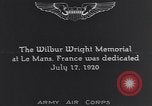
A still picture of Wilbur Wright Memorial in Le Mans, France which was dedicated on July 17th, 1920.
A picture of Wilbur Wright Memorial in Le Mans, France. A still picture of Wilbur Wright Memorial in Le Mans, France which was dedicated on July 17th, 1920.

News media military analysts discuss the problems of Allies invading Europe to defeat Germany in World War II
Map of Europe and label "Invasion." Westbrook Van Voorhis leading a panel discussion about the problems arising from the Allied invasion of Europe in World War 2. He introduces panelists: Hanson Baldwin (military editor of the New York Times) Dewitt MacKenzie (Associated Press military analyst), and Paul Schubert (of Mutual Radio Network). He asks Mr. Baldwin about the importance of aerial bombing campaigns. Baldwin also stresses importance of a land invasion of Europe. Relief map of Europe highlighting major German cities. Asked about the merit of invading Italy on the way to Germany, Mr. Schubert cites the problem of the Alps and suggests other more effective invasion routes. Van Voorhis asks Mr. MacKenzie about best route into fortress Germany. He considers the criterion of ease of supply as most important, and suggests the Atlantic coast, near a good port and not far from England. Animated map shows this idea. When asked about this, Mr. Baldwin agrees completely, calling the conflict "a quartermaster's war." He adds, "The problem of victory is the problem of supply."
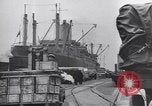
War materiel is loaded on ships to support the Allied invasion of Europe in World War II
A ship being loaded at a U.S. port of embarkation with war materiel to support the Allied invasion of Europe in World War 2. A group of Army dock workers enters the port building. A sign on the front office reads: "U.S. Army Transport Service." Steel structural items and large steel boiler are loaded aboard the ship. Men steady supplies lowered on deck in nets. Men place boxes in the ship's hold. A 2x4 Army truck being lowered into the ship.Tanks and artillery pieces, covered with canvas on the ship deck. A 155mm long tom gun being loaded on the ship More views of equipment and supplies being loaded aboard ship. The covered fuselage of a P-38 Lightning fighter plane being lowered onto the deck. Two civilian men in a wash room talk about upcoming invasion. Troops in full field gear coming aboard the transport ship. Men looking out the port holes of the ship. An invasion convoy getting underway. Soldier on deck, silhouetted against the sky. View of the Pentagon Building in Virginia. Army Service Forces officers meeting in Pentagon. Officers walking in the Pentagon halls. One exchanges salutes with a guard as he leaves the building.
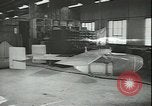
U.S. Army signal corps develops and tests a television guided missile bomb
Film starts showing so-called "Television Bomb"guided missle. Closeup of television controls in the missile. View of the guided missile mounted underneath a B-17 bomber in flight. Guidance operator seen inside the bomber. The television bomb drops away from the bomber. View of the operator inside the bomber watching a television picture transmitted from TV camera in the missile nose. He uses radio controls to steer the bomb toward a test target. The missile explodes on an isolated small island test site.
The Engineer replacement center trainees being trained by the instructors during World War II.
A film titled: 'Engineers in Combat' depicts the training of the Engineer replacement center trainees during World War II. Engineers working on a field. They march in formation. Buildings along a side of the street. Training of the engineers. They are instructed to use rifles, demolition charges, power tools and railroad building machinery. Engineers lay land mines and detect the enemy land mines.
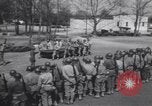
The Engineer replacement center trainees learning the use of assault boats during World War II.
A film depicts the training of the Engineer replacement center trainees during World War II. Engineers gather on a field during their training. They are being demonstrated the use of assault boats. Some of the engineers aboard a boat. The boat gets underway. The engineers are being instructed the use of various tools and equipment. They are instructed to erect bridges. Engineers walking on a pontoon bridge.
CRITICALPAST.COM: About Us | Contact Us | FAQs - How to Order | License Agreement | My Account | My Lightboxes | Shopping Cart | Advanced Search | Featured Collections | Website Terms & Conditions | Privacy Policy ©2026 CriticalPast LLC.
License Agreement |
Terms & Conditions |
Privacy Policy
©2026 CriticalPast LLC.