


 Francais
 Deutsch
 Italiano
Refine Your Search
Ohio-State-football stock footage and images
- Showing 22903 to 22908 of 24494 results more
more Hide
Hide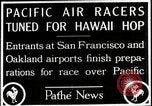
Scenes from the Dole Derby or Dole Air Race from California to Hawaii in August, 1927
Opening scene shows several aircraft and aircrews on an Airfield in Oakland, California, readying for the Dole Air Race to Hawaii. A modified Travel Air 5000 aircraft, NX869, named "Woolaroc," is seen in the near foreground. Behind it is another Travel Air 5000, named "Oklahoma." Next, the "Oklahoma" and the "Aloha"(NX914), a Breese-Wilde 5 Monoplane are seen with engines running and taxiing. The "Aloha" takes off and climbs sharply after gaining airspeed. Several Wickes-class destroyers are seen steaming underway. (Slate reports they patrol the course to be flown over the Pacific.) Scene shifts to wreckage of the "Angel of Los Angeles" a twin engine Bryant Monoplane, which crashed on a test flight at Montebello, California. (Pilot, Arthur V. Rogers, bailed out at the last minute but his parachute didn't fully open and he was killed.) Next is shown the wreckage of the "Pride of Los Angeles," an International CF-10 Triplane, after crashing into San Francisco Bay on August 11th. Pilots J. L. Giffin and Theodore S. Lundgren are seen stepping from the water, unhurt. A crane, on a barge, lifts the wreckage from the shallow water.
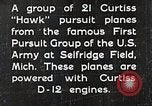
Group of 21 Curtiss Hawk in Selfridge field, Mich.
Group of 21 Curtiss Hawk aircraft in Selfridge Field, Michigan, near Mount Clemens. Men stand in the field. The pursuit planes take off and are seen flying in the sky.

Atomic burst of 15 Kiloton weapon in Test "Grable" at Nevada Test Site on May 25, 1953
Rapid flash and rapidly rising mushroom cloud seen in this test of 15 kiloton weapon on May 25, 1953,called "Grable", at the Nevada Test Site. It was shot from a M65 atomic cannon mobile artillery piece, sometimes called Atomic Annie.

Assembling and loading missile RTV-A-5 under the project MX770 in Santa Susana,California
Presentation of missile program Project MX770 is shown. Technicians assemble missile and check RTV-A-5 (X-10) for flight. Animation of RTV-A-5 shows various compartments of the missile. Integral rocket booster and two fin mounted ramjets(engine) are present. Fuel tank is present over the front wheel of RTV-A-5. Missile engine is shown and missile is placed in the left wing of the RTV-A-5.

Testing of celestial auto-navigator in flight and laboratory at Santa Susana Field Laboratory,California.
Testing of the Celestia Autonavigator is presented under the Missile Project MX770. Technician makes gyro test of Celestial Autonavigator in laboratory. ADS C-47, a flying test laboratory is in flight. Animation shows assembly of a auto-navigator step by step. A graph plot of error against time shows exponential error for pure gyro test while continuous fluctuating error for star checked test.Technician checks auto-navigator in the laboratory.
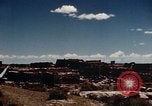
Lifestyle of Hopi Indian people at Oraibi, Arizona, and Navajo Indian people in Monument Valley area of Arizona
Native American Indian people of the Hopi people are shown living in Oraibi, Arizona in the late 1930s. Lifestyle of the Hope people. A woman climbs the stairs of a traditional Hopi dwelling, unchanged by modern civilization. Construction of houses is seen. Hopi women fashion pottery in an ancient village, while kneeling on a blanket on the ground. They shape bowls by hand. Completed Hopi bowls and vases, and ceremonial mats and baskets are shown. A man paints religious dolls known as Kachina dolls, each a replica of costumes worn during religious ceremonies. Children play with the dolls. Indian men work at a mining site, but they are constrasted with many Indian men who choose their traditional way of life. A Navajo American Indian man riding a horse passes near monuments and natural rock formations in the Monument Valley area of Arizona. A young navajo girl herds sheep and goats with Monument Valley rock formations in background, showing how children assist the tribe. Arid lands needing irrigation are shown, and narrator discusses need for irrigation to support growth of the Navajo nation. A Navajo brush shelter dwelling is shown, typical of those erected by the nomadic Navajo following their grazing animals from place to place. Navajo woman grinds corn in traditional manner by hand with a stone. Two Navajo boys watch her. A navajo woman wearing turquoise and silver jewelry. A navajo woman makes a rug by hand, using wool from Navajo sheep. The rug weaver follows no drawn pattern and uses her memory only to make the pattern. Prehistoric Native American Indian dwellings in the Canyon de Chelly are shown, protected as National Monuments, and originally home to ancient Navajo and Anasazi Pueblo people. An anthropologist or archaeologist participating in excavation at the Canyon de Chelly examines a piece of pottery. Scientists at a Canyon de Chelly ruin from end of 11th century AD extract a core sample from timber to determine the year of the dwelling construction by wood growth rate pattern.
CRITICALPAST.COM: About Us | Contact Us | FAQs - How to Order | License Agreement | My Account | My Lightboxes | Shopping Cart | Advanced Search | Featured Collections | Website Terms & Conditions | Privacy Policy ©2026 CriticalPast LLC.
License Agreement |
Terms & Conditions |
Privacy Policy
©2026 CriticalPast LLC.