


 Francais
 Deutsch
 Italiano
Refine Your Search
Ohio-State-football stock footage and images
- Showing 22987 to 22992 of 24494 results more
more Hide
Hide
Six parachutists board air transport carrier C-1 for setting up a record for parachute jump at Kelly Field in Texas.
Activities of the U.S. Army Air Service at Kelly Field in Texas. Six parachutists and crew stand in front of air transport carrier C-1. They board the aircraft. Parachutists leave the plane and descend. The parachutists in flight. They land at a field.
Montage of Wright brothers and their airplanes in France and at Ft. Myer, Arlington, Virginia.
As a contrast to the early pioneering airplanes, passengers are seen seated inside cabin of a "modern" airplane (Douglas DC-4E). View of the DC-4E in flight. A view of Orville Wright. Wilbur Wright gesturing as he talks with officials in France about an aerial course to be flown. Wilbur Wright placing wheels under a Wright Flyer before it is moved across a muddy field in France. A team of men pull a rope raising a catapult weight in a tower. The weight falls, catapulting the Wright Flyer airplane into the air. Soldiers remove a Wright Flyer airplane from a storage building onto the parade grounds at Ft. Myer, Virginia. The airplane is seen in flight with Orville Wright alone, at the controls, On July 30, 1909, soldiers are seen moving a Wright Flyer from its shed for its final acceptance test. President William Howard Taft, U.S. Army Major George Owen Squier, U.S. Army Major Charles E. Saltzman and Wilbur Wright are among those standing with the President, as the Wright Flyer is moved toward the parade ground. Views of the monorail and weight and catapult used for launching an airplane. Men turn the two propellers on a Wright Flyer, as Wilbur Wright stands at the rear of the aircraft engine and makes an adjustment. . On September 9, 1908. U.S. Army Lt. Frank P. Lanham, seen in uniform, seated on a Wright Flyer, is joined by Orville Wright. Wilbur. They take off and set a new airborne endurance record, and Lt. Lanham becomes the first Military officer to fly in an airplane. On July 30th, as part of the final acceptance test, Orville Wright takes Army Lt. Benjamin D. Foulois on a cross country flight to Alexandria, Virginia, and back again. They are seen aboard the Wright Flyer, and then high in the air on their way to Alexandria.
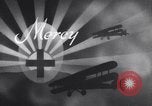
U.S. Army aircraft provide food to snowbound Navajo Indians in Arizona.
U.S. Army Curtiss B-2 Condor bombers being used for humanitarian purpose. Food being packed into the airplanes and delivered to snow bound Navajo Native American Indian people in Arizona. Men load bags of food in a plane. Men look at a map and chart the route with the help of an Indian guide. Aircraft in flight over a snowy region. Shadows of the planes visible on the snow. On the ground, food is distributed to the Navajo families.
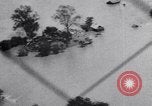
U.S. Army B-10 bombers drop food supplies to flood victims in Pennsylvania.
Aerial view of flooded areas around river in Pennsylvania. Small island protruding out of the flood waters. Cattle and people are gathered on it. Several other small islands in flooded areas with a cattle and people on them. U.S. Army Martin B-10 bombers seen in flight, dropping relief supplies from open bomb bay doors. Flood victims eating in a community dining hall. B-10 bombers flying through hills of Pennsylvania.
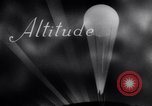
High altitude balloon, Explorer II, is launched from Dakota to altitude of 14 miles above the earth
Men work on gondola, of the high altitude scientific balloon, Explorer 2, a joint venture of the U.S. Army Air Corps and the National Geographic Society. The balloon being filled with helium. The gondola is attached to the balloon and it lifts off. One of the two-man crew can be seen standing atop the gondola, as the balloon begins its ascent. Scene shifts to the return of the balloon. Captain Anderson, pilot, and Captain Steven, in charge of scientific observations, are seen retrieving instruments from the balloon.
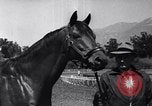
Seabiscuit 'Wonder Horse' is taken to his owner's farm after the retirement from Santa Anita Race Track in California.
Seabiscuit 'Wonder Horse' retires from the Santa Anita Race Track in California. Seabiscuit with a jockey. He gets in a van. A sign on the van reads ' Caution Horse Van'. He is taken to his owner's farm.
CRITICALPAST.COM: About Us | Contact Us | FAQs - How to Order | License Agreement | My Account | My Lightboxes | Shopping Cart | Advanced Search | Featured Collections | Website Terms & Conditions | Privacy Policy ©2026 CriticalPast LLC.
License Agreement |
Terms & Conditions |
Privacy Policy
©2026 CriticalPast LLC.