


 Francais
 Deutsch
 Italiano
Refine Your Search
Ohio-State-football stock footage and images
- Showing 229 to 234 of 24494 results more
more Hide
Hide
United states B-45 aircraft filmed on a Phototheodolite instrument in United States.
Wright Air Development Center in Ohio, United States. A document titled 'Ridenour report'. Warehouse, bins and equipment stored in them at the warehouse. Equipment moved into a large warehouse. Sign on a truck 'WADC supply shuttle truck # 6'. Large milling machine and an operator at a machine shop. Phototheodolite instrument and operator. United States B-45 in flight and tracked on Phototheodolite film. Flight time azimuth recorded. Aerial view of Wright air field, animation shows various buildings and labs at the airfield. Project engineer makes a phone call to another office building.
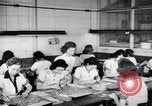
Blind, deaf, disabled and old American workers assisting in the war production effort in Dayton, Ohio, during World War II
Disabled and elderly war production workers contributing to the labor force during World War 2, in Dayton Ohio. Opening scene shows a woman supervisor observing deaf mute women in a lens factory, cleaning segments of bifocal lenses. Closeup of supervisor and one worker communicating by American sign language. A blind man in a shop, using a snap gauge to check finished parts for conformity. A man on crutches taking his place on a war production line. Older men in the shipping department of a factory, packaging and sealing boxes labeled, "Delicate instruments. Handle with care." and placing them on a dolly. Women can be seen at work in another part of the plant. Members of the Dayton Junior Association of Commerce, lined up applying for part-time employment of 4 hours a day, to help the war effort. Students leaving a High School building. (Narrator states schedules were re-arranged for students who would take part-time jobs.)
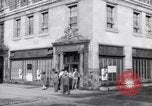
People from all walks of life switch to war work in Dayton,Ohio during World War 2.
Residents of Dayton Ohio, transfer from ordinary pursuits to perform war-critical work in World War 2. Men and women are seen lined up inside offices of the United States Employment Service (USES) in Dayton, Oho. All prospective male workers are cleared through the USES. Certain occupations are reserved for women only. Women doing needlework in their homes, switch to war work instead. One is seen filing a part in a factory. A soda jerk takes on work in a machine shop. A bootblack shining shoes, ostensibly moves into war work. Back, inside the U.S. Employment Service offices, representatives of defense plants set up tables and hire prospective workers on the spot. Workers leaving a Dayton war plant during a shift change. Cars and pedestrians during regular shopping hours in a local town. View of a downtown commercial district. The Manpower Emergency Committee in a meeting. New Store hours are posted for various businesses. A newspaper announcement of special store night hours for war workers. A company poster listing "Victory Store Hours." Dayton stores and shoppers conducting business after dark on nights when shops were open for war workers. Views of shoppers patronizing various retail stores, including a McCrory 5 and 10 cent store, a market store, and a department store. Late shift workers in line at banks to see bank teller and cash pay checks. A soldier in uniform sitting with a woman shopping for new shoes. Workers in a ladies beauty salon or hair salon, and in a men's barber shop, working during night time hours to serve war production workers. Night time recreation programs for workers show workers with musical instruments standing in line, theatre marquees advertising late night shows and movies, with signs advertising Red Skelton and Eleanor Powell among featured stars. Women bowling at a bowling alley, overhead view of couples dancing the lindy hop while a crowd watches, other scenes of couples dancing on dance floors.
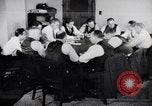
Film summarizing efforts by City of Dayton, Ohio to overcome labor shortage and meet defense production goals in World War II
The City of Dayton, Ohio's local war manpower and emergency committee members are seen gathered around a table to discuss what other than just more workers is needed to meet the war production goals set for the city during World War 2. An animated diagram superimposed on a drawing of a factory, charts the labor needs vs. labor supply. For the management side, the chart cites matters that need to be addressed, including: personnel management; plant layout; reduction in turnover, and absenteeism; and better working conditions, Regarding labor itself, the chart cites the following as needed: additional women; transfers from non-essential jobs; minority groups; part-time workers; and handicapped workers. Next, the emergency committee of community leaders is seen around a table. They are being addressed by Stanley C. Allyn, President of the National Cash Register Company, who notes that Dayton has partially solved its manpower shortage and expects to meet its war production goals.Camera pans over attendees, including labor leaders from AF of L and CIO; Government officials present, including Area Director and Deputy Regional Director of the War Manpower Commission, and Chief of Program Requirements for the Region; leading industrialists and retailers are shown. Local officials seen include the Mayor of Dayton and Secretary of the Chamber of Commerce as well as the Commanding Army Air Forces Generals of Wright Field and Patterson field. Mr. Allyn discusses further work to be done with as much emphasis on human relations as on the mechanics of production. An animated map shows Dayton and other areas of labor shortage, all over the United States. Workers in a factory are seen moving propeller blades across the floor by twirling them on end. Propellers assembled on their hubs are moved across the factory floor on wheeled stands. Artillery shells are seen protruding from containers. Browning aircraft machine guns moving along a conveyor belt. M3 Lee tanks being completed and moving across a factory floor. Glimpse of bombers in production. Army trucks lined up in formation at a factory yard. Closeups of General Dwight D. Eisenhower. (Narrator notes importance Eisenhower places on full support from the home front as essential to the war effort.)
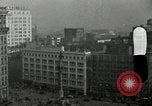
Metropolis city of Cleveland, world famous for width of its streets in Ohio.
City of Cleveland in Ohio United States. Major productions are iron and steel. Elevated views from a tall building looking out over the city center buildings and streets below. Euclid Avenue Street, one of the famous streets. View of Sailors and Soldiers Monument in Cleveland Public Square, fountain, pedestrians walking in Cleveland, and streetcars on busy streets. Slate notes that the Cleveland street railway systems have attracted nationwide attention for their fixed 3 cent rate of fair, as long as the returns permit a 6% dividend upon an arbitrated valuation of the railway properties. Statue of founder General Moses Cleveland in the center of the city.
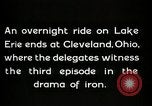
Delegates of the Pan American Highway Commission visit Cleveland, Ohio
Pan American Highway Commission delegates visit Cleveland Ohio during a tour of the United States. Delegates stand outside their cars and view iron ore transport operations. Huge cranes shift ore from ship holds to waiting rail cars. Delegates visit the Huntington Bank Building (originally the Union Trust Building) on Euclid Avenue which had just been completed. View of the delegates gathered at the base of a stairs on one end of the massive bank lobby. View of the Huntington Bank lobby. The delegates visit a truck manufacturing facility in Cleveland (likely either Gotfredson Trucks or White Motor Company). Workers busy building and assembling trucks on the factory floor.
CRITICALPAST.COM: About Us | Contact Us | FAQs - How to Order | License Agreement | My Account | My Lightboxes | Shopping Cart | Advanced Search | Featured Collections | Website Terms & Conditions | Privacy Policy ©2026 CriticalPast LLC.
License Agreement |
Terms & Conditions |
Privacy Policy
©2026 CriticalPast LLC.