


 Francais
 Deutsch
 Italiano
Refine Your Search
Ohio-State-football stock footage and images
- Showing 24295 to 24300 of 24494 results more
more Hide
Hide
Norwegian training ship 'Statsraad Lehmkuhl' with 150 Merchant Navy Cadets aboard arrives at harbor in New York.
Norwegian training ship named 'Statsraad Lehmkuhl' at harbor in New York. The Norwegian ship arrives at the New York Harbor. 150 Merchant Navy Cadets aboard the training ship. Cadets working on ship deck.
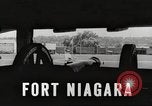
Works Progress Administration restores Fort Niagara near Youngstown, New York during Great Depression
The WPA (Works Progress Administration) project in New York. Fort Niagara near Youngstown. Offices and monument restored by the WPA. People move about in front of the French Castle.

The Works Progress Administration builds roads in rural area connecting them to New York, during the Great Depression.
The WPA (Works Progress Administration) project in New York. The WPA constructs roads connecting rural areas to New York. A man in a rural area drives in his car with milk cans. His vehicle gets stuck in mud on a road. Workers construct roads. A rural farmer drives his car on a newly constructed road. Dynamite used to clear an area for road construction. Workers leave the area after a day's work.

Scenes of financial district, downtown, New York City, during the 1920s.
New York City street signs identify Wall street at Broadway and Wall Street at Nassau Street. Trinity church is seen at end of street. Federal Hall with statue of George Washington in front. Front view of the New York Stock Exchange building. Crowds of commuters fill the street and sidewalks as they emerge from subway during morning rush hour. Interior and trading floor of the New York Stock Exchange as trading day gets underway.
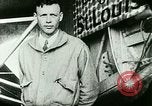
Charles Lindbergh takes off from Roosevelt Field in the "Spirit of St. Louis," on a solo flight across the Atlantic Ocean
Charles Lindbergh's poses next to his airplane, the "Spirit of St. Louis." Ground crew push the airplane, tail first, out of a hangar on Roosevelt Field, Long Island, New York. Its engine and nose are covered in canvas. Lindbergh shakes hands with an official. Ground crew top off the aircraft's fuel, by pouring several gallons into its tank from atop the wing. A man helps Lindbergh don his heavy flying coverall. The aircraft engine starts. Crowd surrounds the aircraft. Lindbergh climbs aboard and the "Spirit of St. Louis" starts its takeoff roll surrounded by group of people. Lindbergh makes a long takeoff roll, bouncing several times (once, quite hard) before breaking ground in a shallow climb.
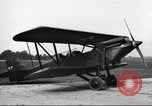
The 1926 Ford "National Air Tour for the Edsel B. Ford Reliability Trophy," at Ford Field, Dearborn, Michigan.
Subject is the 1926 Ford "National Air Tour for the Edsel B. Ford Reliability Trophy," which started at Ford Field, Dearborn, Michigan, on August 7, 1926. Film opens showing a parked biplane with tandem open cockpits. It has an unusual exhaust gathering container atop its engine and an exhaust pipe extending straight down below the fuselage. Camera shows the same aircraft from the rear, with hangar and terminal building in background. Another parked biplane displays the number "19." It is equipped with small interconnected wing flaps on its upper and lower wings. Next is seen a Woodson Model 2-A Biplane with number 14 on its fuselage and another biplane marked Number 11. Closeup of Henry Ford leaning out of a car, talking with a cinematographer, holding a camera, and reporters. A large group of persons involved in the events pose for a photograph. The camera pans across them as they pose in front of a hangar. Scene shifts to spectators crowding around a Ford-Stout 2-AT aircraft as it begins its takeoff roll. Camera follows the airplane as it continues and becomes airborne.
CRITICALPAST.COM: About Us | Contact Us | FAQs - How to Order | License Agreement | My Account | My Lightboxes | Shopping Cart | Advanced Search | Featured Collections | Website Terms & Conditions | Privacy Policy ©2026 CriticalPast LLC.
License Agreement |
Terms & Conditions |
Privacy Policy
©2026 CriticalPast LLC.