


 Francais
 Deutsch
 Italiano
Refine Your Search
Ohio-State-football stock footage and images
- Showing 3817 to 3822 of 24494 results more
more Hide
Hide
Cadets dance with their partners at a graduation hop in the United States.
Activities of West Point cadets in the United States. The cadets gather in a hall for a graduation hop. They dance with their partners in the hall.
Cadets being given degrees after the completion of their graduation in the United States.
Activities of West Point cadets in the United States. The cadets gather on June 10th after the completion of their graduation. The cadets seated in chairs. Officials stand on a platform in front of the cadets. They give degrees to the cadets. A man standing as a cadet outside a building and then he stands as an officer.
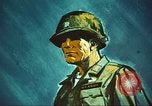
A man gets an admission letter from the West Point Military Academy in the United States.
A documentary film titled 'West Point, The Army Challenge' depicts the story of a young man who enters the West Point Military Academy in the United States. A cadet stands at attention with other cadets at the military grounds before receiving their graduation degree. Past events show the early life of the man and his entry to the West Point Military Academy. The man talks to his friends in his college. He is seated at a desk with his friends and they discuss amongst themselves. They discuss about their career. The man is advised by his friends to join the military academy. His college counselor tells him about the military academy. He says that it is a very good educational institution. He talks about the academic program of the academy and gives him a catalog. The man lying on his bed looks at the academy catalog. He looks at the syllabus and the background of the faculty. The man seated with officials at a desk and discusses to nominate him for the military academy. He goes for a medical check-up and does physical exercises. He receives his admission letter after some days. He discusses with his college counselor.
Peacetime activities and contributions by the U.S. Army in the United States.
Scenes from Army Day on April 6, 1934. Secretary of War George Henry Dern, in broadcast to the nation about importance of the Army, in peacetime. Brief glimpses of the Yellowstone River lower falls and Old Faithful and Beehive geysers erupting in Yellowstone Park, Wyoming. View amongst log buildings in Reproduction of Army Fort Dearborn, at the 1933 Century of Progress Exposition in Chicago, Illinois. A pioneer wagon; Native American Indians in ceremonial regalia; antique locomotives and trains at the Exposition. Army General Leonard Wood being sworn in as the Governor General of the Philippines. Closeup of General of the Armies, John J. Pershing, America's highest ranking Military officer. Headquarters of Walter Reed Army hospital, in Washington, DC, named for U.S. Army Major Walter Reed, who confirmed that yellow fever is transmitted by mosquito. Acting on this, the U.S. was able to complete the Panama Canal. View of French dredging equipment sitting idle in the water after Yellow Fever prevented them from completing the Panama Canal. Closeup of U.S. Army General William C. Gorgas, who, in 1904, headed the Sanitary Department that controlled mosquitoes and eradicated Yellow Fever, so the Panama Canal could be finished. View of alligator in swamp near the Panama Canal. Photograph of George Washington Goethals, Chief Engineer credited with making the canal happen. Explosives employed in Panama Canal construction. Earth and rocks being loaded into open rail cars. A steamship transiting the Panama Canal. The Washington Monument; U.S. Library of Congress; and the Lincoln Memorial, cited as examples of accomplishments by U.S. Army engineers. The Wilson Dam, under construction by Army engineers, in Muscle Shoals, Alabama and system of levees being built to control the Mississippi River. The raging Mississippi River during 1927 flood. Flood victims being assisted by U.S. Army soldiers, at a tent camp, receiving food and clothing. An Army airplane flying over a forest fire. Army personnel supervising men in the Civilian Conservation Corps or CCC. Mail being loaded aboard an Army airplane, as airmail service is being opened between Washington DC and New York City. President Woodrow Wilson talking with Army pilot Major Reuben H. Fleet. Mail being loaded into the nose of an airplane. U.S. Army Douglas World Cruiser airplanes in flight, returning from their trip around the world in 1924. A pilot sitting in front seat of a Douglas O-38 airplane, pulls a fabric hood over his cockpit to practice "blind flying". View of the aircraft in flight, with instructor pilot in the open rear cockpit. Army aviators taking a camera and a rifle aboard their airplane as they prepare to leave on an aerial mapping flight. Aerial view of skyscrapers of Manhattan Island, New York City. Army Signal Corps personnel working on communications devices. A cable laying ship operating at sea, in support of the U.S. Army's Alaskan cable and telegraph system. Men loading chemicals into hoppers on Army crop dusting airplane. Several views of Army airplanes crop dusting. Glimpse of boll weevil, the target of their efforts. Closeup of Karl Connell, who as a major in the AEF, in World War I, invented a superior gas mask known as the “Connell” or “Victory” mask. A group of miners wearing gas masks enter a smoky mine entrance. The Army invented tear gas, which is shown being used to thwart a bank robbery, in a staged demonstration. Brigadier General Hugh Johnson, appointed by President Franklin Roosevelt, as head of the Great Depression era National Recovery Administration, or NRA, is seen about to give a speech. Narrator cites him as an example of U.S. Army officers who also serve the country in civilian life. Scene shifts to cadets on parade at the United States Military Academy, West Point, New York.
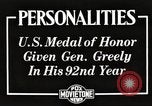
Secretary of War George Dern awards the Medal of Honor to General Greely in the United States.
American explorer and U.S. Army Major General Adolphus Washington Greely being awarded the Medal of Honor in the United States. U.S. Secretary of War George H. Dern presents him the award. He is awarded for his North Pole expedition. Other officials stand with the Secretary of War. General Greely addresses the nation after receiving the award.
Classroom and field training of FBI agents in the United States.
Federal Bureau of Investigation (FBI) agents undergo their training in the United States. FBI 'most wanted' posters are printed on a bank of printing machines. Prospective FBI agents in a large classroom. Instructor points to diagram of a revolver on classroom board. Training of the agents for physical fitness. The agents do deep knee bends, box using a punching bag, and practice jiu jitsu as part of their training. View of the law library at FBI headquarters. View of diorama showing bank robber hideout. Table filled with equipment issued to FBI G-men includes cameras, saws, night sticks, guns, hand cuffs, leg irons, flashlights, and explosives. FBI agents practice machine gun target practice while driving 1935 Hudson Terraplane automobiles. The agents fire at target boards. FBI director J. Edgar Hoover stands with agents who are lying in prone positions as they riddle a 1928 Chevy sedan with bullets fired from machine guns.
CRITICALPAST.COM: About Us | Contact Us | FAQs - How to Order | License Agreement | My Account | My Lightboxes | Shopping Cart | Advanced Search | Featured Collections | Website Terms & Conditions | Privacy Policy ©2026 CriticalPast LLC.
License Agreement |
Terms & Conditions |
Privacy Policy
©2026 CriticalPast LLC.