


 Francais
 Deutsch
 Italiano
Refine Your Search
Ohio-State-football stock footage and images
- Showing 4741 to 4746 of 24494 results more
more Hide
Hide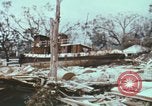
Characteristics and names by which tropical cyclones are known in different places is discussed in the United States.
A documentary in the United States on occurrence of tropical cyclones. A rubbled area after being hit by a tropical cyclone. Soldiers carrying a dead body on a stretcher. Cyclones are known by different names based on their geographical locations. Animation depicts names of cyclones in different areas with the help of a map. In the Western Pacific they are known as typhoons. They are known as Baguio in the Philippines. They are called cyclones in the Indian Ocean and the Bay of Bengal. In Australia they are called Willy-Willy. A cyclone is called a hurricane in the Eastern Pacific, the Gulf of Mexico and the Caribbean. Characteristics of tropical cyclones. Counter clockwise wind flow at the time of a cyclone. The pressure when the tropical cyclone approaches. The eye of the tropical cyclone may be very small or very large in diameter. The strongest winds around an eye average from 90-150 knots. The storm is divided into semicircles for orientation. The right semicircle is considered to be the most dangerous semicircle because of its stronger wind. The left is considered to be relatively less dangerous because of somewhat weaker winds. A demonstration is done by considering ships stuck in both the parts. The ship stuck in the right semicircle revolving in the area. The ship stuck in the left one arrives towards the end and comes out of the storm. Ships underway at sea during a storm. Clouds in the sky. Rain begins to fall. A man checking a parametric center. Animation shows a ship arriving towards the storm center. The ship's radar used to locate the ship's location.
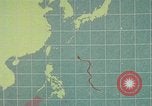
Animation in the United States shows the method of escape by a ship when stuck in a cyclone.
A documentary in the United States on occurrence of tropical cyclones. Animated map shows the passage of a typhoon. The way of evasion for ships from the cyclones is demonstrated. The ship stuck in a typhoon should always head towards the safer side of the cyclone. The ship should run for the less dangerous semicircle if caught in a typhoon. The course of the cyclone should be noticed.
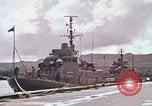
Crew working and undertaking preventive measures to face a typhoon in the United States.
A documentary in the United States on the occurrence of tropical cyclones. A ship anchored at a port. Preventive measures being undertaken by the ship's crew. Mooring lines are doubled and tied properly. Men working on the ship. A ship underway at sea. Men working on different instruments on the ship. Men filling tanks. Water tight security should be ensured. Measures to prevent flooding of the ship should be undertaken. Compartments should be checked. A ship underway at sea. It is stuck in a typhoon. Water breaks over its surface.
A flooded area and beached ships due to a hurricane in a coastal town of the United States.
Damage due to a hurricane in the United States. Houses in the foreground in a coastal town. A flooded area. A car passing on a street. Other cars parked alongside the flooded street. Ships are beached alongside a road. Men watching a ship. Houses submerged in water. A wrecked ship in the area.

Trees being blown by winds during a major storm in the United States.
A thunderstorm brewing in the United States. Clouds in the sky. Trees in the area. Wind blowing the trees. Aerial view of dramatic clouds. Ground view of ominous dark clouds and possible hurricane or tornado environment. Heavy rain falling and a flooded street area.

Safety measures and precautions which can be taken in the event of a tornado, in the United States.
A documentary on occurrence of a tornado in the United States. The aftermath of a tornado in Wichita Falls, Texas. A rubbled area. A man standing near the rubble. Dead bodies on the ground. Doctors treating wounded people. Red Cross workers and volunteers working to help the victims. Temporary housing facilities given to homeless people. Rebuilding work being undertaken. People standing outside a house. A doll on the ground. Disaster plans being worked upon. People discussing amongst themselves. Narrator outlines preventive measures, warnings, and emergency plans and Disaster Plans that should be in place to in the event of a tornado. Narrator discusses what to do, and what not to do in the event of a tornado. National Oceanic and Atmospheric Administration (NOAA) weather radio should be used. It gives warning about tornadoes. When a tornado hits people should take cover in basements. Weather clues should be noticed, warnings should not be ignored and people should not stay in mobile houses at the time of tornadoes. People can take shelter in a ditch. Matches should not be lit and people should not enter the disaster area. Views of the April 10, 1979 tornado in Wichita Falls, Texas as it hits the area.
CRITICALPAST.COM: About Us | Contact Us | FAQs - How to Order | License Agreement | My Account | My Lightboxes | Shopping Cart | Advanced Search | Featured Collections | Website Terms & Conditions | Privacy Policy ©2026 CriticalPast LLC.
License Agreement |
Terms & Conditions |
Privacy Policy
©2026 CriticalPast LLC.