


 Francais
 Deutsch
 Italiano
Refine Your Search
Ohio-State-football stock footage and images
- Showing 4813 to 4818 of 24494 results more
more Hide
Hide
Landing boats underway at sea move in a group to form wave near a rendezvous area in the United States.
A training film on movement and tactics of landing boats in the United States. The rendezvous area. Aerial view of the boats underway at sea. Flags atop flag poles on the boats. The flags are used to give signals. The rendezvous area is protected by support boats. Animation depicts the boats moving in the area. Waves are formed by the boats to complete the boat group. The boats underway at sea circling in the area. They get a signal from the control vessel to move. The boats move in a sequence. Signals to change the formations are given by the Wave Commander. Animation depicts the positions of the Wave Commander and the boats. A landing diagram distance reads 100 yards.
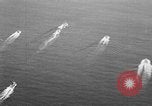
Boats change their position as a signal to change it is given by the Wave Commander in the United States.
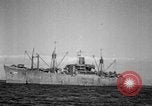
A training film on movement and tactics of landing boats in the United States. A formation of boats approaching the line of departure. The boats retain the same position until a signal to change is given. The Wave Commander signals other formation. Boats underway in a formation. A signal is given by lowering a flag. Animation depicts the positions and formations of the boats. The prescribed distance should be known when the boats hits a beach. The Control Officer aboard the control vessel. The Wave Commander gives signals to move forward. Attack and support boats move forward. They stay in a line and maintain correct speed. Aerial view of the boats. A ship underway. Soldiers fire from a ship. (World War II period).
Different markers represent supply phases of amphibious operations in the United States.
A training film titled: 'Amphibious Warfare Landing Boat Tactics Supply' on supply process of equipment from landing boats. The landing boats underway in the United States. The supply phase of amphibious operations. Men unload equipment at a beach. An officer instructs crew. Preparations for landing supplies. A red marker on the beach represents its center. Different strips which are vertical, horizontal and others are used as markers at the beach. A strip represents an ammunition marker. Tracked vehicle marker is the point where the tracked vehicles will be unloaded. The medical supplies marker. A red cross on a white field. A fuel unloading marker.
The Beach Master and the Traffic Control Officer direct supplies on a beach in the United States.
A training film on supply process of equipment from landing boats in the United States. Markers on a beach. Transport and cargo vessels arrive near the beach. Animation depicts the vessels beaching. Boats in assembly areas. Boats along the side of a landing craft. The Traffic Control Officer and Beach Masters are holding a cargo ticket. An Landing Craft Vehicle Personnel (LCVP) taking on a cargo of rations. A red flag on a boat. The boat proceeds to boat control traffic stations. Soldiers on the beach. The Traffic Control Officer directs the flow of supplies on the beach. The Beach Master's job is to see that the supplies are unloaded quickly and efficiently. He receives a copy of the cargo ticket. The cargo ticket gives information about how much and what cargo the boat is carrying. The Traffic Control Officer dispatches boats to the beach. The boats approach the beach. They are directed by the Traffic Control Officer. (World War II period).
A landing boat carrying gasoline arrives near a fuel marker to unload fuel at a beach in the United States.
A training film on the supply process of equipment from landing boats in the United States. The cargo rendezvous area. Animation depicts Traffic Control Officer's boat marking traffic control stations. The cargo rendezvous area control officer's boat. Another boat marks the port cargo rendezvous area control officer's station. The movement of the boats dispatched from the officers is shown with the help of animation. Landing boats underway. Men aboard the boats. Officers discussing. A Landing Craft Vehicle Personnel (LCVP) flies a yellow flag. Animation depicts movement of boats to their proper unloading markers. A boat carries gasoline. The boat arrives near unloading fuel marker. Officers stand near the marker. A signal is given by an officer to land. The boat arrives at a beach. Trucks, tanks and other equipment at the beach.
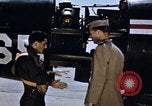
A U.S. Navy F9F Panther pilot takes reconnaissance photographs of a target area and review them with training officers in the United States.
A film on the importance of photographic reconnaissance in the United States. A U.S. Navy North American F9F aircraft parked at an air base. Two K-17 cameras are loaded in the airplane. A pilot in cockpit. Aerial view of the F9F Panther airplane in flight. The pilot looks at a target area on a map. The aircraft flying over the target area. Aerial view of the target area. The pilot takes photographs of the target area. Officers seated at a desk in an office. They look at pictures. The pilot stands nearby. An officer points out mistakes in the photography. The pilot in the cockpit of the F9F Panther and view of the F9F cockpit controls as the airplane is flying over the target area which is a dam complex. Aerial view of the target area. He takes photographs. An officer looks at the pictures. View of three North American F9F Panther aircraft flying in formation overhead.
CRITICALPAST.COM: About Us | Contact Us | FAQs - How to Order | License Agreement | My Account | My Lightboxes | Shopping Cart | Advanced Search | Featured Collections | Website Terms & Conditions | Privacy Policy ©2026 CriticalPast LLC.
License Agreement |
Terms & Conditions |
Privacy Policy
©2026 CriticalPast LLC.