


 Francais
 Deutsch
 Italiano
Refine Your Search
Ohio-State-football stock footage and images
- Showing 5965 to 5970 of 24494 results more
more Hide
Hide
United States soldier examines emaciated patients, gravediggers exhume corpses in Hadamar Euthanasia Center yard, US Major Bulker performs autopsy, US soldiers interrogate chief administrator and nurse of Hadamar Clinic in Germany during WW2
United States Army jeep arrives in Hadamar Clinic (also known as Hadamar Euthanasia Center), a Nazi institution seized by First Army troops in Germany during World War II. Flag of United States drapes over the front of the Hadamar Euthanasia Center after being seized by the Americans. The locals referred to the building as the "house of shutters." United States soldiers get out of jeep and enter the building. United States soldier walks through ward and talks to a patient in bed. Patient in bed talks to United States soldier. United States soldier inspects the rib area of an emaciated, bald male patient. Soldier uncovers the bedsheet of patient and touches patient’s skeletal legs. Bald patient in hospital bed. Soldier sees a patient sitting on bed. Soldier inspects emaciated, shirtless patient. Gravediggers with gas masks exhume corpses from graveyard attached to the Nazi institution. Gravediggers digging for corpses. Gravedigger drags an emaciated, naked corpse out of the soil. A gravedigger unearths a corpse. Gravediggers drag a corpse by her limbs from the earth. Gravediggers pull out a naked corpse. Gravediggers line up corpses for later inspection by WCIT (War Crimes Investigation Team) officials. Major Bulker performs an autopsy of the corpses found in the Hadamar Euthanasia Center graveyard. One soldier takes notes, and another soldier takes photographs of the autopsy. Soldier taking notes while smoking a pipe. United States soldiers interrogating Hadamar Euthanasia Center Chief Administrator, Alfons Klein, and male nurse, Karl Willig. Soldier shows bottle of morphine, used by nurses to euthanize patients. Alfons Klein and Karl Willig leaves the interrogation room.
United States Embassy workers injured after North Vietnamese terrorist attack in Saigon
Helicopters on an airfield during the Vietnam War. Wreckage of a destroyed plane with debris. A nose art of a destroyed plane. Bombed soldiers’ barracks at a United States airbase in South Vietnam. Photographs of soldiers’ loved ones, including a portrait of a young girl, among debris in bomb site. Vietcong car bombing of the United States Embassy in Saigon, South Vietnam on March 30, 1965. A 1962 Chevrolet C10 Suburban ambulance arrives in the scene. A bloodied embassy worker covers his face. Another embassy worker is taken away. A bleeding victim holds his cigarette as he’s carried on a stretcher. A United States Army Bell UH-1 Iroquois “Huey” helicopter in flight. U.S. Army soldier in helicopter fires machine gun. Soldiers advancing in field and an upturned helicopter is seen in the foreground. Soldiers escape from the upturned helicopter. United States soldiers recuperate in makeshift hospital beds. A soldier with head covered in bandage. A shirtless soldier sleeps with his mouth open. Coffins draped with the United States flag at an airfield in South Vietnam. Soldiers and sailors pay tribute to the fallen soldiers. Soldiers carry the coffin of a fallen colleague to an aircraft. Vietnamese civilians look on. A pair of poor Vietnamese children. Vietnamese men and women praying. Drafted soldiers onboard a ship arrive in Vietnam. They unload supplies, one of them holding a banner. Soldiers holding the United States flag and a banner. Combat units of the United States Marine Corps onboard ship heading to Vietnam. The Marines disembark a landing craft upon landing on beach head in Vietnam. A Lockheed C-130 Hercules taxiing at an airfield in Vietnam. Army combat unit soldiers disembark and unload weapons from the transport plane. Trucks carrying combat soldiers moving.
Filipino citizens after United States occupation of Philippines
Dramatization of the Second Continental Congress during the American Revolutionary War. The United States Declaration of Independence. The Thomas Jefferson Memorial (16 E Basin Dr SW, Washington, DC 20242, United States) in Washington DC. Bronze statue of Thomas Jefferson. The statue of United States President Abraham Lincoln at the Lincoln Memorial (2 Lincoln Memorial Cir NW, Washington, DC 20002). President Woodrow Wilson meets European leaders in France after World War I. Artistic depiction of United States soldiers fighting in the Spanish-American War. Map showing the Philippines, one of the two territories acquired by the United States after the Spanish-American War. Filipino students attend a class. They listen to the teacher standing in front of them. Behind the teacher are two blackboards. Two American consultants working with a Filipino man at the Manila City Planning. A scale model of Manila. Men constructing a house in the Philippines. Filipino men carry an entire native Kubo nipa house as a form of “Bayanihan”. A parade in Manila in 1946. The United States grants independence to the Philippines on July 4, 1946. Paul V. McNutt, High Commissioner to the Philippines, reads a proclamation at the ceremony held at the Independence Grandstand in front of the Rizal Monument. Filipino women wearing traditional Filipiniana dresses attend the ceremony. The United States flag is lowered as the Philippine flag is raised.
USDA and FDA authorities test and register new pesticide ‘Compound 776’ for agricultural use in the United States
A farmer driving a tractor sprayer in the United States. The farmer parks his tractor sprayer in front of a garden shed. The farmer inspects bottles of pesticide. Safety precaution written on a pesticide bottle carry a warning that reads “DO NOT USE WITHIN 10-DAYS OF HARVEST”. Various labels and safety instructions on pesticide containers. Photographs of scientists researching on pesticide development in laboratories. An entomologist holding an insect cage to inspect specimens. A chemist inspects a petri dish. United States agricultural officials and experts deliberate as part of a pesticide’s registration process. A farmer fills a sprayer with water. A woman feeds an infant with Gerber baby food. An Afghan Hound dog eats from pet bowl. Scientists and pesticide manufacturers talk inside a laboratory. A can of Compound 776. State scientists test Compound 776 inside a laboratory. Nozzle spraying pesticide. Plant specimens are sprayed with Compound 776 pesticide during testing. A scientist taking notes while inspecting crops during a fieldwork. Another scientist spraying Compound 776 onto plants. A man with a folder labeled “Labels Compound 776” and a data book “Pesticide Petition Compound 776”. A manufacturer submits pesticide registration petition to the Department of Agriculture or the USDA. The “Application for registration of economic poisons” document. USDA Pesticides Regulation Division official examines the pesticide registration of Compound 776. The official opens the data book of Compound 776. A scientist uses rabbits for animal testing. Scientist treats a rabbit’s shaved skin with chemicals. A man visits the United States Food and Drug Authority (FDA). Pesticide manufacturer submits a pesticide registration petition to the FDA in Washington DC. An FDA officer inspects the pesticide petition. FDA scientists probe the residue levels of Compound 776 inside a laboratory. A scientist points to a graph depicting the residue data plotted against time. FDA authorities study industry data on a pesticide. Bottles, jars, and containers stored in shelves of a laboratory. Laboratory rats inside cages react to pesticide. A chemist working in a laboratory. A Federal Register journal of the United States. Camera zooms to “Food and Drug Administration” in the front page of the Federal Register. A “Notice of Registration Under the Federal Insecticide, Fungicide, and Rodenticide Act” from the USDA. Printing press printing pesticide labels. A truck transporting pesticide enters Maryland state line border. Agricultural pesticides and a weighing scale displayed in shelf.
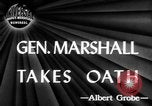
Chief Justice Vinson administers oath to General George C. Marshall as the new Secretary of State in Washington.
United States Army General George C. Marshall takes oath of Secretary of State in Washington D.C. U.S. army General Marshall, wartime Chief of Staff, returns from China and assumes his new role as Secretary of State. Chief Justice Frederick Moore Vinson administers the oath, while President Harry S. Truman and members of his cabinet look on. People outside a building of State Department (Old Executive Office Building, 1650 17th St NW, Washington, DC 20006, United States). Secretary of State George C. Marshall works in office.
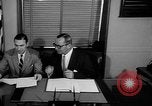
State Department officials in Washington, D.C., discuss a document with many signatures. One signs it.
Opening scene shows Douglas MacArthur II, Counselor of the State Department, discussing a document with Assistant Secretary of State, James C. Hill. The document contains many signatures, and James Hill signs it, as well. Closeups of him and MacArthur looking directly at the camera. Closeup of the document. Scene shifts to exterior of the U.S. State Department building, as seen from Edward J Kelly Park, across 21st Street from the building. Opening scene shows Douglas MacArthur II, Counselor of the State Department, discussing a document with Assistant Secretary of State, James C. Hill. The document contains many signatures, and James Hill adds his signature to it. Closeups of him and MacArthur looking directly at the camera. Closeup of the document. Scene shifts to exterior of the U.S. State Department building, from Edward J Kelly Park, across 21st Street from the building. Bronze sculpture copy of Myron's Discobolus (Discus Thrower) is seen in the foreground.
CRITICALPAST.COM: About Us | Contact Us | FAQs - How to Order | License Agreement | My Account | My Lightboxes | Shopping Cart | Advanced Search | Featured Collections | Website Terms & Conditions | Privacy Policy ©2026 CriticalPast LLC.
License Agreement |
Terms & Conditions |
Privacy Policy
©2026 CriticalPast LLC.