


 Francais
 Deutsch
 Italiano
Refine Your Search
Okinawa Ryukyu Islands 1944 stock footage and images
- Showing 655 to 660 of 9549 results more
more Hide
Hide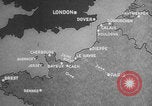
German troops reinforce defenses in Southern France after Allied 1944 invasion of Normandy in World War II
Film opens with map of western coast and towns in France. Camouflaged trucks filled with German infantry drive along rural French road in World War 2. Closeup of smiling soldiers in one truck. A makeshift sign reads (in German) "One-way street to the front." A soldier passes out newspapers to other soldiers riding bicycles. Closeup of a soldier reading the newspaper. Closeup of the paper has headline reading (in German) "Eisenhower has not surprised us." Troops on bicycles ride through a village. Large wooden sign warns (in German) that the enemy understands things you might say about military activities. Camouflaged vehicles drive along a road, passing overturned civilian vehicles at the sides of the road. View from rear of German soldier on motorcycle, with foliage on his helmet, looking skyward for aircraft. Formations of Allied aircraft are seen overhead, and German troops seek protection in ditches at side of the road. Scene shifts to German troops firing anti-aircraft guns at the planes. Black flak clouds are seen near the Allied airplanes. A lone B-17 bomber is seen overhead. Next, burning wreckage of an aircraft is seen strewn across a field. No markings are visible on the wreckage. A sign identifies the town of Avranches in Southern France. German infantry enter the war-torn town on civilian cars and other vehicles of opportunity and motorcycles. A German half track personnel carrier tows an artillery field piece.
Warsaw bombed by Germans in retaliation to 1944 uprising, various scenes of Warsaw before WW2
Newspapers around the world reporting on the bombing of Warsaw by Nazi Germany as retaliation for the Warsaw Uprising during World War 2. Newspaper headlines read, "Poles Fighting Inside Warsaw," and "Warsaw Being Razed by Hitler's Order," and "Warsaw's Plight" and "Warsaw Poles Fight Tanks in Streets." Scenes of Warsaw in flames as buildings are being bombed by German forces. Montage depicting Warsaw on fire. Scenes of Warsaw before WWII, including scenes such as the Warsaw Old Town Market Square (rynek Starego Miasta, 00-279 Warszawa, Poland), the column of Sigismund III Vasa (plac Zamkowy, 00-001 Warszawa, Poland), the Royal Palace (plac Zamkowy 4, 00-277 Warszawa, Poland) and the Lazienki Park, before World War 2. Statue of King Jan III Sobieski in Lazienki Park. Men strolling near a palace. Baroque gates in park.

Newly naturalized Americans recite the Pledge of Allegiance during the 1944 “I Am An American Day” (WWII)
More than a million people attend the “I Am An American Day” citizenship ceremony in Central Park in New York City, during World War 2. Over 150,000 people attended the ceremony as newly naturalized American citizens. Native American Indians in traditional dress and women and men in military uniform attend the ceremony. Flags of various nations are flown. Wounded Army soldiers and wounded Navy sailors arrive as guests of honor. New York City Mayor Fiorello LaGuardia shakes hands with servicemen, giving tribute to their heroism during World War II. Immigrants stand up to recite the Pledge of Allegiance to the United States of America as part of the naturalization ceremony. Speaker recites the Pledge of Allegiance, which predates the inclusion of "under God" which was added later in the 1950s.
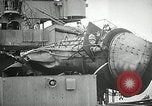
Damaged USS Louisville and men overhaul it in Okinawa, Japan.
Damaged USS Louisville (CA-28) hit by Japanese Kamikase in World War 2. Damaged forward stack of the ship. Float of its scout plane left on catapult, is jettisoned. Large stack of the USS Louisville knocked down. Engine of seaplane blown up by explosion on the signal bridge. Man welds in superstructure. View of other men working to repair damage to the Cruiser.. [Note: The following eyewitness account of the kamikaze attack was recorded by Seamen 1st Class, Enrico Trotta, who was a crew member on the USS Louisville (CA-28) from 1943 to 1946, "At 1923 (hours) two planes which were identified as friendly flew around and one kamikaze dove onto the battleship USS Mississippi BB 41. The other kamikaze plane turned to the Louisville and started to make a run on us. I was on No. #4 - 20 mm AA gun mount on the port side below #2 main battery and I fired 58 rounds to set the kamikaze plane on fire prior to hitting the Louisville’s front smoke stack bending and twisting it and killing 9 men on the 40 mm gun mount mounting on the forward superstructure tripod about 140 feet from our gun mount. The kamikaze also cut our sea plane off and left only the pontoon on the catapult. Three other 20 AA mm gun crews opened up firing 4, 11, and 20 rounds as well. We were not told to fire for we did it on our own. We were only manning the guns at the time and were not on general quarters. Later, the officers came by and said good job."]
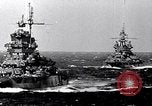
Role of U.S. Naval gunfire during battle for Okinawa, Japan, during World War II.
U.S. Battleships cruising in the Pacific. Close views of naval 16 inch gun barrels Navy personnel manning radio and teletype stations in a communications center. (They are shirtless, presumably due to heat.) They receive a message from General Bruckner, Commanding General, 10th Army, to Admiral Turner, Commander, Task Force 51,praising the active naval support for U.S. ground forces. Scenes of naval gunfire of all types. Japanese aircraft hit and burning. A U.S. naval 16 inch gun fires and produces a giant smoke ring.
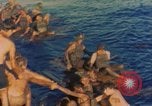
Rescued sailors are helped aboard a U.S. Navy submarine near Okinawa, Japan.
Clinging to pieces of wreckage, exhausted sailors from a destroyed allied vessel are helped aboard an United States Navy submarine by fellow sailors. Some of the rescued sailors are covered in oil. Sailors from the submarine help the victims aboard while others post lookout with binoculars. Some victims are wearing flotation bladders and float on wooden planks. (World War II period).
CRITICALPAST.COM: About Us | Contact Us | FAQs - How to Order | License Agreement | My Account | My Lightboxes | Shopping Cart | Advanced Search | Featured Collections | Website Terms & Conditions | Privacy Policy ©2026 CriticalPast LLC.
License Agreement |
Terms & Conditions |
Privacy Policy
©2026 CriticalPast LLC.