


 Francais
 Deutsch
 Italiano
Refine Your Search
Okinawa Ryukyu Islands 1944 stock footage and images
- Showing 1723 to 1728 of 9549 results more
more Hide
Hide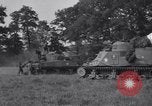
Free French tank crew removing casualties from one of their Sherman tanks during World War II
French tank crew of the Free French Forces, leave their M4A2 Sherman tank to inspect another that has been knocked out. Both tanks display the logo of French 2nd Armored Division (2e Division Blindée, 2e DB), commanded by General Philippe Leclerc. The destroyed one belongs to the 501ème Régiment de Chars de Combat (501st RCC 3eC) and was knocked out, probably by an 88mm anti-tank shell, on August 13, 1944 in Ecouves forest. Closeups of huge holes penetrating the turret of the tank. The other tank's crew members begin recovering bodies of dead from the stricken tank, which has the name "l'Ourcq" stenciled on its side. They remove the body of one dead soldier and place it on a blanket. They also remove the headless body of another from the tank. (Note: Reportedly, the destroyed tank was number 420583.)
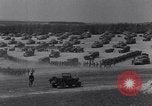
Allied forces gather in British seaside ports and depart in convoys to invade France during World War II
Opening scene shows U.S. troops, tanks, jeeps, and trucks assembled in a sandy marshaling area in southern England preparing to proceed, on 30 May 1944, to embarkation points for the invasion of France during World War 2. Troops are seen heading toward Sherman tanks, landing vehicles, tracked, and other military vehicles. An army Captain is seen overseeing some of the activity. The troops riding armored vehicles and trucks begin moving in formations from the marshaling area. Wading tanks and Sherman tanks, some pulling artillery pieces, are seen moving through an English town.(An unusual deep wading tank with no turret and two forward guns in the front is seen. (It seems to be a modified Stuart tank.) Next, the vehicles are seen arriving at a seaport pier, where a large transport ship is docked. A heavy truck is seen loading in reverse aboard British Landing Craft T 453, at Trebah gardens (Polgwidden cove) at Falmouth docks, Grove place slipway falmouth, England. View from the landing craft as another truck backs into it. Another truck driving forward onto a landing craft. Allied troops marching toward the embarkation points and marching from a pier to board a transport ship. Troops boarding USS LST 376. Troops boarding Higgins boats to be ferried to their transport ship, the USS Samuel Chase (APA-26) anchored in the harbor. Troops stepping from the Higgins boats to board the Samuel Chase. Some of the troops boarding the transport ship by means of a landing net, and being helped aboard as they reach the top. Camera pans across the harbor where transport ships are moving to their places in the invasion convoy. View from a ship underway, with other transport ships behind it and barrage balloons in the air above. Troops on a ship's deck shooting craps with dice. Sailors playing with a small puppy. Soldiers napping on deck. View of sailors on a warship being briefed in groups about their forthcoming combat roles. Troops being briefed about the invasion operations. Troops checking and making sure their personal arms and equipment are ready. One soldier shining his boots. The U.S. battleship USS Arkansas (BB-33) seen at anchor. Closeup from rear of General Dwight D. Eisenhower, British Admiral Sir Bertram Home Ramsay and another officer on the deck of British light cruiser, HMS Belfast. Major General Clarence Ralph Huebner, Commanding General of the 1st Infantry Division ("The Big Red One") standing on deck of the cruiser, USS Augusta (CA-31) together with Rear Admiral Alan G. Kirk, who is later seen with his Chief of staff, Rear Admiral Arthur D. Struble, on the deck conversing with officers. An unidentified American admiral walking along a ship's deck followed by a Captain and other members of his staff. Other officers conversing on a ship's deck. Inserted near this point is a view of a U.S. Navy Vice Admiral walking along a deck followed by a Captain and other naval officers.
Fairchild XBQ-3 flying bomb taxiing at Fairchild facility in North Carolina
Opening slate reads: "XBQ-3 Aerial Missile." Next, an XBQ-3 flying bomb is seen taxiing on an airfield. It resembles an AT-21 training airplane. But it is actually a flying bomb (aka an aerial torpedo or an Assault Drone). The one shown in this film is the first of two built by the Fairchild Company. It displays serial number 43-25252. (The second was 43-25253). With a safety pilot aboard, it taxis about on a concrete ramp, at Fairchild Field in Burlington, North Carolina. The XQB-3 accommodated one pilot for testing or ferrying purposes, but otherwise was designed to be remotely guided to it's target and detonate on impact. Guided missile technology was progressing at such a pace as to render the 'flying bomb' concept obsolete and so the U.S. Army Air Corps cancelled the program in late 1944. (World War II period).

Infantry, artillery, and warplanes during the D-Day invasion by Allies in Normandy, France during World War 2.
The D-Day assault on Normandy by the Allies, against Germany's conquest in World War 2. Troops of infantry, artillery and tanks, warplanes ready assembled in south of England for attack at Normandy in France on June 06, 1944. Supreme Commander General Dwight D. Eisenhower and British General Montgomery in discussion with each other. B-17 bombers on mission to Nazi bases. Soldiers move from warships to landing crafts, and land on the coast of Normandy under enemy fire. Parachute troops jump from aircraft landing behind enemy lines. Surrendered German soldiers march, guarded by Allied soldiers. From a June 13, 1963 newsreel recounting events years earlier.
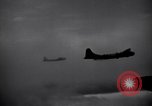
U.S. 8th Air Force operating B-17s and B-24s in Europe and B-29s against Japan in Pacific during WW2
Formation of U.S. 8th Air Force B-17 bombers in flight over Germany during World War 2.Gunners firing 50 caliber machine guns from various positions in a B-17, as attacking German interceptor aircraft race past. One German aircraft is hit and pieces of it fall off. B-17 enters bombing run. View of bombardier and bomb sight image. German aircraft continue attacks and gunners continue defending as the bombardier announces "bombs away." This is a high altitude mission and all crew members are on oxygen. Glimpse of pilot and copilot in cockpit. Pilot alerts gunners to a German FW-190 aircraft attacking them. Waist gunners pause to look at a German fighter smoking, as it falls, and strikes the ground in an explosion. Sequence shifts to formation of B-24 Liberator bomber on a mission with bombs visible dropping from bomb bays. Sequence shifts again, rapidly, to a formation of B-29 Superfortress bombers dropping bombs. Nighttime view of incendiary clusters being dropped on Japan. (Note: One of the B-29s seen is serial number 42-24547, assigned to the 6th Bomb Group, 315th Bomb Wing. This B-29 crashed short of the runway on 31 Dec 1944, at Borinquen Field, Puerto Rico, where the 6th bomb Group underwent combat crew training. And the B-29s shown do not display any tail codes.)
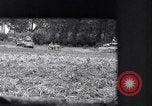
United States 1st Army rolls into St. Quentin, France and crosses over to Belgium, in World War II
U.S. 1st Army troops pass an abandoned German pill box near Cambrai, on their way to the Belgian border, during World War 2. U.S. tanks advancing along road to Saint-Quentin on September 1, 1944.Road sign points toward St. Quentin. Some French civilians watch as troops ride into the city aboard military vehicles. American flag is seen at window of a building.September 2nd, lead elements of the 1st Army pass road sign marking boundary between France and Belgium. A road sign on ground at the old formal border reads "Douane Belge." American tanks speed across Belgian fields in pursuit of retreating German soldiers.US units firing tank guns and machine guns at German positions.Smoke rising.Destroyed and burning German artillery, tanks, halftracks, and other vehicles and equipment along side of road.Destroyed civilian automobile and wagons. American troops entering town where Belgian flags fly. German Army Captain, accompanied by U.S. troops, urges his soldiers to surrender.He steps over wire fencing into a field where German soldier are coming forward. View of numerous German prisoners of war being held in a meadow.
CRITICALPAST.COM: About Us | Contact Us | FAQs - How to Order | License Agreement | My Account | My Lightboxes | Shopping Cart | Advanced Search | Featured Collections | Website Terms & Conditions | Privacy Policy ©2026 CriticalPast LLC.
License Agreement |
Terms & Conditions |
Privacy Policy
©2026 CriticalPast LLC.