


 Francais
 Deutsch
 Italiano
Refine Your Search
Okinawa Ryukyu Islands 1944 stock footage and images
- Showing 2413 to 2418 of 9549 results more
more Hide
Hide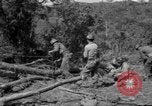
U.S. military training: "Aggressor" troops build an apron barbed wire fence and fell trees at Vieques Island in Puerto Rico.
During U.S. military joint services training, "aggressor" troops undergo Airborne-Amphibious training exercise and Defense preparation at Vieques Island in Puerto Rico. Aggressor troops in process of building an apron barbed wire fence. Spinning wheel in the hands of a soldier. Aggressors use an electric power saw to fell tree. Huge tree falls on ground.
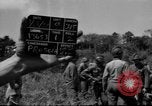
U.S. joint services military exercise: "Aggressor" troops build an antitank ditch at Vieques Island in Puerto Rico.
During a military exercise of joint U.S. services, "aggressor" troops undergo Airborne-Amphibious training exercise at Vieques Island in Puerto Rico. Explosion blasting for antitank ditch. Aggressor troops stand in antitank ditch and walk out of there.
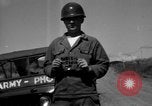
U.S. joint services military exercise: Troops set sandbags around 90mm AA gun emplacements at Vieques Island in Puerto Rico.
"Aggressor" troops undergo Airborne-Amphibious training exercise at Vieques Island in Puerto Rico. Part of a joint services U.S. military exercise. Aggressor troops set sandbags around 90mm AA gun emplacements. 90 mm AA gun placed on ground ready to fire.
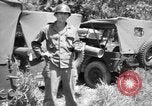
Joint services exercise of U.S. military. "Aggressor" troops fire 90mm AA gun at Vieques Island in Puerto Rico.
"Aggressor" troops undergo Airborne-Amphibious training exercise at Vieques Island in Puerto Rico. This is during a joint-services training exercise of the U.S. military. Aggressor troops fire 90mm AA gun placed around a wall of sandbag. They rotate the turret of the gun in various directions and fire the 90 mm AA gun.
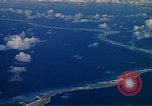
Operations Crossroads, nuclear test "Able" at Bikini Atoll, Marshall Islands, in the Pacific Ocean.
Operation Crossroads nuclear bomb test "Able" at Bikini Atoll, Marshall Islands in the Pacific Ocean. Aerial view of atoll. White light spreads due to blast. Shock waves in the lagoon. Ships grouped together at anchor. Blast goes off amid ships as it throws out a huge shock wave in all directions. Mushroom cloud forms immediately over the ships.
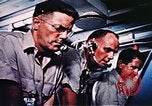
Detonation of liquid thermonuclear device MIKE, the first hydrogen bomb, at Enewetak Atoll, Marshall Islands.
Full-scale thermonuclear test of ultracold liquid deuterium, codenamed Ivy MIKE at Enewetak Atoll in the Pacific Proving Ground in the Marshall Islands (sometimes spelled Eniwetok or Eniewetok). (Left to right) Chief engineering and firing commander, Stan Burris -- later the leader of the Strategic Ballistic Missile development, including Polaris and later editions; retired as CEO of Rockwell Aerospace -- military firing and security commander, Colonel Richard Lunger, and ultracold refrigeration engineering commander for thermonuclear liquid fuel state monitoring, Robert Gibney. The intense nuclear radiation ignited the atmosphere around the device, creating a fireball 4.2 miles across. A remote firing control was created, using a televison tower beam signal to safely trigger the detonation from the USS Estes, approximately 35 miles south/southeast of the detonation. White hot device remnant specks are visible throughout the surface of the fireball. Shockwave from Operation Ivy Mike explosion is seen spreading across the water, then a white mushroom cloud spreading above. View of crew on ship deck observing blast. Device yield: 10.4 megatons.
CRITICALPAST.COM: About Us | Contact Us | FAQs - How to Order | License Agreement | My Account | My Lightboxes | Shopping Cart | Advanced Search | Featured Collections | Website Terms & Conditions | Privacy Policy ©2026 CriticalPast LLC.
License Agreement |
Terms & Conditions |
Privacy Policy
©2026 CriticalPast LLC.