


 Francais
 Deutsch
 Italiano
Refine Your Search
Okinawa Ryukyu Islands 1944 stock footage and images
- Showing 2689 to 2694 of 9549 results more
more Hide
Hide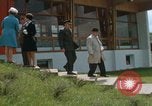
Former war correspondents visit Normandy American cemetery and Memorial in Normandy, France and present a time capsule
Former U.S. war correspondents in Normandy, France to mark the 25th anniversary of Allied invasion of France during World War II. Correspondents outside a cafe near Normandy as they prepare to leave a luncheon. Retired General J. Lawton Collins is escorted by a uniformed U.S. Army officer to a waiting car. View of the Normandy coastline from a moving car. American flag on the bonnet of a car as it drives along the road. Graves at the Normandy American Cemetery and Memorial. Wife of a correspondent walks amidst graves at the cemetery. Grave of Wesley J. Rubenstein with a Star of David Jewish headstone. An F-4E Phantom aircraft in flight overhead. American and French flags hoisted at the cemetery. Correspondents tour the cemetery. View of a plaque ad time capsule unveiled by the correspondents and presented that day. It says, "In memory of General Dwight D. Eisenhower and the forces under his command, this sealed capsule containing news reports of the June 6, 1944 Normandy Landings is placed here - by the newsmen who were there. June 6, 1969." A man with a baby tied to his back. Correspondents speak during the ceremony. A photographer clicks pictures.
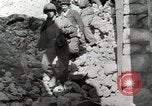
Inhabitants of San Pietro Infine, Italy, attempt to begin life anew, after U.S. Forces capture the village from German Forces, during World War II
Aftermath of the Battle of St. Pietro Infine, Italy, after it was taken by soldiers of the U.S. Army 36th Division, 143rd Infantry Regiment and troopers of the 82nd Airborne Division, 504th Parachute Infantry Regiment, during World War 2. Several U.S. soldiers of the 143rd Infantry Regiment, scramble down a mountainside over rubble from destroyed buildings in San Pietro Infine, Italy, following the battle there during December 1943. (These scenes were photographed later, in 1944.) Next, more local people are seen running from a mountain cave, where they had taken refuge during the battle of San Pietro. Old people, women, and children make their way down the rubble strewn hillside and onto a remnant of road surrounded by destroyed buildings. Italian women carry their belongings balanced on their heads as they walk towards the remains of their dwellings. A man leads two cattle. One woman carries a new coffin balanced on her head. An 82nd Airborne trooper warns local people about the danger of mines and booby traps left behind by retreating German soldiers. A soldier removes a booby trap in a doorway. Women trying to clean up and settle in the ruins of their homes. As one woman sweeps debris, an huge explosion occurs, bringing down large portions of a building. U.S. Soldiers dig through debris, with shovels. An MP and infantryman stand with several Italian men as one is grief stricken while they retrieve the body of a loved one from the rubble. A woman weeps. Women nurse and comfort their babies. Small children are seen happily emerging from a cave. A mother admonishes her boy. Women and children are relieved and smiling. Several children scamper down a hill. Others are seen walking about and posing shyly for the camera. Local men clearing rubble and women washing clothes in an outdoor stream as they try to reestablish some normalcy in their lives. A shoemaker resuming business at a small bench outdoors. Men unloading sacks of flour from a truck. People purchasing flour being weighed in an outdoor market. Farmers plowing fields with oxen. A church procession, led by a youth carrying a Christian banner, moves from a bombed out church, between mounds of rubble, . Statue of a Saint at the church.
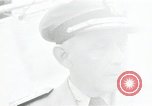
Admiral Gallery, who was Commander of task force that captured U-505 is present as it is towed to Chicago for a museum in 1954
Admiral Daniel Vincent Gallery, United States Navy, is piped aboard a U.S. ship. He poses briefly with three civilians (possibly members of the original U.S. boarding party) . View of the German submarine Unterseeboot 505 (U-505), captured by U.S. Naval Task Force, TG 22.3,on June 4, 1944. Admiral Gallery (then a Captain) commanded TG 22.3. U-505 is written on hull of the ship and she flies the German flag. The submarine is towed under an open draw bridge. Scene of harbor in Chicago, Illinois, where crowd is gathered. Striking the German colors on the submarine. A launch motors out to the submarine, which is being towed with German flag flying. A line is thrown to the submarine. Small boat approaches stern of submarine and person on the U-505 attempts, unsuccessfully, to pass a package to the small boat, which then comes abeam on port side to try again. View of tugboat with submarine behind.
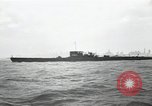
Admiral Gallery and others greet the U-505 as it is towed into harbor in Chicago enroute to a museum
Scenes of the captured German submarine U-505, as it arrives in Chicago, Illionois enroute to the Museum of Science and Industry. Officials and guests, board the U-505 from a small boat as it proceeds under tow. Among those boarding are Admiral Gallery, who, as a Captain, commanded the task force that captured the U-505 in 1944, The Admiral waves from the conning tower of the submarine. He is seen with three civilians (possibly members of the original boarding party). The submarine docks with many celebrants on board.
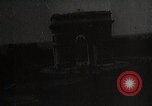
VE Day. Huge crowds gather in Paris and London to celebrate victory and end of World War II. Flashbacks to war events
Victory in Europe day as huge crowds gather to celebrate end of World War II in Europe, in Paris and London. Crowd swarms around the Arc de Triomphe in Paris. Crowds celebrating at Piccadilly Circus in London. Flashback to scenes of World War II. U.S. troops training for D-Day invasion. B-17 bombers at high altitude over Germany leaving streams of contrails. A B-17 hit and falling. B-24 bombers of the 706th Squadron, 446th Bomb Group, on bombing mission. (One: tail number 41-29177, was shot down on August 26, 1944.) U.S. war materiel pouring into the UK. New P-38s and new P-47s. A German Me-109 aircraft hit and falling. The German pilot bails out and parachutes downward. Invasion fleet elements assembling in England.

Representing the life of a typical Japanese soldier and celebrating the defeat of Germany in United States.
Germany and Japan defeated in World War II. The defeat of Germany is celebrated in United States. Scenes represent the life of a typical Japanese soldier: a flag is raised to celebrate his birth; boys in uniform play war; troops sack Nanking; and in1944 he is killed to attack over harbor in America. In a dramatization, a soldier with an American machine gun is killed. Dead Americans. American soldiers honor their dead comrades covered with United States flag.
CRITICALPAST.COM: About Us | Contact Us | FAQs - How to Order | License Agreement | My Account | My Lightboxes | Shopping Cart | Advanced Search | Featured Collections | Website Terms & Conditions | Privacy Policy ©2026 CriticalPast LLC.
License Agreement |
Terms & Conditions |
Privacy Policy
©2026 CriticalPast LLC.