


 Francais
 Deutsch
 Italiano
Refine Your Search
Okinawa Ryukyu Islands 1944 stock footage and images
- Showing 2929 to 2934 of 9549 results more
more Hide
Hide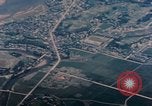
A town on Kyushu Island, Japan, is strafed by U.S. Army Air Force planes in final days of World War II.
P-47 aircraft of U.S. Army Air Forces 464th Fighter Squadron, 507th Fighter Group, strafe a town on Kyushu Island, Japan at the end of World War 2. Aerial view of a town. Places in town on fire. Thick black smoke rises.
New Guinea natives carry supplies for the Allies and the Allies bombard a Japanese held island in the South Pacific.
War between the Allied Forces and the Axis troops in the South Pacific during World War II. New Guinea Papuan natives carry arms, ammunition and supplies for the Allies in a boat. An overnight camp of the Papuan people. The natives carry the supplies across mountains and makeshift bridges. The Australians inspect a Japanese submarine in Sydney Harbor, Australia. They remove the firing mechanism of the torpedo and the instrument which helps a torpedo to find its way once fired from a submarine. U.S. and Australian naval forces move towards a Japanese held island and bombard it. The sailors load and fire artillery. Smoke rises in distance as the shells hit the targets. U.S. Marines survey the damage. Dead Japanese soldiers. A lone U.S. Marine with captured Japanese prisoners.
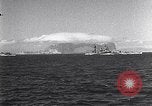
Ships passing through Mediterranean Sea with rocky islands in background.
Ships passing through Mediterranean Sea with rocky islands in background. Warships in line. Warships at harbor. Destroyer underway in harbor. Battleship in harbor at anchor. Battleship's turret guns.
View of Juneau, Alaska from Douglas island.
View of the Capital City of Juneau, Alaska, filmed from Douglas island across the Gastineau Channel. Mount Juneau is on the left and Mount Roberts on the right.
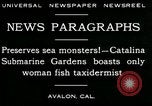
Woman taxidemist, Emily Parker, shows sea life specimens at Catalina Submarine Gardens in Avalon, on Catalina Island, California
Woman taxidermist, Emily Parker, interviewed at Catalina Submarine Gardens, in Avalon, on Catalina Island, California. Numerous preserved species of sea life are mounted on the wall behind her. She is working on a specimen of hammerhead shark. Next, Ms.Parker displays a preserved Tuna and several other species including a pair of so-called Flying Fish. she touches- up a billfish specimen and inspects a shark. (Note: Ms. Parker's husband, C.B. Parker, was a Taxidermist in Catalina. After he passed away in 1926, Ms.Parker continued his business. She was considered to be one of the first women taxidermists.)
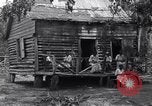
"Congo Baskets" being woven by African Americans in the Sea Islands of South Carolina
Film opens showing members of an African American family seated on the porch of their house in the Cooper River District of South Carolina. They are all engaged, including the father, in weaving, what in those days were called, "Congo Baskets." (The grass used by these basket makers is indigenous to the Cooper River District, and not found elsewhere. But the same type of baskets are made in various parts of Lowcountry Africana, associated with the Geechee-Gullah culture in the Sea Islands of South Carolina and Georgia.) As the basket makers work, a man, with a pig on a leash, walks slowly past the busy family. In the next scene, while others continue working on their baskets, the man deftly cuts Palmetto leaves into strips that are used to sew the baskets. Next, the camera focuses on individual workers showing their dexterity and skill as they work. In the final scene, the man examines and displays finished baskets of several different designs.
CRITICALPAST.COM: About Us | Contact Us | FAQs - How to Order | License Agreement | My Account | My Lightboxes | Shopping Cart | Advanced Search | Featured Collections | Website Terms & Conditions | Privacy Policy ©2026 CriticalPast LLC.
License Agreement |
Terms & Conditions |
Privacy Policy
©2026 CriticalPast LLC.