


 Francais
 Deutsch
 Italiano
Refine Your Search
Okinawa Ryukyu Islands 1944 stock footage and images
- Showing 3451 to 3456 of 9587 results more
more Hide
Hide
Crew members are inspected aboard USS Franklin in the Pacific Ocean during World War II.
A film to honor and remember the men who served in the U.S. Navy during World War II. A log book entry of USS Franklin (CV-13). Crew on the flight deck of USS Franklin in the Pacific Ocean. Fueling crew in red shirts, aircraft directors in yellow shirts. Men who load armor and aircraft in blue shirts. Men are reviewed by the executive officer. After the inspection men leave for their work. Aircraft taxi on the flight deck on 20th February, 1945. Aircraft of Air Group 35 and 75 take off. Aircraft in a formation flight. Aerial view of the Naval Air Station at Kanoehe, Hawaii. A ship loaded with supplies. Supplies loaded on trolleys. 'Outrigger Canoe Club' at a beach. Fliers on the beach. They sunbathe and enjoy rowing. Sailors board USS Franklin. The ship underway at sea to rejoin task force 58. Escort vessels sail alongside. Aircraft in flight overhead. The ship heads towards Ulithi island. A log book entry. A fleet of ships near Ulithi island. Carrier Hancock in the fleet. The fleet sails towards the island of Honshu, Japan.
Residential area in the suburbs of New York City, and train and ferry commuting methods into New York City
Manhattan Island in New York City, United States. A map shows the location of the five Boroughs in the New York City. A sign reads ' New York City' and marks Route 25D (Horace Harding Boulevard) on boundary between Queens County in the city and Nassau County on Long Island. .Camera pans to the Nassau County side where newly constructed homes are seen. Closeup of one of the houses, shows a small child coming out the front door to pick up two bottles of milk left by the milkman on the stoop. More views of homes in this neighborhood. A man throws a newspaper on steps of a house. Commuters (mostly headed to Manhattan) fill the platform at a station of the Long Island Railroad, and board a train as it arrives. View of the train heading West with Manhattan skyline visible in distance. View of train in major rail yard in Queens, with skyscrapers of Manhattan visible in distance.The Empire State and Chrysler Buildings are recognizable. Views of Ferry boats crossing to and from Manhattan,with sky scrapers in background. Passenger's view of ferry approaching battery terminal and docking. Commuters leaving the ferry.
U.S. Marines land and advance near Mount Suribachi amidst enemy fire during the Battle of Iwo Jima in World War II.
'Action on Iwo Jima' depicts the Battle of Iwo Jima or Operation Detachment during World War II. United States Marines Divisions eliminate positions on Mount Suribachi. Mount Siribachi on the island coast. Additional waves of Marines arrive at the island. 3rd Marine Division arrives to enforce the 4th and 5th Divisions. Landing crafts and ships approach the shore amidst enemy fire and explosions. Crouched Marines in a Landing Craft Vehicle Personnel (LCVP). Marines advance inland amidst mortar fire and machine gun fire by the Japanese. They advance across mine fields on the beach. Soldiers unload supplies from landing crafts and ships. They pull a tank across the beach. A view of the battle from inside a tank. Marines battle around Mount Suribachi. Advanced units scale cliffs and take cover against grenades and demolition charges from the Japanese in caves and pill boxes. The Marines use flames to flush Japanese soldiers out of dug in positions. A Japanese soldier takes cover from machine gun fire. Guns fired and explosions on the island.
U.S. Air Force aircraft drop parachute food supplies over Japan following floods and volcanic eruptions.
Disasters in Japan. Rescue operations in Kyushu Island after being stricken by floods. Japanese people evacuating on Honshu Island following volcanic eruptions. Flooding in Honshu Island. U.S. Air Force aircraft drop parachute food supplies over Japan.
U.S. soldiers load and fire a disappearing gun and ammunition kept in a store room in the Philippines (WW2)
During timeframe of Japanese occupation of Philippines during World War II. Ships and landing craft underway at sea. United States Army General Douglas MacArthur shake hands with Manuel L. Quezon, President of the Commonwealth of the Philippines. President Quezon speaking with General MacArthur. A car exits a tunnel in Corregidor Island. Artillery shells in an underground storeroom. A fire control room in Corregidor Island. Soldiers walk inside a building. They discuss amongst themselves. United States and Filipino soldiers defending Corregidor Island from Japanese forces. United States prisoners of war walk along a field. The soldiers load and fire a United States Army disappearing gun.
Man flashing blinker light and some men watching other ships underway in the Pacific Ocean.
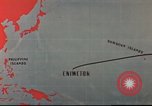
The sea voyage of the victory ship Hannibal Victory from San Francisco to the Philippine Islands during World War II. The ship underway in the Pacific ocean. Animated map locates Hawaiian Islands, Philippine Islands and Eniwetok. A man at the controls of the ship. Mountains in the foreground. Man flashes the blinker light for the purpose of signaling. Men watching other ships underway from the deck of the ship. A man watching through binoculars.
CRITICALPAST.COM: About Us | Contact Us | FAQs - How to Order | License Agreement | My Account | My Lightboxes | Shopping Cart | Advanced Search | Featured Collections | Website Terms & Conditions | Privacy Policy ©2026 CriticalPast LLC.
License Agreement |
Terms & Conditions |
Privacy Policy
©2026 CriticalPast LLC.