


 Francais
 Deutsch
 Italiano
Refine Your Search
Okinawa Ryukyu Islands 1972 stock footage and images
- Showing 895 to 900 of 4614 results more
more Hide
Hide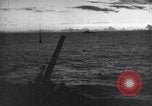
U.S. Task Force attacks Japanese positions on Island of Wotje in Gilbert and Marshall Islands during World War II.
Attack on Wotje Island, February 1, 1942. Crew members move F4F-3 Wildcat's and Douglas Dauntless SBD aircraft across crowded flight deck of the U.S. aircraft carrier, USS Enterprise (CV-6) during raid against Japanese positions in the Gilbert and Marshall Islands, by Task Force 8, of the U.S. Pacific Fleet, commanded by Vice Admiral William Frederick Halsey, Jr, during World War 2. Oversize U.S. stars are evident on the aircraft, at this early stage of the war (1942). Crewmen roll bombs, on dollies, across the deck. F4F Hellcat aircraft sit with engines running as some Douglas Dauntless aircraft commence take off. The destroyer USS Gridley, DD-380 passes abeam the Enterprise at time 00:37. A Curtiss SOC Seagull airplane catapults from the heavy cruiser USS Northampton, CA-26. Several U.S. aircraft seen in flight. View from stern of a U.S. heavy Cruiser as a destroyer crosses her wake, behind. The heavy cruiser USS Northampton, CA-26 and the heavy cruiser USS Salt Lake City, CA-25, in background (time 1:09 to 1:11) bombard Wotje island. Black smoke billows from a ship burning close to shore. Brief glimpse of the heavy cruiser USS Northampton, CA-26's triple battery of 8-inch guns. The heavy cruiser USS Salt Lake City, CA-25 fires a broad side. Scene from the stern of heavy cruiser with fires burning on Wotje Island in background. Formation of Japanese aircraft attacking U.S. ships are fired upon by antiaircraft guns. Black flak bursts seen in the sky. Vice Admiral Halsey consulting with other officers aboard his flagship, USS Enterprise.
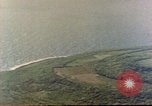
Aguiguan Island south of Tinian. P-38 in flight. Fleet at Ulithi anchorage in Caroline Islands. World War Two.
Scenes from Pacific theater during Second World War. Aerial view of Aguiguan Island south of Tinian Island in the Mariana Island chain. Aerial views of the Caroline Islands in vicinity of Ulithi atoll. A U.S. P-38 lightning fighter plane aloft near clouds. Aerial views of the U.S. fleet at anchor near Ulithi atoll.
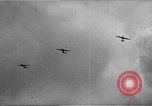
USAAF B-24 bombers drop bombs over target areas in Volcano Island and Yap island in the Pacific Theater during World War II.
U.S. bombings on islands in the Pacific Theater during World War II. Several aircraft in flight. A map showing a flight path from Volcano Island in the Philippines to Iwo Jima in Japan. On 10th August, 1944 : A United States Army air Force B-24 Liberator bomber aircraft in flight. Several B-24s in flight. The aircraft drop bombs over target areas and explosions occur. Smoke rises from the bombed areas. A map showing the flight path to Yap island. On 20th August, 1944 : A B-24 in flight drops bombs over target areas on Yap island. Smoke rises from the resultant explosions.
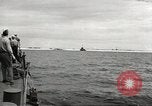
Japanese troops surrender Marcus Island and Wake Island in the Pacific Theater
Part of ceremonies marking Japanese surender and victory over Japan at end of World War 2. Japanese forces surrender Marcus Island on board USS Bagley (DD-386) in Pacific Theater. Japanese Rear Admiral M. Matsubara surrenders his garrison to U.S. Navy Rear Admiral Whiting. Japanese and Allied officers sign the papers of surrender. View in September of American flag being raised on Wake Island by U.S. Marines after Japanese surrender. Colonel Walter Baylor accepts honors at the ceremony, having been the last to leave Wake Island, and now the first to return. View of destroyed Grumman F-4 Wildcats that assisted in efforts to hold off Japanese forces for 14 days of attack, earlier in the war.
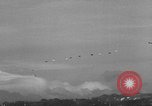
Aircraft fly over the island and drop paratroopers on Corregidor in the Philippine Islands.
Paratroopers landing on Corregidor in the Philippine Islands during World War II. A paratrooper descends. Many parachutes on the ground. An aircraft passes paratroopers descend to Corregidor. Aircraft pass over the island and drop paratroopers. Ships underway at sea. Paratroopers descend, many parachutes lay on the island in the background.
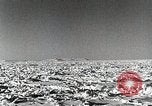
The icebreaker, USS Burton Island, breaking her way through ice sheets Northeast of St. Lawrence island, Alaska
The icebreaker, USS Burton Island, heading Northeast from St. Lawrence Island, Alaska, through ice field. View from bow, as she follows "groove" where ice field has separated and refrozen enabling the icebreaker to easily make way. As she progresses, the ice thickens and she slows, until the USS Burton Island finally stops. The ship's helicopter cranks up and warms up preparing to scout out easier pathways through the ice field. View from the low-flying helicopter, of a polar bear moving across ice flows. view of the icebreaker from returning helicopter. Since no "leads" could be found, the ship must use engine power. View of the engine room where sailors start more engines to increase the icebreaker's driving power. The icebreaker backs down from the ice sheet, and then as Captain calls for more forward power, a sailor on deck advances control, and the ship begins to break her way forward, through the ice.
CRITICALPAST.COM: About Us | Contact Us | FAQs - How to Order | License Agreement | My Account | My Lightboxes | Shopping Cart | Advanced Search | Featured Collections | Website Terms & Conditions | Privacy Policy ©2026 CriticalPast LLC.
License Agreement |
Terms & Conditions |
Privacy Policy
©2026 CriticalPast LLC.