


 Francais
 Deutsch
 Italiano
Refine Your Search
Okinawa Ryukyu Islands 1972 stock footage and images
- Showing 997 to 1002 of 4614 results more
more Hide
Hide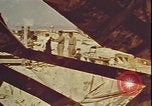
Funeral services for dead U.S. servicemen on Midway Island after Battle of Midway during World War II.
Burial services for fallen U.S. servicemen on Midway Island after Battle of Midway in World War 2. Chaplain before flag draped caskets. Marines give 3-volley salute. U.S. Navy Captain, USMC (US Marine Corps) Colonel Harold Douglas Shannon, and USMCR (US Marine Corps Reserve) Major James Roosevelt salute. Boats on water for burial at sea. Formation of aircraft. A Marine looks through binoculars. Smoke and flame rise from burning building on Midway Island. A man crosses out signs with paint brush indicating lost Japanese aircraft and battleships in Battle of Midway.
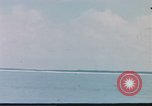
USS Bluegill (SS-242) reconnoiters and shells Pratas Island in the Pacific during World War II
Pratas Island in the Pacific Ocean, as seen from the deck of surfaced U.S. submarine, the USS Bluegill (SS-242) during World War 2. Barrel of deck gun seen. Japanese radio towers seen faintly in distance on the island. The boat shakes as its deck gun fires toward the radio towers. The Bluegill seen from another boat as she sits partially surfaced with small waves breaking over her deck. she submerges and then surfaces again. Huge explosions occur as demolition charges detonate destroying Japanese installations ashore. Dense smoke fills the area. A crew member stands on deck of the Bluegill, firing a rifle toward the shore.
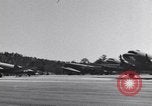
U.S. 801st Medical Air Evacuation Squadron tends wounded evacuated in C-47s from New Georgia Island, in World War II.
Sequence starts at Tontouta Air Base in New Caledonia, on the near left side of runway 2 in the area of the 13th Troop Carrier Squadron ( a.k.a. the Thirsty 13th) with their plane "Lady Eve" on the right. (The 801st Medical Air Evacuation Squadron was assigned to the 13th TCS on January 9, 1943, and remained with it until the end of the war. But they also flew on planes of the 63rd and 64th TCSs, and with the Marines.) Takeoff is on runway 11 at Tontouta Air Base. A pilot and a co-pilot at the controls in the cockpit of a C-47. A navigator at work. C-47s in flight west over New Georgia, 10 miles southeast of Munda, near Eghelo. The plane landing at Munda has no tail number and is probably a U.S. Marine Corps plane. They evacuate wounded soldiers from Munda airstrip on New Georgia Island in the Solomon Islands during World War 2. Doors of the aircraft are opened. An ambulance backs to the door of the aircraft. Litter patients are removed from the ambulance and loaded aboard the C-47.
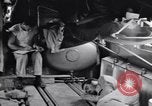
U.S. corpsmen treat wounded aboard a C-47 airplane flying over Munda airstrip,New Georgia Island, in World War II
U.S. 801st Medical Air Evacuation Squadron evacuates wounded soldiers from Munda airstrip on New Georgia Island in the Solomon Islands during World War 2. Interiors of a U.S. Army Air Force C-47 Skytrain transport airplane shows a medical corpsman giving water to a wounded soldier. A corpsman treats a patient with bandaged face and arms. Aerial view of a coastline. The C-47 approaches an airstrip, which appears to be Henderson Field on Guadalcanal, for landing. Litter patients are unloaded from the aircraft and placed into an ambulance.
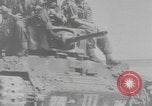
U.S. soldiers searching for Japanese prisoners and firing at their positions along a shore in the Solomon Islands.
United States troops in the Solomon Islands during World War II. Tactical maneuver of bypassing some Japanese held islands and advancing to more strategic positions is explained. U.S. soldiers aboard a tank advancing along a shore. Some of the soldiers walking along the shore. They fire at Japanese positions. Holding rifles they search for Japanese prisoners. Buildings on a field. The soldiers standing in front of the buildings. Dead bodies of Japanese soldiers lying on the field.
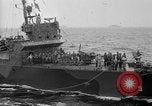
U.S. Marines land at the Solomon Islands and raise the U.S. flag during World War II.
United States Marines Corps on their way to invade the Japanese held Solomon Islands during World War II. A mail ship arrives and the Marines on the deck of the ship. U.S. Navy F4U Corsair aircraft in flight. Patrol boats underway. Marines on the bridge aboard a ship. The Marines climb down a landing net and come aboard a landing craft alongside the ship. Naval guns bombard Solomon coast. Landing crafts pull away. An aircraft in flight. Smoke rises from the coast due to bombarding. The landing crafts head towards a beach. Crafts arrive at the coast. Men put sand bags around a gun emplacement on the beach. A sign in Japanese. The United States flag being raised on the island.
CRITICALPAST.COM: About Us | Contact Us | FAQs - How to Order | License Agreement | My Account | My Lightboxes | Shopping Cart | Advanced Search | Featured Collections | Website Terms & Conditions | Privacy Policy ©2026 CriticalPast LLC.
License Agreement |
Terms & Conditions |
Privacy Policy
©2026 CriticalPast LLC.