


 Francais
 Deutsch
 Italiano
Refine Your Search
Okinawa Ryukyu Islands 1972 stock footage and images
- Showing 2131 to 2136 of 4623 results more
more Hide
Hide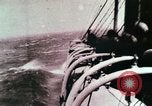
Europeans go through immigration processing at Ellis Island in the early 1900s
Mix of period footage circa 1910, retrospective interviews in 1975, and some still images. European immigration in bad travel conditions to America. View from rail on deck of a ship in heavy seas. An elderly European immigrant recalls his experiences of the journey on ship to America. Ship in Atlantic Ocean. Picture of European immigrants on ship deck. Statue of Liberty and Ellis Island. Early 1900s period footage of immigrants arriving at Ellis Island and disembarking from ship, then walking with luggage for processing at Ellis Island. Some immigrants peer across New York Harbor at the skyline of New York city. Scene change to 1975 and views of interiors of a no longer used building in Ellis Island. Names of persons carved on walls. A man shares his experience as an immigrant passing through Ellis Island, and then as an immigration inspector reviewing new immigrants as they arrived.
Immigration officers face problems in communicating with immigrants who speak different languages at Ellis Island circa 1910.
European immigration to America from late 19th Century to early 20th Century. Film begins showing closeup photographs of European immigrants at Ellis Island circa 1910. The segment involves difficulties dealing with various immigrants' languages. A man, who worked at Ellis Island early in the 20th century, recounts confusion about a Bulgarian interpreter's of an immigrant's answers to questions. Next, in 1975, an immigrant who went through Ellis Island in 1910, tells interviewer that in addition to normal questions, he was also asked if he was an anarchist. Closeups of Ellis Island Immigrant inspection officers. The former Ellis Island worker who spoke earlier about language confusion, is seen describing the way foreign Surnames were often misspelled and anglicized by recording officers. More closeup photographs of seemingly happy immigrants that ostensibly had been admitted to America. Views from and of an early type steam locomotive belching dense black smoke as it traverses open prairie land in America.
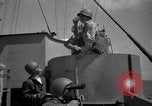
Guns aboard United States ship Minneapolis (CA-36) firing during the Battle of Wake Island in World War II.
Battle of Wake Island and Santa Cruz Island in Pacific Theater during World War 2. United States sailors on board the USS Minneapolis (CA-36). One of the sailors drinks from a glass and another one scans the sky during shelling of Wake island. 5 inch-25 caliber multipurpose guns trained skyward. Curtiss Scout observation plane (SOC Sea gull) warms up on catapult. Gun crew with helmets and masks, man their guns. Explosions occur from shelling of Wake Island. A ship strafed by aircraft. Smoke rises as shells drop in the sea. Turrets of guns trained to starboard as officer stands on a bridge. Wake Island being shelled and antiaircraft flak seen in sky. U.S. heavy cruiser fires. Main battery, 8 inch 55 caliber guns, firing from turrets aboard the USS Minneapolis as officers stand in the foreground. Antiaircraft guns firing.
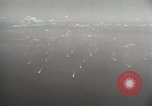
American campaign against Japanese-held islands in the Pacific during World War II
U.S. sea power in the Pacific Theater during World War II. Aerial view of landing craft speeding through the water below. Animated map of Pacific Islands including the Solomons, New Britain, and New Guinea. Shows arrows depicting American amphibious assaults on Russell Islands in February, 1943; on New Guinea, and Rendova in June, on New Georgia in July, on Eastern New Georgia in August, on Choiseul, in October, and Bouganvillle in November, 1943. Aerial view of a Pacific Island airfield. Grumman F4F aircraft with engine running on an aircraft carrier. Bow view of an American Essex class Aircraft Carrier making way in heavy seas. A Douglas Dauntless airplane heading away from a carrier (in background). Map showing locations of American North and South Pacific naval forces and arrows pointing to Tarawa Atoll in the Gilbert Islands, and then to the Marshall Islands (Kwajalein Atoll and Enewetak Atoll). American infantry marching with full field packs, at a port, where they board transport ships. An artillery field piece being loaded on the ship, along with landing vehicles tracked, and army trucks. A convoy of troop ships and supply ships at sea.
Parachutes land and C-47 Skytrains fly over Corregidor in the Philippine Islands.
U.S. Airborne 503rd Parachute Infantry Regiment prepare for the invasion of Corregidor in the Philippine Islands during World War II. Parachutes land on the island. United States Army Air Force Douglas C-47 Skytrains in flight over the island. The island is covered with a smoke screen. The parachutes land near barracks on the island.
Mixture of scenes from various U.S. amphibious assaults on Japanese occupied islands in the Pacific during World War 2
First scenes show United States Marines riding in a landing vehicle tracked (LVT) heading toward a Japanese occupied island in the Pacific. View from one of the landing craft of heavy smoke obscuring the island coast. Next, a dozen landing craft from the USS George Clymer (APA-27) are seen with mountains of the target island looming in the background. View from a different perspective shows several landing craft heading toward an inlet to the island. View from a landing craft of a Japanese Mitsubishi A6M "Zero" airplane flying overhead. Closeup of American soldiers in a landing craft headed toward a different Japanese occupied island. U.S. soldiers leaving a landing craft in the surf. View from inside a landing craft as U.S. Marines head ashore. Soldiers splashing in the surf. Troops wading ashore. Soldier dug in on beach near underbrush, firing many round from his Browning M1919 machine gun. Marine firing his rifle behind a palm tree. Troops seeking cover at very edge of shore. Some lying in the water, before moving on. A soldier firing an automatic weapon through foliage. A bomb explodes near an invasion ship. Troops descending on rope nets from the troopship, USS Crescent City (APA-21) and entering her Higgins boats. Heavy equipment and ammunition being offloaded from the troop transport ship. Marines coming ashore. An LVT in the background. Marines behind a barricade built by the Japanese. Marines throwing hand grenades and firing Browning M1919 machine guns. Flame throwers being used to force Japanese from strongholds. Marines gathered all along a shore line. A bulldozer driving along the waters edge. Soldiers rolling steel mesh across the sand. An antiaircraft machine gun with a side magazine mounted on a jeep, moves on the sand. Several ensuing scenes show flame throwers being used. Marines near a wrecked Japanese structure and then escorting a Japanese prisoner. A group of Japanese prisoners being spoken to by a Marine with a microphone. Marines hunkered down on a beach. One is cranking a hand powered radio transmitter. Front ramp of a landing craft is dropped down with a splash at waters edge. An M3A1 light tank drives off the landing craft. A truck being offloaded onto the shore. A heavy field artillery piece being moved into position. Troops work to move another field artillery piece into position. Trucks and other vehicles wading through shallow water as they leave an LST. Troops wading ashore from the LST. Trucks arriving on the shore. A tractor pulls a canvas covered vehicle. Soldiers ride aboard a light tank. Unusual view of troops assembled on shore of a mountain with ice seen in places on it (likely in the Aleutians). Crowded beachhead with LST 477 seen beached. Marines looking at destroyed Shore defense installation containing heavy gun. Remains of a 4-engine Japanese Kawanishi H8K2 (Emily) flying boat in the water. Seabees building an airfield with heavy construction equipment. Troops gathered around a Navy F4F aircraft that landed on the new (unfinished) airfield. Closeup of the smiling pilot climbing down from his plane. Troops saluting as the American flag is raised on remains of a Palm tree trunk, on Eniwetok, February 1944. Remains of a Japanese shrine and views of dead Japanese soldiers.