


 Francais
 Deutsch
 Italiano
Refine Your Search
Okinawa Ryukyu Islands 1972 stock footage and images
- Showing 2227 to 2232 of 4623 results more
more Hide
Hide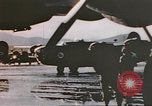
U.S. Air operations from Adak, and views of.the island's defenses during the Aleutians campaign of World War II.
As film begins, two U.S. B-24 bombers are seen taxiing across the Adak airfield to takeoff on a bombing run against the Japanese airfield at Kiska Island. Closeup of B-24 with engines running. About an inch of water covers the ramp. The two bombers take off (followed by others unseen). Airmen on the ground watch them depart. Scene shifts to the port of Adak. A cargo ship and a tugboat moving a barge are seen in the water. Trucks drive along the beachfront. Mountains loom in the background. Military supplies, including munitions are seen piled along the beach. Soldiers carry some goods over their shoulders. Closeup of items piled on the beach. A dog trots along with soldiers walking the beach. Change of scene highlights guns installed as coastal defense on the island, including fixed heavy guns, anti-aircraft guns and machine guns. A sailor viewed through a life safer buoy, paints part of a warship. A Navy PBY Catalina on patrol is seen overhead. U.S. gunboats patrol the harbor. Crew members are seen aboard a U.S. destroyer patrolling deep waters off Adak. They exchange blinker light messages with a Bancroft-class (four-stacker) destroyer. Glimpse of the Bancroft-class destroyer flashing blinkers lights. Sailors on a destroyer respond to alarm of sonar sound contacts and man battle stations. Closeup of a Bancroft-class destroyer, followed by views of depth charges being launched from a destroyer underway. Exchanges of blinker light messages between camera destroyer and a Bancroft-class destroyer.
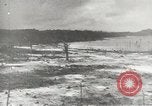
Steel meshes are laid for construction of airstrips and airplanes take off from Pacific islands.
Earth moving equipment on Pacific islands. A rough terrain and a later view of the same area as an airfield is constructed by equipment. Airplanes fly over a Japanese island. Beaches and pontoon bridges. Steel meshes are laid for construction of airstrips on Bougainville and in the Aleutians. An aircraft lands. Airplanes take off from a runway constructed by earth moving equipment.
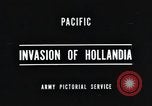
Allied troops capture the island of Hollandia, Indonesia under the leadership of General MacArthur during World War II.
Allied troops invade Hollandia, Indonesia during World War II. United States ships underway in the Pacific Ocean on April 22, 1944 to attack Japanese positions in Hollandia. The ships underway as United States Army General Douglas MacArthur looks at the convoy from United States cruiser USS Nashville (CL-43). Radars on alert in case of enemy attack. A United States destroyer transfers mail aboard the USS Nashville. Troops being briefed aboard a ship. Naval guns fire at the coast during night and flaks burst. American carrier planes bombard Japanese position on the island. Allied ships underway as planes fly overhead. Troops in landing crafts as they head for the beach. Allied troops disembark from the crafts and advance inland. Trucks, tanks and troops unload from landing crafts. Allied soldiers walk through mud as they advance. General MacArthur gets off Nashville and inspect an airfield under construction on the island.

OSS personnel relax as they swim, dive and float in their free time during a training in Nassau, Bahama Island (WW2)
A training of U.S. OSS ( Office of the Strategic Services) personnel for underwater demolition at Salt Key in Nassau, Bahama Island during World War II. OSS personnel of the underwater operations seated under trees as they eat sandwiches for lunch. Men work on their boats. Two men row boats. A man looks at a compass. Personnel learn about navigation at a beach. Men at the beach as they take lessons in infiltration. The Governor of Bahamas visits the island. OSS personnel lined as the Governor meets them. The men skin dive for recreation. Two personnel come ashore. A man on a floating platform with mascot dog Henry. The men swim and float on wooden platforms during their free time. The personnel practice shooting, navigation, handling boats and radio operations.
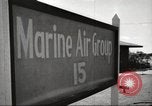
Aircraft takes off from Ewa Marine Corps Air Station for Guam in Mariana Islands.
United States Marine Air Group at Ewa Marine Corps Air Station, Hawaii. Sign reads 'Marine Air Group' at Ewa Marine Corps Air Station near Pearl Harbor, Hawaii. Aircraft taxis on an airfield. Marines get off the aircraft. Blinkers operate. Man talks into a radio. Sign reads 'Marine Transport Squadron 352'. Aircraft taxis on an airfield. Aircraft in flight. Aircraft passes over Johnston Island on its way to Guam. Aerial view of Guam Island.

Diagnosis of U.S. Army men suffering from dengue fever on an island in the South Pacific during World War II.
A film titled 'Breakbone Fever Dengue' shows U.S. Army personnel catching dengue fever on a South Pacific island during World War II. A U.S. Army medical officer reads out an official report on the outbreak of dengue in the South Pacific. U.S. troops on an island in the South Pacific. Men work on aircraft engines. Stationary planes on an airfield. U.S. soldiers on hospital beds and lined up outside a dispensary after catching up dengue fever. A close view of Aedes mosquito on human skin. Dengue casualties on hospital beds. Mosquito breeding places at a U.S. Army base shows water collected in rubbish heaps, fuel drums, coconut shells, cans and bottles and water in tires. A native village shows men walking towards a building in the background. Doctors examine patients in a hospital. The effects of dengue showing patients facing problems with eye movements and back pain. The body temperature chart of a patient. Men shows rash on the chest of a patient. A laboratory report after a diagnosis.
CRITICALPAST.COM: About Us | Contact Us | FAQs - How to Order | License Agreement | My Account | My Lightboxes | Shopping Cart | Advanced Search | Featured Collections | Website Terms & Conditions | Privacy Policy ©2026 CriticalPast LLC.
License Agreement |
Terms & Conditions |
Privacy Policy
©2026 CriticalPast LLC.