


 Francais
 Deutsch
 Italiano
Refine Your Search
Okinawa Ryukyu Islands 1972 stock footage and images
- Showing 2887 to 2892 of 4623 results more
more Hide
Hide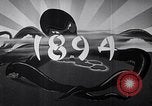
The Rise of Japanese militarism in the 20th Century
Film opens showing reenactment of Japanese attack ostensibly against Formosa, in 1894. Japanese troops and artillery are shown. The event is depicted in a critical political cartoon. Next, Japanese Admiral Heihachiro Togo is seen in 1904, standing with other naval officers. Then, Japanese warships are shown, firing barrages of naval gunfire at the Russian fleet in Port Arthur, Manchuria. Huge black clouds arise from burning ships. Scenes of Japanese people celebrating their naval victory. Date shifts to 1910. Cartoon depicts Japanese annexation of Korea. Cartoon illustrates Japanese actions in World War I when, siding with the Allies, Japan acquired the German-held Shandong (Shantung) Peninsula of China, as well as German-held Marianas, Carolines, and Marshalls islands in the Pacific. Japanese representatives are seen participating in Post World War 1 international activities. They signed the so-called Five-Power,Four-Power, and Nine-Power treaties, and participated in the League of Nations. Glimpse of two Japanese officers, followed by cartoon depiction of the Mariana, Caroline, and Marshall Islands, that Japan insisted on keeping. Cartoon shows them being fortified. A Japanese military marching band parades down a city street while being cheered by spectators on the sidewalks. Next, Japanese military General, Baron Tanaka Giichi, is seen in uniform with other officers. Cartoon illustrates the so-called Tanaka Memorial document that Baron Tanaka allegedly presented to the Emperor, in 1927, outlining a strategy to conquer the world. Cartoon then illustrates plan of conquest by acquiring Chinese manpower; Manchurian iron and coal; Siberian timber, coal, wheat, and metals; Tin,oil and rubber from Malaysia and the East Indies. The United States is shown as the last conquest. Views of ordinary farm and factory activities in the U.S. Cars parked in the Ford Motor Company factory lot. Japanese officials and legislators meeting in the Diet (Parliament). Japanese theater patrons and a Japanese woman singing with an American-style band, are shown as examples of activities the Japanese Government sought to discourage. A Japanese female ensemble in traditional dress, playing traditional instruments, is shown as more desirable. Western dancing and western hollywood movies are shown and narrator states they were forbidden by the Japanese government. Japanese movie scene depicts ancient martial arts. A musical production on stage displays German Nazi swastika flag , Japanese rising sun, and symbol of Kingdom of Italy, celebrating the axis alliance. Japanese men are shown playing the ancient game of Chu Shogi, instead of playing Western card games. People are shown in a library, where Western books are replaced by more militaristic tomes, such as: "If we fight" by Admiral Shinsaku Hirata, March 15, 1930 (shown on film slate). Slate goes on to quote about attack on Hawaii as the first battle in war of the Pacific. Film cites another approved Japanese publication: "Arguments Against American Policies" by Kawashima Seichiro, Christmas Day, 1924. It discusses distruction of the American fleet and subsequent landing on the U.S. West Coast.
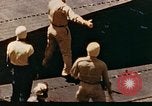
Ship Borne Dive-bombers strafe enemy sites in the Pacific.
Flight deck officers giving launch signals. Launch of aircraft on deck of carrier ship. Ship Borne Dive-bombers (SBD) formation in view. Torpedo bombers TBM Avenger makes a deck launch. Curtiss SB2C Helldiver in a diving run. SBDs in formation. Enemy buildings and dock area being strafed. Coastal area of island seen. Wooden area being strafed. Blasted hangars on enemy held island. (World War II period).

United States rushes to build new military bases in the Pacific during World War II
Local Pacific Islanders are seen in wooden dugout boats in the vicinity of U.S. Navy warships, in a bay during World War 2. Closeup of a man in one canoe with an outrigger. A boy sitting in one carrying a box of fruit. U.S. military engineers aboard a ship, look at shore with binoculars. Sailors in stern of a boat flying Naval ensign. Sailors on a barge, transport the fuselage and float of a OS2U Kingfisher Floatplane to an island, where they bring it ashore amidst grove of palm trees. Sailors roll 55gallon drums of fuel shore from a barge. A jeep is lowered over the side of a ship and driven ashore. Supplies, including foodstuffs, are brought ashore. Cartons containing canned corned beef; canned cherries, and many other foods, are stacked up in a warehouse. Engineers chart water depth in a bay as they mark boundaries for construction of a seaplane base. Caterpillar tractors level trees and clear land for the base. Soldiers install a 155mm long tom gun in position for coastal defense. Marines prepare temporary shelters of palm fronds. A U.S. Navy PBY Catalina seaplane flies overhead.
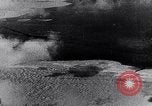
The December 7, 1941 attack on Pearl Harbor, as filmed from Japanese aircraft
Scenes filmed from attacking Japanese aircraft during the attack on Pearl Harbor, December 7, 1941. View from Japanese aircraft strafing and bombing U.S. aircraft and hangars on the ground at Ford Island. Japanese Nakajima B5N (Kate) tail number 229, seen flying past the camera plane. Smoke rising from the ground below. White plumes erupt from torpedoes striking U.S. ships on opposite side of Ford Island. Japanese-captioned still photographs: Of heavy black smoke rising from bombed fuel tanks; Of a torpedo hitting the USS West Virginia; of other ships on battleship row, including the USS Nevada, Arizona, Tennessee, Oklahoma, Maryland, and California. (World War II period).
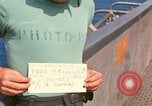
Aircraft launched from flight deck of USS Constellation at Yankee Station, Vietnam.
Operations aboard U.S. Navy's USS Constellation (CVA-64) at Yankee Station, Vietnam. A-4C aircraft moves onto catapult. Men on deck. Plane ready for launch. Aircraft in flight. A-4C aircraft launched from Number two catapult. Island in the far background. F-4B aircraft launched from angled deck. Catapult console operator with raised hands. He lowers his hands and presses a button. A-4C launched. RA-5C aircraft moves on catapult. Catapult crew under aircraft. Men hook up and check bridle. Men leave the area. RA-5C aircraft being launched from number one catapult. Catapult console operator on deck. F-4B aircraft ready for launch. C-2A aircraft comes in for recovery. Men wearing yellow shirt in the foreground. Plane rolls out with area. C-2A taxis toward in front of island. A-6A aircraft towed over deck by tractor. F-4B parked at deck edge between two other F-4B aircraft.
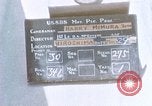
Destruction in Hiroshima, Japan from the atomic bomb explosion. View of flattened and damaged industrial buildings and rubble
Physical damage caused due to atomic bomb explosion in Hiroshima, Japan. Seven months after the blast, camera surveys area covered with rubble. Island between the Motoyasu and Kyobashi rivers with gas plant. Charred and flattened remains of buildings. Some buildings still standing but gutted. Various other buildings on the island. A crumpled steel frame building in the foreground. Various buildings affected by the atom bomb explosion.
CRITICALPAST.COM: About Us | Contact Us | FAQs - How to Order | License Agreement | My Account | My Lightboxes | Shopping Cart | Advanced Search | Featured Collections | Website Terms & Conditions | Privacy Policy ©2026 CriticalPast LLC.
License Agreement |
Terms & Conditions |
Privacy Policy
©2026 CriticalPast LLC.