


 Francais
 Deutsch
 Italiano
Refine Your Search
Okinawa Ryukyu Islands 1972 stock footage and images
- Showing 3169 to 3174 of 4623 results more
more Hide
Hide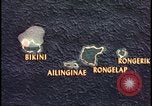
Animation predicts fallout path from Bikini Atoll atomic bomb explosion.
Animated map of Bikini Atoll area shows islands of Bikini, Ailinginae, Rongelap, and Rongerik. The predicted fallout radiation strength is posted for each area of the map with accumulated radiation doses to H+50 noted. The decreasing dose from 3000 to 1300 and then 800 is shown. A dotted line demonstrates path of fallout radiation over the Bikini Atoll area. Next, a map of the United States USA Eastern seaboard is shown with Washington D.C. as the origin of the atom bomb explosion and the fallout cloud extending to New York City.
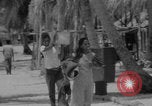
Native men and women carry belongings, push outrigger in shallow water during evacuation of Bikini Atoll
A man and a woman carry their belongings as they evacuate Bikini Atoll during U.S. preparations for nuclear weapon testing under Operation Crossroads. Their young children follow behind them. Native women carrying sacks and boxes on their shoulders. A man pushes a canoe loaded with boxes in the water. Bikini Atoll coast. A boy paddles with a small canoe. Native man pushes outrigger in shallow water (loaded with belongings). A moving DUKW. Belongings of island natives are gathered on the beach before evacuation. United States Navy personnel on LST (LST 1108) wait for natives.
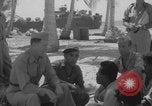
Commodore Ben Wyatt addresses natives of Bikini Atoll through interpreter
United States Commodore Ben Wyatt, the military governor of the Marshall Islands, addresses the natives of Bikini Atoll through his local interpreter James during “Operation Crossroads” (U.S. nuclear weapon testing program). Locals of Bikini Atoll sit down and listen to Wyatt. Other United States Navy personnel are present in the meeting. Interpreter speaks to the natives. A group of United States sailors gather outside a hut. They hold a sign that reads “CROSSROADS TAVERN”. Natives carry belongings and banana or pandan leaves toward LST. A woman carrying a large sack on her shoulders. Natives bring their belongings into a United States LST (Landing Ship, Tank). An outrigger loaded with boxes floats near the LST.
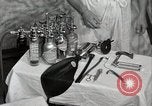
1st U.S.Marine Corps Medical Battalion surgeon attends to wounded U.S. Marine in tent, Bougainville, Papua New Guinea.
Physician of the 1st United States Marine Corps Medical Battalion performs surgery on a wounded U.S. Marine in a tent at Bougainville, Papua New Guinea, within the Solomon Islands archipelago. Surgeon prepares instruments for operation. Patient is given anesthesia via inhalation. His back shows large cut swabbed with antiseptic. The patient is given intravenous injection. Surgeon performs a thoracotomy incision on patient's chest to remove shrapnel from his thoracic cavity. The lung is visible in the wound as a retractor is placed to expose the inside of the chest. The surgeon removes the shrapnel and places it on piece of cloth. Surgeon reapproximates the ribs using wire suture. Chest tube is inserted. Doctors dress the wound with gauze. Attending medical staff wipe face of patient and doctor with clean cloths. X-Ray of the patient shows pieces of shrapnel in his chest.
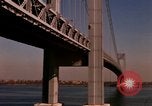
Vessels pass under the Verrazzano Narrows Bridge in New York. Views of the Verrazzano Narrows Bridge from Fort Wadsworth
Boats and ships in the "The Narrows" (tidal strait for Hudson River between Upper and Lower New York Bay) in New York. They pass under The Verrazzano Narrows Bridge. Ground Level views of the Verrazzano Narrows Bridge from Fort Wadsworth on Staten Island.
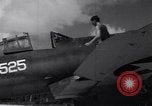
Pilot and plane captain of F4U aircraft perform engine start during World War II in the Pacific theater
Location looks like Espiritu Santo in the New Hebrides Islands, during World War 2. Palm trees in background. The weather is clear and sunny. Plane captain, in shorts, climbs into cockpit of an F4U corsair airplane of Marine Aircraft Group 11 (Number 525 on fuselage). Marine pilot hands him his seat pack parachute, which the plane captain places into the seat. The pilot climbs into cockpit, as plane captain stands on right wing and gives thumbs up for engine start. The engine does not start, so he walks along wing to check the engine. The scene is repeated, with plane captain scrambling over the fuselage again to a position on the wing for engine start. This time the engine starts. He clambers back to cockpit and helps pilot with his shoulder harness. Another view of this shown in closeup from left wing of the aircraft. View from in front of the aircraft, as engine starts, and plane captain steps up to help pilot with shoulder harness.
CRITICALPAST.COM: About Us | Contact Us | FAQs - How to Order | License Agreement | My Account | My Lightboxes | Shopping Cart | Advanced Search | Featured Collections | Website Terms & Conditions | Privacy Policy ©2026 CriticalPast LLC.
License Agreement |
Terms & Conditions |
Privacy Policy
©2026 CriticalPast LLC.