


 Francais
 Deutsch
 Italiano
Refine Your Search
Okinawa Ryukyu Islands 1972 stock footage and images
- Showing 3505 to 3510 of 4623 results more
more Hide
Hide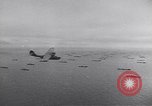
U.S. Engineers work to construct supply routes throughout the world during World War II.
PBY Catalina aircraft seen inflight above an Allied convoy of ships at sea. Closeup of British flag displayed at stern of one ship. A destroyer escort in the convoy. U.S. Army engineers creating a road in an area of wilderness. A steam shovel empties its bucket into a truck. A surveyor taking readings with a transit. Two graders moving side-by side as they level a new road A tractor pulling a drum compactor. A vehicle drives on a mountainside road built by Army engineers. Snow covered mountains seen in background. Animated map showing far flung places where military supplies had to be delivered during World War 2. An open Army truck carrying American troops on Guadalcanal in the Pacific. U.S. soldiers walking on a pier at Attu in the Aleutian Islands of Alaska. American soldiers arriving at a pier in Accra, Gold Coast. Soldiers hold the American flag on a hilltop in Casablanca, French Morocco. Chinese Generalissimo Chiang Kai-shek and Madame Chiang, in Chungking. American troops in foul weather gear neat tents in Kiska, the Aleutians. Troops offloading from a troop transport ship in Cairo, Egypt. Troops in Algiers, and in Sicily. Troops hitting the beach in an amphibious assault.
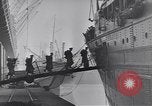
U.S. Army Service Forces transporting troops and supplies worldwide during World War II.
U.S. troops board a large troop transport ship via a gangplank. Troops on an intermediate deck of the ship. Some are sprawled out relaxing. View from above of more troops boarding a ship. Men and equipment on the pier below. American forces at various far flung places where the U.S. Army Services Forces facilitated their transport and logistic support. Fleeting glimpses of troops in: Ireland; Alaska; Trinidad; and South America. Troops jam the upper deck of a transport ship. Army Service Forces officers in a planning meeting. Naval officers on deck of a ship look through binoculars as U.S. Naval ships bombard the coast of Solomon Islands and landing craft carry marines in an amphibious assault. Next, a man is seen annotating a map of North Africa. Secret maps pertaining to Allied landings in Tunisia and Algeria. Animated map illustrates amphibious landings on North African coast, highlighting Casablanca, Oran, and Algeria. Landing craft carry troops and supplies that are piled up in the sand beach. Soldiers moving military supplies ashore, in fire brigade fashion. Soldiers working at desks in Offices of the Army Service Forces. Filing cabinet in background. Trucks on the move in remote locations. Supply ship being loaded at a terminal. Fuel drums and army vehicles a being loaded aboard ships. Officers seated at a conference table. Ordinary American enlisted soldiers in a griping session at an Army post in the United States. Camera pans over large formation of soldiers. Animated chart shows more than half of servicemen who are part of Army Service Forces (ASF), are unaware of that. Troops marching in review at a tropical location, where reviewing officers wear pith helmets. Chart illustrates lack of unit pride in ASF. Images of various ASF logos. Chart shows results of polling data from soldiers and service members. Signal Corps and Engineers elements of ASF have the greatest unit pride. But most think better of other branches of the Army. More troops marching, in steel helmets and carrying rifles with bayonets affixed. Troops marching overlaid by "50%" indicating that half don't believe their contributions to the war effort are significant. Troops lined up (for pay?). More charts expressing concern about low morale. A heavy gun firing. German paratroopers jumping from a formation of Junkers Ju 52 aircraft. Charts expressing prevailing U.S. troops view that Germany wouldn't be too hard to defeat. Chart showing lack of understanding about why the U.S. is fighting Germany. Image of President Franklin D. Roosevelt and Prime Minister Churchill seated in front of their key military officers at Casablanca Conference in World War 2. Chart shows U.S. soldiers believe that the greatest war effort is expended by the U.S. followed by Russia, with China and Britain providing little. Chart illustrates that only half U.S. troops want to get overseas and fight. Chart shows U.S. War Department films can correct this problem.
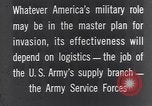
Commanding Generals of U.S. Army Services Forces and their missions are reviewed in this World War II film
Film starts with view of the U.S. military headquarters Pentagon building in Virginia, as seen from Columbia Island, across the lagoon, in World War 2.. Closeup of the building. Inside, Lieutenant General Brehon Burke Somervell , Commander of the Army Service Forces (ASF) is seen presiding over a staff meeting that includes seven Major Generals, who head the ASF technical services. Flag of the Quartermaster Corps seen in closeup. Officers of that organization are seen meeting. Scene shifts to a warehouse where military supplies are being moved on trailers pulled by small tractors. Carts filled with equipment are seen. Men prepare some for transport to America's allies overseas. Men fill packages with articles of clothing. A sign reads: "Maj. Gen. Reybold, Chief of Engineers." Engineers officers at a conference table rise as their Commander, General Reybold, enters. He sits and they begin their meeting. Closeup of staff officers in the meeting. Officers walk through a section of the Army Map Service, where cartographers, draftsmen and others are busy at tables creating maps. One of them is seen fitting several aerial photographs together to form a detailed map. A cartographer at the mapping service is seen annotating a map of the Marseille area of France. Views of high speed offset presses printing large scale maps for the military. A sign identifies the office of the Chief of Ordnance. Staff officers of that office are seen at work. Closeup of small arms being placed in a shipping box. An open yard filled with M24 Chaffee light tanks. A vast yard at a railroad siding, containing countless tanks on one side and building materials on the other. Sign inside the Pentagon at office of Major General H.C. Ingles, Chief Signal Officer. Closeup of General Ingles at his desk. Members of his staff consult with him. Sign at office of the Chief, Chemical Warfare Service. Major General William N. Porter, the Chief, looks over maps with several staff. Troops training under gas attack and smoke screen conditions. The entrance to the office of the Surgeon General of the U.S. Army. Inside, Major General Norman Thomas Kirk , Surgeon General, confers with a Colonel. Maps of areas where disease poses a threat to U.S. military forces. Office of Major General C.P. Gross, Army Chief of Transportation. Inside He holds a meeting with members of his staff. View of a pier where military supplies are being offloaded by means of derricks.
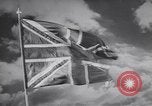
Scenes of World War II spanning several years, primarily from the European theater of operations, and operations of U.S. Army forces.
Montage of World War II scenes in rapid succession, including: British flag flying; British civilian men looking through debris and victims of Japanese bombing in China; a German armored car moving rapidly; Heavy artillery pieces firing; German SdKfz 251 half-track armored personnel carrier rushing past the camera; The German Nazi flag flying from the Eiffel Tower in Paris, France; German troops marching through the Arc de Triomphe (Arch of Triumph) as they occupy Paris; New York Times newspaper headline reading: "Nazis execute 50 French hostages in Bordeaux!" French Army prisoners of war; British Colonial troops in a labor gang; German Messerschmitt Bf 109 aircraft in flight; French refugees fleeing advancing German forces; Momentary closeup of ME- Bf-109 firing guns and then climbing away from roadway filled with refugees. Animated illustration showing shadows of German bombers flying towards Britain. Numerous dead civilians, victims of Axis military actions in various parts of the world. The White cliffs of Dover. Formation of German Heinkel HE-111 bombers coming over England. Aerial view from above of numerous German Ju 87 Stuka dive bombers in flight. British Royal Air Force airman ringing alarm bell and RAF pilots scramble; responding by running to their spitfire aircraft, taking off and climbing to intercept German bombers. Closeup of one pilot in his cockpit during dogfight. A formation of three German Ju 87s seen from below. Gun camera glimpse of one being shot down from behind. An aircraft shot down and crashing. German aircraft bombing England at night during Battle of Britain (1940). Point of view shots from inside German aircraft during blitz over Britain, with aerial views of explosions and fires on ground in England. Narrator mentions Coventry as a target. Smoking ruins from German blitzkrieg bombing. Aerial views of areas bombed by German aircraft. British civilians carrying coffins and lowering them into grave sites as they bury victims of Nazi German bombing. Closeup of the shoulder patch worn on uniforms of soldiers in the U.S. Service Forces. Views of war materiel in warehouses and being loaded aboard ships destined to the war zones. American soldiers on a Pacific island. United States Army soldiers engaged at communications centers and using radio and radar antennae. Military equipment and weapons being moved by railroad train. Military supplies being loaded on rail cars and railroad trains running on tracks. U.S. troops on a beachhead following an amphibious landing. A British soldier eating bread. Two American soldiers drinking from cups. Closeup of a military police "MP" armband. Large formation of marching U.S. soldiers. Closeups of soldiers in the field, using radio telephones, cutting through barbed wire, looking out of ship porthole windows, and some simply posing momentarily for the camera. A U.S. Army soldier showing the "V" for victory symbol with his hand.
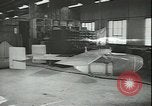
U.S. Army signal corps develops and tests a television guided missile bomb
Film starts showing so-called "Television Bomb"guided missle. Closeup of television controls in the missile. View of the guided missile mounted underneath a B-17 bomber in flight. Guidance operator seen inside the bomber. The television bomb drops away from the bomber. View of the operator inside the bomber watching a television picture transmitted from TV camera in the missile nose. He uses radio controls to steer the bomb toward a test target. The missile explodes on an isolated small island test site.
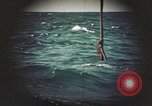
Coastline of Bali being bombed during World War II.
Periscope view of the Pacific Ocean during World War II. Some objects float in water. Enemy coastline of Bali island being shelled. Mountains in the background.