


 Francais
 Deutsch
 Italiano
Refine Your Search
Okinawa Ryukyu Islands 1972 stock footage and images
- Showing 3787 to 3792 of 4623 results more
more Hide
Hide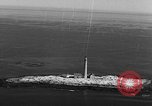
Lighthouse, coastguard station and small sailboats in an open harbor in the United States.
Lighthouse and coast guard station in the United States. Aerial view of a light house that appears to be on an island. Building at Coast Guard station in Gloucester, Massachusetts. Open harbor; small sailboats and ships in harbor.
U.S. Navy Sixth Fleet Commander Vice Admiral Martin with Rear Admiral Geis aboard USS Independence in the Mediterranean Sea.
20th anniversary of U.S. Navy Sixth Fleet aboard USS Independence (CVA-62) in the Mediterranean Sea. U.S. Navy Sixth Fleet Commander Vice Admiral William I. Martin, welcoming official guests upon their arrival on the flight deck of the USS Independence (CVA-62). Vice Admiral Martin chats with Rear Admiral L.R. Geis, Commander Carrier Division Four on the flight deck. An aircraft parked in the background. PH unit is seen in foreground. The island in the background. Sideboys standing in the background at attention. Vice Admiral Martin interviewed on the flight deck. Vice Admiral Martin and Rear Admiral Geis standing on the flight deck. Vice Admiral Martin is interviewed by a reporter and holding a mike. The aircraft in the background. The reporter completes his interview and walks off. Vice Admiral Martin and Rear Admiral Geis pass over the flight deck. Rear Admiral Geis standing in the mid background. A part of the flight deck crane (utility crane) seen overhead. Rear Admiral Geis and Vice Admiral Martin standing on the flight deck with the U.S. Navy missile destroyer USS Barney (DDG-6) seen along side. View of the USS Barney. The USS Barney along side USS Independence. U.S. Navy ASROC (for Anti-Submarine ROCket) Launcher in the mid deck area, training around. A radar antenna in motion on the USS Barney. The port bow of USS Barney. Tillie crane hook hangs. The USS Barney, begins to move out from the side of USS Independence. The tail of a KA-3B aircraft in view.
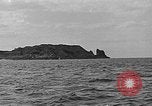
U.S. soldiers greeted in the Town of Milly, France, during World War II.
United States soldiers greeted in Milly, France. View of an island from a rowboat. U.S. soldiers walk in single file along the sides of street in Milly, France, and are greeted by civilians. The civilians standing on either side of a road. Local officials speak to a large gathering of citizens. Townspeople parade down a street, led by several citizents playing musical instruments. An M4 Sherman tank maneuvers past a soldier and a horse. Truckloads of U.S. soldiers move along a road.
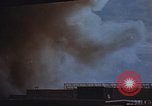
U.S. Navy engages Japanese fleet in Battle of Midway during World War II
Battle of Midway in the Pacific Ocean during World War 2.Opening scene shows fires burning and destruction on Midway Island while Japanese bombers are attacking. U.S. marines firing machine guns and antiaircraft guns, creating numerous black flak clouds among attacking Japanese aircraft. A burning aircraft descending to crash in the sea. Japanese bombs bursting nearby and Marines in a jeep driving past burning aircraft. More bombs exploding. A Marine medical corpsman wearing a Red Cross armband. A Japanese plane streaks low across the sky and a drops a bomb that explodes raising a huge cloud of black smoke from a petroleum fire on the ground. Camera focuses on the huge flames and smoke rising from the oil fire. Closeup of Marine firing heavy machine gun. A Japanese aircraft is struck and the sound of a failing engine is heard. Fire and smoke is everywhere. Next, the sound of a falling aircraft intensifies and a Japanese plane is seen crashing with a huge explosion. Closeup of a burning wing from the aircraft with Red ball insignia visible. Scene shifts to the sea, where American aircraft are flying cover over U.S. warships maneuvering below. View from a U.S. warplane taking off from an aircraft carrier. A loose formation of Douglas SBD Dauntless aircraft in flight above clouds. Aerial closeups of some in the formation, including one showing pilot in front cockpit and gunner in the rear. Next, Navy F4F Wildcat and Douglas Dauntless aircraft are seen being launched from a Carrier, where sailors are firing 1.1" quad AA guns, creating numerous black flak clouds in the sky. A 5-inch gun creates a huge ball of fire as it fires. More shots of quad AA guns and 5-inch guns firing, as aircraft continue to launch from carriers. Brief view of the U.S. aircraft carrier, USS Yorktown (CV-5) obscured by smoke from Japanese bombs hitting her boiler. The Japanese aircraft veering away from it after their attack. More views of anti aircraft guns firing from the camera ship (an aircraft carrier) and of Japanese aircraft attacking. Another brief glimpse of the USS Yorktown clouded by smoke. Sound of an airplane crashing into the sea and glimpse of pleased American Navy officers and sailors. More glimpses of the Yorktown billowing black smoke.
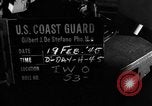
Men on deck of LST watch as Japanese ammunition dump burns in Iwo Jima, Japan during World War II.
Landing crafts underway off the shore of Iwo Jima during the Battle of Iwo Jima of World War II. Japanese ammunition dump in flames. Men on deck of LST (Landing Ship Tank) watch in the foreground. LSTs (Landing Ship Tank) lined up on a beach and other landing craft underway. Landing craft loaded with U.S. troops, head towards the beach. Plane flies over an island.
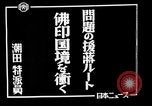
Japanese forces occupy Vichy French Indochina in the Second Sino Japanese War (WW2)
Japanese forces occupy part of Vichy French Indochina during 2nd Sino Japanese War and World War II. Animated map shows Leizhou (luichow) Peninsula and Hainan Island of China opposite the North Central coast of North Vietnam, centered at Haiphong harbor. Lines appear showing the path of Japanese troops occupying North Vietnam from Haiphong, in two sweeps to Northeast and Northwest and circling towards Hanoi. Mountainous terrain of the region is shown. Camera pans down a sheer cliffside in the mountains. Narrow roads are shown carved in the mountains and hills. A Japanese sentry stands at a sandbagged outpost, displaying the Japanese flag. A solitary building sits atop a hilltop in the background. A concrete marker indicates distance of 171 km to Hanoi. Several Japanese engineers make their way to the top of a mountain, accompanied by soldiers. An abandoned French heavy gun is seen in a concrete emplacement. View of Japanese soldiers looking out from the hilltop. A sign along a mountain road reading "Keep to the right," in French, English, and Japanese. Soldiers gather around a large tree fallen across the mountain road. They pose for the camera next to the tree. Japanese officers walking through an archway, from a large building in background. Closeup of barrel containing portland cement, followed by view of many such barrels being examined by Japanese engineer.
CRITICALPAST.COM: About Us | Contact Us | FAQs - How to Order | License Agreement | My Account | My Lightboxes | Shopping Cart | Advanced Search | Featured Collections | Website Terms & Conditions | Privacy Policy ©2026 CriticalPast LLC.
License Agreement |
Terms & Conditions |
Privacy Policy
©2026 CriticalPast LLC.