


 Francais
 Deutsch
 Italiano
Refine Your Search
Okinawa Ryukyu Islands 1972 stock footage and images
- Showing 4393 to 4398 of 4614 results more
more Hide
Hide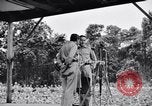
Bob Hope and Jerry Colonna of Bob Hope Troupe entertain U.S.soldiers on Bougainville during USO tour in World War II
The Bob Hope Troupe on U.S.O tour in the South West Pacific in World War 2. They entertain U.S. soldiers on Bougainville. Their guitarist Tony Romano, together with Hope and Jerry Colonna, sing "If I had my way." They pause to remedy some microphone problem, and then continue. The guitarist then sings in solo falsetto and Bob Hope follows with comic banter about being a private in the army. The trio finishes by finishing the song together.
Wrecked airplanes and P-38 operations on Henderson Field, Guadalcanal, during World War II
U.S. military personnel working at end of Henderson airfield on Guadalcanal during World War 2. One pushes a wheelbarrow. Camera pans across and along runway to P-38 aircraft parked haphazardly in grass. It continues to pan, showing lots of damaged aircraft and parts, including several P-40s. Mechanics work on one of the P-40s. A fuel truck passes. Tents are seen behind the piles of parts and aircraft. Numerous auxiliary fuel tanks are piled up in one area. Broken aircraft parts are seen in a ditch off the side of the runway. Trees and foliage are in the background with tents pitched amongst them. As the camera continues to pan farther down the runway, it reveals more orderly campsites, with tents and laundry drying. Mechanics work on the engine of a P-38 parked on a sandy ramp. Palm trees and water seen in background. More P-38s are parked in good order. Scene shifts to a P-38 taking off. It is followed by a second, and then a third, all taking off in quick succession.
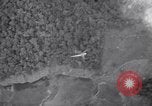
United State H-6 helicopter flies over and lands at Luzon,Philippines during World War 2
United States H-6 helicopter flies over wooden terrain in Luzon,Philippines during World War II. It approaches a clear area along a mountain road with a building as a number of locals stand there. H-6 lands and local children gather around the helicopter. Later it lifts off.
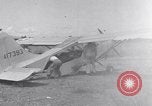
United States L-5C aircraft serves as air ambulance for carrying stricken soldiers in Luzon, Philippines after World War II.
U.S. Army pilot and ground crewman inspect litter space on L-5C, tail number 44-17383. The aircraft taxis past a parked Sikorsky R-6 helicopter and takes off. Four pilots in flight suits converse near two L-5s. Large group of Philippine children gather behind them. A U.S. soldier (Corporal) is brought on a stretcher and placed on ground near the L-5C. The children gather all around to watch. They are led away about 50 feet from the airplane, as the stricken Corporal is loaded into the Stinson L-5C air ambulance aircraft. A trailing slate reads: "Survivors MACASPAC"
U.S. Stinson L-5B aircraft and Sikorsky H-6 helicopter carry wounded soldiers in Luzon, Philippines, after World War 2
United States Sikorsky H-6 helicopter carrying wounded soldiers lands in Luzon,Philippines, after World War II. Five men look at the wounded soldier as he is released from a litter pod. A man lying on stretcher in Stinson L-5B smokes a cigarette. A wounded soldier inside an L-5B air craft as Philippine children stand near the plane. L-5B takes off and is refueled later. Natives and military men stand near an H-6. An H-6 lands carrying a wounded soldier. Soldier is taken out of H-6.
Units of United states 14th Corps capture Clark Field as they advance toward Manila, Philippines, during World War II
American troops in their drive toward Manila, in 1945, during World War 2, pass several knocked out and burning Japanese Type 89 Chi-Ro tanks. A dead Japanese soldier, shot dead while trying to commit suicide, lies on the ground with an undetonated hand grenade in his mouth. U.S. M4A2 sherman III tanks and infantry of the XIV Corps moving on the Lingayen Plains Philippines, leading to the capital, Manila. U.S. armor towing artillery ford a stream, as they pass beneath framework of an apparently unusable bridge. A battery of U.S. M101 105mm Howitzer artillery pieces is set up and bombards the Clark Field area. One striking shell produces an explosion, fire and column of black smoke. U.S. troops ride forward atop tanks. Glimpse of one soldier with flamethrower tanks on his back. American tanks firing their guns. Destroyed Japanese aircraft on the ground. A soldier using a mine detector to sweep the area. He signals to another soldier who comes to probe the area with a long knife. Next a soldier is seen standing in a hole dug around a bomb Placed nose up under the ground by the Japanese. Soldiers pull it from the hole, using a rope. U.S. soldiers walk in area full of similar holes and bombs pulled from them. General Douglas MacArthur is seen, on January 26, 1945, walking among remains of Japanese aircraft at Clark Field. He visits the Filipino cemetery at Camp O'Donnell, which was a prisoner of war camp, considered the terminating point of the Bataan Death March, where some 20 thousand Filipinos and almost 2 thousand Americans died during the Japanese occupation of the Philippines. MacArthur is seen standing by a large Christian Cross monument, and walks among untended graves marked with small wooden crosses. The Mount Pinatubo volcano is seen on the horizon in the background. MacArthur and those accompanying him walk around a large monument containing a placard written in tagolog. U.S. soldiers start a mortar barrage against Japanese forces dug in on "Hill 70." Infantrymen move through trees and brush to flush out the entrenched enemy. Glimpse of type of improvised device made of explosives and gasoline, that U.S. soldiers are using to drive Japanese troops out of their fortifications. As a soldier watches with binoculars, the camera records several of these devices exploding with great force. Glimpse of a dead Japanese soldier on the ground. U.S. troops ride atop an M18 Gun motor carriage of the 637th Tank Destroyer Battalion, as it crosses a river. American tanks and infantry moving cautiously across a bridge as shells explode ahead of them. Tanks firing at Japanese troops entrenched in hillside above a road. Large numbers of American infantry marching along a road accompanied by tanks. Areas around them burning from fires set by retreating Japanese forces.
CRITICALPAST.COM: About Us | Contact Us | FAQs - How to Order | License Agreement | My Account | My Lightboxes | Shopping Cart | Advanced Search | Featured Collections | Website Terms & Conditions | Privacy Policy ©2026 CriticalPast LLC.
License Agreement |
Terms & Conditions |
Privacy Policy
©2026 CriticalPast LLC.