


 Francais
 Deutsch
 Italiano

Refine Your Search
Panama 1969 stock footage and images
- Showing 613 to 618 of 1052 results more
 Hide
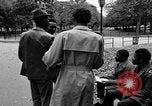
Ernest Green works to provide job education and construction trade jobs to black citizens in New York City
The work of African American civil rights leaders in the United States. Ernest Green, one of the "Little Rock Nine" students, encourages black apprenticeships in building trades. Through his work at the Recruitment and Training Program, or RTP, Inc., in Brooklyn, New York City, Ernie Green reaches out and speaks to young black men in need of jobs. Young black workers without jobs stands outside a fenced area and look in at white men working at a construction site. Young black men unemployed on street corners and in front of shops. African American children on a city street, bundled in coats and walking to school. Ernest Green reflecting on the difficulty for black young men in getting jobs and in feeling welcome in the work force. Two young black men talking on a city sidewalk, looking in store windows, and then talking and doing a multiple step hand shake. Blacks in a classroom coaching young minority men in preparation for a sheet metal or other building trade union qualification test. African American men with construction jobs are seen laying bricks for a new building, working with steel beams, pouring cement, and constructing a building. Black workers install building windows and work with a torch on steel girders.
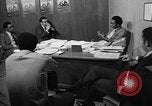
Ernest Green in a meeting with other officials in New York, planning programs to train unemployed youth.
The work of African American civil rights leaders in the United States. Ernie Green, leader of the Recruitment and Training Program. or RTP, Inc. in Brooklyn, New York, is seen in a meeting with officials. Green and others working to create construction trade training opportunities for young unemployed African American men, and any young man who needs assistance. Black and white students exit an integrated high school. African American men and women stand in a queue to cast their votes in an election as narrator notes increase in black voting. Scenes of African American citizens in voting booths. An African American politician running for office greets voters on the street.
Night Observation Device being installed on a Lockheed AC-130 in Thailand.
During the Vietnam War, airmen are seen lifting a Night Observation Device (NOD) or Starlite Scope, into an AC-130 Gunship. Closeup of airman's hand fastening cable connection and sleeve, to install it. Views of two airmen connecting additional cables as part of the installation. One of the airmen seated at the controls rotates the unit around and checks its vertical motions. He tightens two connections and then steps away from the unit.
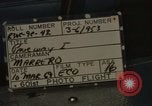
The dropping of Mk 84 laser guided bomb from F-4D Phantom jet during Vietnam War.
Paveway I laser guided bomb carried by fighter bomber in Vietnam. Aerial view over wooded terrain of a U.S. Air Force F-4D Phantom jet, from Ubon Air Base in Thailand, descending and, while still at fairly high altitude, releasing a 2000 lb Mk 84 laser guided bomb against Viet Cong ground target.
Major Williams explains the operations of laser guided bombs through diagrams and graphs at Ubon Air Base in Thailand.
Major Williams gives information about laser guided bombs at Ubon Air Base in Thailand . He points to photographs, maps and tactics charts. He provides information about Paveway, the laser guided bombs and their tactics. He explains a diagram to describe the operations.
U.S. Air Force photo interpreters view prints and photographs of targets and interpret them at Ubon Air Base in Thailand
Interpretation of the photographs of laser guided bomb strikes. U.S. Air Force Photo interpreters, Major Mills and 1st Lieutenant Davison view the prints and KB-18 negatives. The photographs are pasted on a board on a wall at Ubon Air Base in Thailand.