


 Francais
 Deutsch
 Italiano
Refine Your Search
Phu Cat Air Base Vietnam 1969 stock footage and images
- Showing 6661 to 6666 of 13375 results more
more Hide
Hide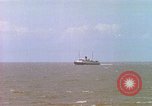
Postwar development of air transportation in Europe
Development of transportation in Europe after World War 2. An ocean-going ship is seen plying the waters of an estuary. A white tower is seen with moving radar antenna on top. A radar operator works in front of radar screens in the control room. He wears headset and microphone. Narrator notes how radar helps navigation in crowded estuaries like the Scheldt. Captain onboard ship ostensibly speaking to the radar operator. Another radar antenna rotating rapidly. A British European Airways (BEA) Vickers VC. 1 Viking airplane at Schiphol Airport (Evert van de Beekstraat 202, 1118 CP Schiphol, Netherlands) in Amsterdam. Glimpses of European airlines using the Douglas DC-3 aircraft such as the Belgian SABENA, Polish LOT and Scandinavian Airlines (SAS). A TAP Air Portugal (Transportes Aéreos Portugueses) DC-6 parked, and a KLM Royal Dutch Airlines (Koninklijke Luchtvaart Maatschappij) DC-6, named the “Vliegende Hollander”, taxiing. An Air France Sud-Est SE-161 Languedoc 4-engine aircraft, taxiing. View of control tower and related buildings at the airport. A person marking a carton for air delivery. A man loads parcels from his automobile trunk, into a Scandinavian Airlines DC-3 aircraft. Venue shifts to Orly airport (94390 Orly, France) in Paris, France, where a DC-6 airplane sits in front of a terminal building. Airport staff prepare to welcome a dignitary, including uniformed brass band seated at an awninged pavilion, and a military honor guard. A DC-4 aircraft parked in nearby background. A party welcomes the President of France, Vincent Jules Auriol, arriving on an Air France Lockheed Constellation airliner. A large contingent of Army troops are assembled in formation to honor the arriving President. He strolls across the ramp, accompanied by a French general and an admiral, among others. He climbs stairs of the pavilion as the band plays La Marseillaise (National Anthem).
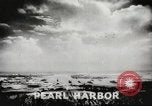
Japanese air attack on Pearl Harbor blows up U.S. battleships and destroyers in Honolulu, Hawaii during World War II.
A 1943 film about the December 7, 1941 Japanese air attack on Pearl Harbor in Honolulu, Hawaii during World War II. Film blends dramatized scenes with actual historic footage from the event. Formations of Japanese bombers approach Pearl Harbor. USS Arizona (BB-39) bombed. U.S. personnel aboard USS Arizona as the ship is bombed. Smoke billows up from the explosion. U.S. sailors aboard USS Oklahoma (BB-37). USS Oklahoma and USS California (BB-44) are bombed by Japanese aircraft. U.S. troops fire machine guns at Japanese aircraft. USS Cassin (DD-372), USS Downes (DD-375), and USS Pennsylvania (BB-38) bombed in the dry dock of Pearl Harbor. Ships in flames. USS Oglala CM-4 sinks after being attacked. Air raid alarms sound in Honolulu. Japanese people in Honolulu as the Japanese air raid on Pearl Harbor continues. A Japanese man being interviewed after air raid says he cannot think that Japanese aircraft attacked Pearl Harbor.
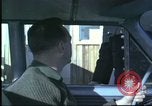
The BMEWS station at Fylingdales in England operated by British Air Ministry with a group of USAF advisors.
Activities in and around the Ballistic Missile Early Warning System (BMEWS) station at Fylingdales in England. It is operated by British Air Ministry with a group of United States Air Forces (USAF) advisors. Royal Air Force (RAF) guard checking car through a gate. Sign board reads: 'Royal Air Force Fylingdales'. Radar reflectors and radomes.
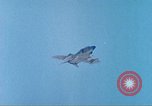
Officials watch U.S. Air Force firepower demonstration at Fort Bragg in North Carolina.
The activities and joint demonstrations by the United States Readiness Command (USREDCOM), Brass Key II at Fort Bragg in North Carolina. People gather in a large number to watch the demonstration. Fire power demonstration by the Air Force units. A U.S. Air Force McDonnell Douglas F-4 Phantom II airplane in flight. Plane fires a television-guided AGN-65 Maverick missile at a target. Officers and guests watch the aircraft demonstrations through binoculars from a reviewing stand. Smoke from explosion on the target area. Demonstration of gunship operations. U.S. Air Force Lockheed AC-130 aircraft in flight. The AC-130 Gunship firing its 20mm cannons its 40mm cannons, and its 105mm howitzer. U.S. Air Force A-7 Corsair II airplanes in flight. Mark 82 low drag 500 pound Laser guided bombs being dropped from the airplanes. Smoke arising from an explosion. McDonnell RF-4C reconnaissance aircraft approaching in sky overhead, and delivering, via small parachute packages, its aerial photographs taken that day.
U.S. Army Air Forces officers confer with General Electric executives about producing America's first turbojet airplane engine
Documentary film 'The Jet Engines' about the develpment of an American jet airplane, with help of the British who provide General Electric Company with a prototype engine developed by British RAF Group Captain Frank Whittle. A B-17 aircraft taxis and takes off from the runway. Vehicles carry U.S. Air Forces officers and civilian engineers to an airfield where a man stands with a gun next to a U.S. Army Air Forces B-17 Flying Fortress aircraft. The visitors look at cargo containers being offloaded from the aircraft. They contain a prototype British Whittle turbojet engine. Scene shifts to meeting of executives of the General Electric Company with U.S. Army Air Forces officers. They look at schematic of the Whittle engine. GE officials commit to building an American turbojet engine to power U.S. Air Forces airplanes.
U.S. Army Air Corps airplanes and crews preparing for Alaskan Flight in 1934
Slate lists planned flight legs of U.S. Army Air Corps aircraft as: Washington DC to Edmonton, Alberta; Fairbanks Alaska to Seattle Washington; and Washington DC to San Diego California. Another slate explains that under command of Lieutenant Colonel H.H. Arnold,ten B-12 bombers demonstrate their capabilities in an 18,000 mile flight. Lt. Col Henry H. Arnold, U.S. Army Air Corps, stands in front of a large map on which planned flights are charted. Sign behind him identifies "Engineering Office," at Patterson Field. Arnold uses pointer to show the routings to another officer who has joined him. The next sequence shows Arnold describing the flight plans to more participants, using more charts. Camera pans across ten assembled Army personnel. Lt. Col. Arnold poses with 15 aviators in front of a YB-12 bomber (displaying air intake on port side of engine). Camera pans over eighteen mechanics and ground crewmen posed in front of the bomber. Symbol of eagle superimposed over map of alaska, is painted on side of forward fuselage. Arnold discussing the mission with Army officers and civilian officials, as they walk past a YB-10 (with air intakes atop the cowlings). Camera pans across Patterson field ramp, where officials, automobiles, YB-10 aircraft, and local civilian workers, including several women, are seen. Crew chief seen refueling a YB-10 with long hose from an underground fuel tank installed at edge of the ramp.
CRITICALPAST.COM: About Us | Contact Us | FAQs - How to Order | License Agreement | My Account | My Lightboxes | Shopping Cart | Advanced Search | Featured Collections | Website Terms & Conditions | Privacy Policy ©2026 CriticalPast LLC.
License Agreement |
Terms & Conditions |
Privacy Policy
©2026 CriticalPast LLC.