


 Francais
 Deutsch
 Italiano
Refine Your Search
Phu Cat Air Base Vietnam 1969 stock footage and images
- Showing 7033 to 7038 of 13375 results more
more Hide
Hide
German airship Hindenburg crashes and catches fire before landing at the Lakehurst Naval Air station in New Jersey.
German airship Hindenburg catches fire in Lakehurst, New Jersey. German airship Hindenburg in flight over Lakehurst, New Jersey after a trans Atlantic flight. It flies over the Lakehurst Naval Air Station as it prepares to land with passengers aboard it. Grounds crew lined up on the field. Airship crashes and catches fire while attempting to land at the Naval Air station. Airship burns as ground crew rush to rescue the passengers. The disaster killed 35 people. Steel frame structure of the airship as it burns.
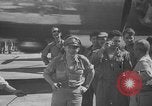
U.S. Army Air Force Major General Haywood Hansell welcomes a B-29 and crew on their arrival on Isley Field, Saipan
U.S. Army Air Force Major General Haywood S. Hansell, Jr. Commander of the 21st Bombardment Command, welcomes B-29 pilot, Lieutenant D.O. Horsfall, and his crew, upon their arrival at Isley Field, Saipan, after their flight from Bolling Field, Washington, DC, where they had been seen off by the Army Air Forces Chief of Staff, General Henry (Hap) Arnold. (World War II period).
U.S. Air Force tests effectiveness of incendiary bombs on a test village built at Eglin Field, Florida, in World War II
Tests before incendiary bombing of Japanese cities during World War 2. The tests being conducted at the Eglin air field in Florida. A plane in flight. The plane drops numerous small indendiary bombs on the huts in the test area. High altitude view of the bombing. Smoke arises due to the bombardment. A conflagration ensues. Air Force personnel put out the fires with hoses.
Beginnings of successful powered heavier-than-air flight. Wright Brothers flights in U.S. and Europe. General Hap Arnold
History of aviation. A balloon in flight. Historic glider such as that which interested U.S. War Department as early as 1898. In 1903, a crew of men moving a Wright Flyer into position. Two men turn over propellers on a Wright Flyer, and the engine starts. View of the Wright-designed water-cooled engine. View of Orville Wright. The famous first powered flight, at Kitty Hawk, North Carolina, with Orville Wright at controls. Animation shows that 120 foot flight juxtaposed against a B-36 wing. Wilbur Wright in Europe, in 1908, gesturing as he converses with interested parties. A gallery of spectators including the President of France, King of England, King of Spain, and King of Italy. Wilbur Wright places a wheel under the right wing of a Wright Flyer and lashes it to the strut. A team of horses pulls the plane across the field. Men maneuver the plane onto a monorail on the ground. Men pull on a heavy rope to raise a weight in a tower, for a catapult. Two men spin the propellers and the Wright Brothers airplane motor starts. Wilbur Wright and his passenger, a French journalist, board the plane. The catapult weight drops, launching the aircraft which flies low over the field. U.S. President Theodore Roosevelt speaking (He is seen on a podium campaigning for the Bull Moose Party nomination at the Kansas State Fair in Hutchinson, Kansas on September 22, 1912.) War department issues specifications for a heavier-than-air craft. Reenactment of a Wright brother signing a bid contract. A Wright Flyer airborne at Fort Myer, Virginia, as the Wrights meet the Army specifications and sell, U.S. Army airplane number 1, to the War Department, in 1908. Gold Aviator wings being pinned on the uniform of a U.S. Army pilot. Photograph of Army Air Forces Chief, General Henry (Hap) Arnold, wearing his original aviator wings on his service uniform. A Glenn Curtis training airplane starting up and taking off. View of a DH-4 airplane and a Wright Flyer taking off together.
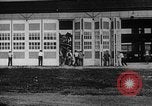
U.S. Army Air Service Fokker T-2 flown coast to coast nonstop by Lieutenant John A Macready and Lieutenant Oakley G Kelly.
On May 2, 1923, scenes of the first successful non stop flight across USA. Men open accordian doors to large hangar, revealing a specially modified Fokker T-2 airplane. Lieutenant Kelly and Lieutenant Macready, on the field, pose with Orville Wright. United States Army Air Service Fokker T-2 plane is pushed out of hangar by men. Painted on side of the plane is: 'Army Air Service Non Stop Coast to Coast'. Pilot gets ready as the airplane is fueled. Pilots and other Army officers on airfield. Animated map of the United States map illustrates course the flyers will take. Plane taxis on airfield. The Plane in flight and over Rockwell field, San Diego, California, and making a landing. Spectators on field greet the pilots as they climb down from the airplane.
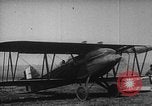
Battleship bombing tests organized by Billy Mitchell carried out by U.S. 1st Provisional Air Brigade in 1921 and 1923
Brigadier General Billy Mitchell taxis in a Boeing Model 15 ( or a Curtis P-1Hawk) airplane, after landing at an airfield. . Battle ships underway at sea. Mitchell organizes 1st provisional Air Brigade for bombing demonstration against battleship target.. Crews and airplanes train and prepare at Langley Field, Virginia. Soldiers load bombs under plane wings. Planes take off to bomb the obsolete U.S. battleship USS Alabama. View from airplane in flight as it drops phosphorus bomb on the Alabama. View from water as bomb strikes with huge explosion. Armorers prepare heavier bombs for the next demonstration. Planes take off and bomb the USS Alabama again. General Mitchell crouched down beside a bomb loaded on an airplane for new tests in 1923. General Pershing, Admiral Shoemaker, Assistant Secretary of War, Davis, and General Patrick on deck of the Ship, USS St. Mihiel (AP-32) to observe the tests. Views of planes dropping bombs on Battleship USS Virginia and the ship rolling over and sinking. Large formations of 1920s era Air Service aircraft in flight.
CRITICALPAST.COM: About Us | Contact Us | FAQs - How to Order | License Agreement | My Account | My Lightboxes | Shopping Cart | Advanced Search | Featured Collections | Website Terms & Conditions | Privacy Policy ©2026 CriticalPast LLC.
License Agreement |
Terms & Conditions |
Privacy Policy
©2026 CriticalPast LLC.