


 Francais
 Deutsch
 Italiano
Refine Your Search
Phu Cat Air Base Vietnam 1969 stock footage and images
- Showing 7165 to 7170 of 13375 results more
more Hide
Hide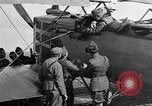
American Air Service officers examine a Vickers machine gun mounted on a Brequet 14 airplane in France, during World War I
U.S. Air Service officers observe test firing of Vickers machine gun on a Brequet 14 airplane, at the First Air Depot in France, during World War 1. Colonel T. D. Milling, Commanding Officer, First Brigade, First Army Corps; Captain G. C. Thomas Jr.,96th Aero Squadron; First Lieutenant V. F. Ludden, 96th Aero Squadron, and Pilot, 1st Lieutenant C. G. Sellers (in the cockpit) examining a Vickers machine gun mounted on the side of a Breguet 14 airplane, named "Photo." Lieutenant Sellers fires the machine gun from the cockpit. View of the machine gun firing with expended cartridges being ejected. (The gun is designed to synchronize and fire through the turning propeller when the engine is running. But that is not demonstrated here.)
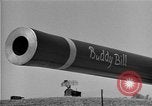
United States advanced air defense systems in the Cold War
The barrel of a 120mm M1 anti-aircraft gun is seen with a white ring and the name "Buddy Bill" painted on it. Another shown is named "Bashful-Baby." A soldier is in the process of painting a name on his gun barrel. View of the M51 Skysweeper anti-aircraft gun. Closeup of the radar dish atop the gun. View of the numerous controls of the gun. A Skysweeper gun set up in a desert setting, test site. An officer approaches the gun crew and gives an order. A gun crew member lowers the gun barrel, while two others retrieve shells for it. Hand of operator seen adjusting settings on gun controls. An aircraft (drone) is seen in flight overhead. The gun begins to automatically track it. A gunner presses a firing switch and the gun begins to fire shells. Black flak clouds form as shells explode in the air. several rounds are fired, the drone is struck and fall, burning, from the sky. Change of scene shows a Nike surface to air missile in a launch position. A soldier stands near a sign at a test site, reading "Launch Area." Soldiers slide a Nike missile across a set of rails, hook it up to a launch stand, turn on various control switches, and quickly leave the area. Aerial view of several Nike missiles laid horizontal on similar rails. Closeup on the ground of a Nike missile being raised to an uptight firing position. A rotating radar antenna. An Army technician at a battery of controls in a Nike operation center. Soldiers at a plotting table in th operation center. One wears a headset and announces countdown to firing. A visiting Allied military officer observes the activities. A clock on the wall records the countdown. A field grade Army officer with a headset stands near the soldier during the countdown. A hand actuates the firing switch and the Nike missile is seen launching. Men track it with elaborate camera equipment. The Army controller then announces time to intercept, as a dial in the control room shows the countdown progressing. . View of a B-17 target drone aircraft in flight at high altitude. As intercept is announced, the Nike strikes the B-17 which explodes and falls. Views of Nike test launch. View of the B-17 drone leaving contrails as it flies at high altitude, and then exploding and burning after being struck by the Nike missile. Pieces of the aircraft fall off as it burns, including two of its engines. Army Master Sergeant Stuart Queen, host of the "Big Picture" television program, wraps up the presentation.
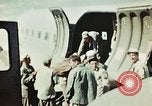
U.S. wounded soldiers transported to North Africa by air evacuation during World War II.
Wounded American soldiers arriving in North Africa, after being evacuated by air from combat zones, during World War 2. U.S. soldiers in fatigues, offload wounded troops, on litters from a U.S. C-47 air evacuation aircraft, and place them into an Army ambulance that drives away. The unloading soldiers wait for another ambulance. Several airmen sit in a jeep with a woman in a blue flight outfit, wearing a headscarf. They are facing away from the camera and watching patients being transferred. The tail of the C-47 can be seen in the background. It displays the tail code "N." Numerous closeups of wounded being moved on stretchers from the aircraft to ambulances.

Japanese billiard player Masako Katsuro demonstrates her skills to Air Force men in Sacramento, California.
Japanese billiard player Masako Katsuro in Sacramento, California. She is married to American Air Force Sergeant. She demonstrates her skills to Air Force men. She hits balls on the billiards table. Men applaud.
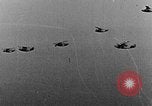
German Battleship Ostfriesland is sunk by U.S. Army Air Corps bombers during test
A medium bomb (probably dropped by a U.S. Navy aircraft) is seen hitting the German Battleship Ostfriesland on July 20, 1921 in the Atlantic Ocean off the coast of Cape Hatteras, North Carolina, United States. A formation of U.S. Navy Curtiss F5L flying boats is seen in the air. The following day, July 21, 1921, 2000 lb. bomb is seen exploding near the Ostfriesland. The bomb is dropped by an airplane from an Air Corps unit commanded by Army Brigadier General Billy Mitchell (neither seen). Several other 2000 lb. bombs explode on and near the Ostfriesland, causing it to roll over and sink.

German Heinkel He-111bomber shot down by the British Royal Air Force in Scotland during World War II.
Many sightseers stand around the wreckage of a German Heinkel He111H-2 bomber that crash landed in a field. A swastika painted on the tail of the bomber. The damaged cockpit. Several British Royal Air Force fliers examine it. (Note: This is German Heinkel He-111H-2 bomber,coded 1H+JA of Luftwaffe Stabskette/KG26. Known as the 'Humbie Heinkel,' it crash landed, on 28 October, 1939, at Humbie, East Lothian, Scotland, after being shot down by No.602 'City of Glasgow' Squadron of the British Royal Air Force, during an armed reconnaissance mission over the Firth of Forth, where Royal Navy warships were harbored, during World War 2.)
CRITICALPAST.COM: About Us | Contact Us | FAQs - How to Order | License Agreement | My Account | My Lightboxes | Shopping Cart | Advanced Search | Featured Collections | Website Terms & Conditions | Privacy Policy ©2026 CriticalPast LLC.
License Agreement |
Terms & Conditions |
Privacy Policy
©2026 CriticalPast LLC.