


 Francais
 Deutsch
 Italiano
Refine Your Search
Phu Cat Air Base Vietnam 1969 stock footage and images
- Showing 8233 to 8238 of 13375 results more
more Hide
Hide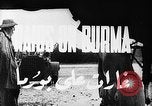
Royal Air Force bombers drop bombs over target areas in Burma during World War II.
The Royal Air Force bombs Burma during World War II. British airmen on an airfield in Burma. Bombs brought in on a bomb cart. An airman rolling a bomb to the underside of an aircraft to fix it onto the bomb rack. A few airmen fixing the bomb onto the bomb rack on the underside of the wing. A man in front of one of the wings of the aircraft and the pilot standing in the cockpit with the hatch open. The bomber aircraft taxis on the airfield and takes off. The aircraft in flight over the clouds. The pilot in the cockpit. Aerial views of the target areas in Burma. Bombs being dropped on the target areas. Explosions occur and smoke rises from the explosions.
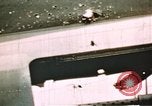
Battle-damaged B-17s and wounded air crewmen of 351st Bomb Group at RAF Station Polebrook, England, in World War II
Field ambulance pulled up beside a B-17, of the USAAF 8th Air Force, 351st Bomb Group, on grass at RAF Station Polebrook, Northhamptonshire, England, during World War 2. Holes seen in vertical stablizer of the B-17. Wounded crewman is lifted into ambulance on a litter. View of battle damage to gunner's position in the B-17. Belt ammunition dangling in the hole. Airmen carrying another crewman on a stretcher.Bullet and shrapnel holes in B-17 fuselage. USAAF Lieutenant Colonel examines Flak hole in wing of B-17. View of crashed B-17 with fuselage cracked in two. It bears the Group's "triangle J" tail code. Ambulatory wounded crew member escorted to an ambulance.Airman standing in front of a B-17 with battle damage. USAAF Sergeant seated on ground beside a damaged B-17. Views of battle damage all over the B-17. Aircrews stand by their aircraft as more wounded are moved to ambulances. Pilot looking out of Copilot's window in B-17 cockpit, under which "flap raiser" is written in chalk. (A sarcastic comment on limited duties of copilot.) Aircrews gather to relax, as one plays guitar and sings "Home on the Range." All join singing the refrain.One airman re-reads a letter from home. They all jump up and rush off to duties.

The U.S. Army introduces new surface-to-air Hawk missile in the United States.
The U.S. Army introduces its newest air defense missile Hawk. Hawk missiles are launched from a launching carrier. Aircraft overhead being attacked by a missile. Hawk missiles launched from a carrier. The aircraft explodes after facing an attack and it comes down in flames.
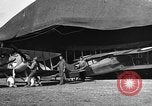
U.S. First Air Depot mechanics turn the propeller of a Spad XIII fighter at Colombey-les-Belles, France, in World War I.
Activities at the U.S.First Air Depot in Colombey-les-Belles, France during World War 1. A Spad XIII biplane fighter is parked in front of a canvas hangar, containing two French airplanes (painted with blue-white-red tail fin flashing). Mechanics pull the prop through on the Spad but have trouble starting it. Two of them take turns and finally get the engine started. A group of mechanics and soldiers push a Spad XIII up to and into a tattered Bessoneau hangar with an officer supervising. Row of Salmson 2A2s in background.
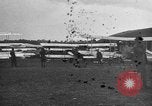
Pilots and mechanics work on DeHavilland DH-4 bombers at the 1st US Air Depot in Colombey-les-Belles, France during World War I.
Activities at the First Air Depot in Colombey-les-Belles, France during World War I. An early morning scene shows a large number of new De Havilland DH-4 bombers, painted in French colors, parked on the airfield. Pilots and mechanics begin to move amongst the aircraft and work on them. Extended panorama of hangars and buildings with clouds in the sky. New DH-4 and Spad XIII aircraft near canvas hangars. Some aircraft stripped for parts or repair. Mechanics and pilots near the aircraft. Men smooth parts of the airfield using horse-drawn wooden platforms. Pilots and mechanics near new and repaired parked aircraft.
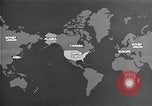
Air Defense warning systems of the United States extend far abroad during the Cold War
Animated map of world highlights the continental United States, Alaska, the Soviet Union and Europe. Circumferential rings illustrate the scope of radar coverage by America's various air defense installations in the world. A radar installation in a desert. Camouflaged radar installation at a remote airfield where U.S. aircraft are parked. An army camp ow tents and sandbags, containing a large radar array. Views of several radar antennas rotating in various places as narrator explains function of radar systems. View of "Radio Jim Creek," Naval Radio Station very low frequency (VLF) radio antennas at Jim Creek near Oso, Washington State. . The transmitter, itself, is located at Arlington,Washington State. Views inside the transmitter facility, where sailor technicians monitor various instruments and are seen at various work stations. (Note: this army production fails to mention that this Naval Radio Station's primary mission it to communicate with submerged U.S. submarines.)
CRITICALPAST.COM: About Us | Contact Us | FAQs - How to Order | License Agreement | My Account | My Lightboxes | Shopping Cart | Advanced Search | Featured Collections | Website Terms & Conditions | Privacy Policy ©2026 CriticalPast LLC.
License Agreement |
Terms & Conditions |
Privacy Policy
©2026 CriticalPast LLC.