


 Francais
 Deutsch
 Italiano
Refine Your Search
Phu Cat Air Base Vietnam 1969 stock footage and images
- Showing 8833 to 8838 of 13375 results more
more Hide
Hide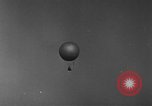
Stages of history of flight from balloons to successful heavier than air manned flight by Wright Brothers
Various stages of manned flight are seen during history of flight. First a balloon with a passenger basket suspended below. Then a man is seen making a long flight in a glider from a high hillside. Men maneuver a Wright flyer on the ground. It is a 1910 model B, displaying number NR 14333 on its wing. Men turn the propellers to start the engine. Closeup of the engine. The first occupant is already seated in the airplane as the second walks around the right wing checking things. Closeup of Orville Wright. A Wright flyer taking off. The distance of the first successful flight by the Wright Brothers is illustrated by an animated representation of it over the wing of a 1950 era B-36 bomber.
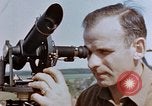
U.S. Army Air Forces meteorologists at work on control tower of airfield in U.S. occupied Germany
Activities of the United States airmen at an airfield in Germany after World War II. A United States airman looks through sextant on the terrace of airfield control tower. On roof beind him are anemometer and weathervane. Tower operator speaks on the microphone in the control room. American airman works on a desk. Aircraft parked in grass on the airfield as seen through the large windows of the control tower.
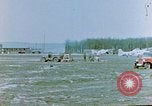
U.S. Army Air Force ground crewmen, driving a captured German Tomato Juice truck, deliver ammunition to a parked P-51
American ground crew delivers ammunition in a captured German commercial truck, painted tomato red. "Tomato Juice" is painted on side of the truck (in German).They drive and stop near a parked P-51 aircraft, where they get out and remove ammunition boxes from the back of the truck. They set the ammunition boxes down near P-51 plane.
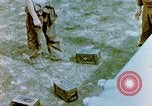
U.S. Army Air Force ground crewmen open boxes of 50 caliber ammunition for a P-51. They drive away in German Tomato Juice truck
U.S. ground crewmen open ammunition boxes near a P-51 plane and take out belted 50 caliber ammunition. They then get into a captured tomato-colored German truck bearing the words "Tomato Juice" (in German) on its side. They drive away in the truck.
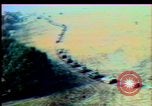
Soviet Army and Air Force in practice ranges prepare to intervene and march in to Poland border, during Poland Crisis.
Crisis in Poland around time of imposition of Martial Law by its Military Government. Large convoy of Soviet military bombers advances on countryside roads towards border of Poland. Soviet warplanes and helicopters strafe targets. A Soviet missile launched destroys its targets accurately. Tanks and Soviet amphibious vehicles cross a river. Infantry soldiers on alert at their posts along the Soviet-Polish border. Soldiers watch the border with binoculars.
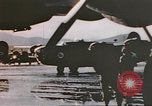
U.S. Air operations from Adak, and views of.the island's defenses during the Aleutians campaign of World War II.
As film begins, two U.S. B-24 bombers are seen taxiing across the Adak airfield to takeoff on a bombing run against the Japanese airfield at Kiska Island. Closeup of B-24 with engines running. About an inch of water covers the ramp. The two bombers take off (followed by others unseen). Airmen on the ground watch them depart. Scene shifts to the port of Adak. A cargo ship and a tugboat moving a barge are seen in the water. Trucks drive along the beachfront. Mountains loom in the background. Military supplies, including munitions are seen piled along the beach. Soldiers carry some goods over their shoulders. Closeup of items piled on the beach. A dog trots along with soldiers walking the beach. Change of scene highlights guns installed as coastal defense on the island, including fixed heavy guns, anti-aircraft guns and machine guns. A sailor viewed through a life safer buoy, paints part of a warship. A Navy PBY Catalina on patrol is seen overhead. U.S. gunboats patrol the harbor. Crew members are seen aboard a U.S. destroyer patrolling deep waters off Adak. They exchange blinker light messages with a Bancroft-class (four-stacker) destroyer. Glimpse of the Bancroft-class destroyer flashing blinkers lights. Sailors on a destroyer respond to alarm of sonar sound contacts and man battle stations. Closeup of a Bancroft-class destroyer, followed by views of depth charges being launched from a destroyer underway. Exchanges of blinker light messages between camera destroyer and a Bancroft-class destroyer.
CRITICALPAST.COM: About Us | Contact Us | FAQs - How to Order | License Agreement | My Account | My Lightboxes | Shopping Cart | Advanced Search | Featured Collections | Website Terms & Conditions | Privacy Policy ©2026 CriticalPast LLC.
License Agreement |
Terms & Conditions |
Privacy Policy
©2026 CriticalPast LLC.