


 Francais
 Deutsch
 Italiano
Refine Your Search
Phu Cat Air Base Vietnam 1969 stock footage and images
- Showing 8851 to 8856 of 13375 results more
more Hide
Hide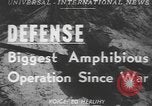
United States Army, Navy and Air Force maneuver in Puerto Rico
United States soldiers carrying baggage and weapons embark onto a ship. Soldiers in landing crafts underway in the sea. Planes fly overhead and paratroopers land on an island. Landing craft comes ashore and troops debark. Soldiers fight in simulated war conditions and explosions occur. Landing crafts and tanks at the beach.
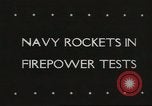
The United States Navy test fires its rockets at various land, sea and air targets.
United States Navy rockets being test fired in the United States. A boat underway at sea. A rocket launcher at land releases the rockets and explosions occur at sea. The rockets being test fired. A navy airplane fitted with a rocket rack and men load rockets into the rack. The aircraft in flight and rockets being dropped. The rockets hit the ground and billows of smoke rise up. (World War II period).
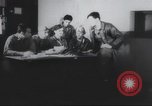
B-17 crew of the U.S. 8th Air Force is debriefed by intelligence officer upon return from a bombing mission.
A U.S. intelligence officer interviews members of a flight crew upon their return from a bombing mission in World War 2. Pilot of the aircraft says that as the B-17 aircraft approached the target over the river, they were hit by Flak in the left wing and tail surface. The Pilot says they dropped their bombs effectively and were attacked by "109s or 190s" (Messerschmitt Bf 109s or Focke-Wulf FW-190s) that dove down on them and swooped up underneath. He refers to his ball turret gunner sitting next to him and says he knocked off one of them. The gunner says he saw the German plane when it came down from the tail, dove under, and started coming up. When asked, the gunner says the German plane was about 900 feet away when it was hit by his machine gun fire. He also noted they were the last ship in the bomb run. Next, after questioning the tail gunner, the intelligence officer asks the Bombardier about his actions. He explains that after releasing his bombs, he began to plot their positions as they exploded on the ground. He notes they got good bursts on the engine sheds, on the concentrations of box cars in the center of the marshalling yards, and on the viaducts leading to the center of the bridge. He notes that all the bombers ahead of them hit some part of the target, with most dropping their bombs right where they were supposed to. (World War II; WW II; World War 2; World War Two)
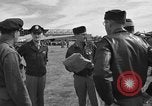
U.S. Army Air Force pilot boards a German JU-88 aircraft and takes off at an airfield during World War 2.
Captured German JU-88 aircraft at an Allied-controlled airfield in European Theater during World War II. General Carl Spaatz and other officers stand under the nose of JU-88 Junkers aircraft. Pilot climbs in the belly turret of the aircraft followed by the crew members. Ladder being folded and placed inside the turret. Turret being closed. Mechanics crank the motors of JU88. Propellers rotate and motor starts. Aircraft taxis along the airfield. JU 88 Junker takes off.
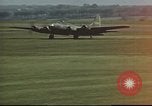
U.S. 8th Air Force B-17 bomber returns to an airfield with wounded on board, in England during World War II.
An ambulance races to meet a B-17 as it taxis after landing on a grass field in England, during World War II. A wounded crewman sits on grass. First aid is administered to him.
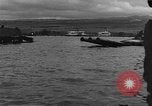
A wrecked plane and ships and smoke from explosions after the Japanese air attack on Pearl Harbor, Hawaii, United States.
Damage in Pearl Harbor, Hawaii, United States due to the Japanese attack. A wrecked ship in the sea. A man stands on a wrecked airplane destroyed due to the attack. Trees and houses in the background. Smoke from burning equipment in the far background. Smoke rises as a ship explodes. (World War II period).
CRITICALPAST.COM: About Us | Contact Us | FAQs - How to Order | License Agreement | My Account | My Lightboxes | Shopping Cart | Advanced Search | Featured Collections | Website Terms & Conditions | Privacy Policy ©2026 CriticalPast LLC.
License Agreement |
Terms & Conditions |
Privacy Policy
©2026 CriticalPast LLC.