


 Francais
 Deutsch
 Italiano
Refine Your Search
Phu Cat Air Base Vietnam 1969 stock footage and images
- Showing 9145 to 9150 of 13375 results more
more Hide
Hide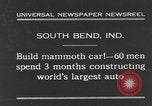
A mammoth Studebaker "Giant Car" roadster is seen in South Bend, Indiana.
In South Bend, Indiana, views of a "Giant Car" Studebaker roadster built by a group of 60 craftsmen working under Studebaker's Paul Auman. This giant scale version 1931 model 80 Studebaker Four Season Roadster was used in the film "Wild Flowers." The Giant Car is 41 feet long with a wheel base of 325 inches. It is 13 1/2 feet high, 15 feet wide, and weighed 5 1/2 tons. Men drive up beside the giant President roadster in a normal vehicle. Some use a rope ladder to climb up into the giant car and others climb up the wheel fender and then onto the hood. A boy is shown trying unsuccessfully to climb up a giant wheel of the car (each wire wheel was 6 feet 8 inches in diameter and weighed 600 pounds). The boy's small pedal car is seen beside the Giant Car tire. A police officer in a motorcycle rides up beside the giant car. He places a board-style 'Police Ticket' on the running board and then climbs up onto the running board to present the ticket to a woman who is behind the wheel of the giant roadster.
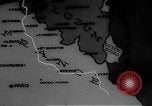
Canadian troops in action around the town of Albert, in West Flanders, Belgium during World War I
Canadian troops in West Flanders, Belgium near Ypres and Albert during World War 1. An animated map shows the region and the Somme River. Canadian troops hunkered down in grass and shrubs on a hill overlooking flat terrain. Shells exploding on horizon in background. A large contingent of Canadian troops marching downhill with left-shouldered arms. Senior officers walk out of a courtyard gate. Next, General Sir Sam Hughes, Canadian Minister of Militia and Defence, is seen shaking hands with several officers. Scene shifts, after he greets only two, and shows Canadian troops marching in platoons along a dusty road. Next, Canadian soldiers are seen moving supplies by horse-drawn wagons along a tree-lined road leading into a town. Final scenes show the war-damaged Albert Basilica. The camera pans upward, along its tower, to the Golden Virgin statue at its top, which is leaning precariously to one side, almost falling off its base. (The statue became the subject of British superstition that the war would end when the statue fell. But British artillery, itself, knocked it down while targeting the tower to prevent its use by the Germans as an observation post, during the 1918 Spring offensive)
Combat fatigued U.S. soldiers are interviewed and sent for treatment in the Training and Rehabilitation Center, Italy.
Psychiatric procedures for United States soldiers in combat areas during World War 2 suffering stress following trauma of battle. Battle scenes: Strong and courageous soldiers sent for fight. They attack enemy and fire rifles from hidden places. Smoke rises. They face danger in battle day after day. View of wounded, burned and dead soldiers in battle. Strongest soldiers of the army maneuver over field. Soldiers seated facing the stress of combat and become psychiatric casualties. Chart depicts fighting front and its three levels: division, army and base. Soldiers are sent to battalion aid station and back to clearing stations for treatment. Medical van brings the wounded soldiers and psychiatric casualties to battalion aid station. One officer checks the ID card of soldiers. ID card reads: '1st battalion, 168 infantry regiment, yes incurred in Italy'. Chart shows training and rehabilitation center (T& R center) near clearing station. Soldiers reach to training and rehabilitation center. A Sign of 'Training and Rehabilitation Center'. Combat fatigue cases are reconditioned by battle training. A psychiatrist interviews a soldier suffering from reactive depression and asks about troubles and feelings faced by him when he got wounded. After interview soldiers are send to clearing center. Soldier enters into tent at camp. They take rest, make social contacts with other soldiers, write letter, get shaved and eat food. Two days later, soldier is re-interviewed about improvement after relaxation in training center. He shows improvement and is encouraged. Recovered soldiers fill the artillery outside the tent near training center. (Modern equivalent - PTSD or post traumatic stress disorder treatment)
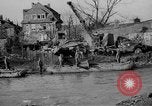
3rd Division fires rocket barrages and First United States Army Infantry advances through German towns east of Inde River
Activities of First United States Army pressing eastward in Germany during World War 2. U.S. engineers and soldiers build a bridge over the Inde River since all nearby crossings had been destroyed by retreating German forces. Army vehicles cross the completed bridge. Soldiers bring heavy artillery and adjust it. View changes to Mausbach area to the South, where rockets are launched by 3rd Armored Division toward the river. Line of 75 U.S. Army rockets seen being loaded by U.S. soldiers and then fired together. Bright flashes and smoke as rockets are fired. Tanks of the 3rd Division moving out from the town. A U.S. vehicle in the advancing column toward Gressenich is hit by German guns. U.S. Army tanks, lined up like artillery, fire on German forces at Gressenich. Continuous line of 3rd Armored Division tanks, armored vehicles, and 6x6 vehicles come to the front and advance on roads of cities and villages moving eastward, and supporting the U.S. First Army Infantry. 1st Army infantry move through Hurtgen forest near Aachen. Ruined German factory is used as an observtion base by U.S. forces to coordinate attack on Gressenich, which was captured on November 19, 1944. 3rd Armored Division tanks move into open fields to continue offensive toward Werth, with U.S. infantry soldiers staying close to tanks for cover. Soldiers carry the wounded U.S. tank commander after German counter fire hits lead U.S. tank in the column. The wounded soldier is dragged to safety. Men of U.S. Army 1st Division Infantry enter town of Werth under German mortar fire and move from house to house clearing enemy snipers and mopping up in the ruins. U.S. Army soldiers guard a column of German prisoners (POW) who surrendered in Werth. View of ruined and destroyed buildings in German towns like Hamich after defeat. U.S. Army soldiers move through the town on foot with a small church in the background. U.S. Army trucks arrive in a rubbled village with food and ammunition for the offensive drive toward the Ruhr.

Baseball game between Chicago White Sox and Cleveland Indians; White Sox clinch the American League pennant in Cleveland, Ohio.
Newsreel clip on the Chicago White Sox baseball team clinching their first American League pennant in 40 years in 1959. Clip opens with crowd filing into Cleveland's Municipal Stadium, which is decorated with a giant smiling Indian (the team's logo). Scenes from game: White Sox shortstop Luis Aparicio doubles into the right-field corner to score Bubba Phillips, who slides to beat a throw to home. (Note photographers standing just a few feet away from the plate.) Billy Goodman doubles to score Aparicio. Two fans in white shirts, smoking cigars, intently watch the game. White Sox manager Al Lopez, in dugout, waves a fielder over to a different position. Indians load the bases in the ninth inning. White Sox call on Gerry Staley to get final outs. Staley throws one pitch and Vic Power of the Indians hits into a double play, ending the game. White Sox players celebrate in the clubhouse, pouring beer on each other's heads. Player in hat does a goofy dance.

A man demonstrates and controls a wingless aircraft in a model form in Cedar Rapids, Iowa.
A wingless aircraft, the 'Aerodyne' based on aerodynamic principle is demonstrated in a model form at Cedar Rapids, Iowa. A man demonstrates and controls the wingless aircraft. The aircraft in a model form in flight.
CRITICALPAST.COM: About Us | Contact Us | FAQs - How to Order | License Agreement | My Account | My Lightboxes | Shopping Cart | Advanced Search | Featured Collections | Website Terms & Conditions | Privacy Policy ©2026 CriticalPast LLC.
License Agreement |
Terms & Conditions |
Privacy Policy
©2026 CriticalPast LLC.