


 Francais
 Deutsch
 Italiano
Refine Your Search
Phu Cat Air Base Vietnam 1969 stock footage and images
- Showing 9325 to 9330 of 13375 results more
more Hide
Hide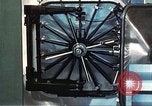
A scientist examines the internal organs of a dead animal at the Plum Island Animal Disease Center in Long Island, New York.
A film based on the Plum Island Animal Disease Center in Long Island, New York which is dedicated to study of foreign animal diseases. Incoming supplies and equipment needed to carry out research are admitted through autoclaves to achieve sterilization. Technicians at different machines handle glassware and other equipment to be used for the research. Scientists expose research animals to foot and mouth disease virus in an isolated room. The virus is injected below the tongue of the animals. A man takes out the internal organs of a humanely destroyed cattle. The scientist lays down his knives and wears rubber gloves. He examines the internal organs of the cattle during the post-mortem. The animal carcass is placed into an incinerator. A technician wearing red clothing operates the incinerator. The carcass burns in the incinerator.
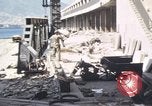
Damage in the port of Messina, from U.S. bombing during World War II
U.S. soldiers in bomb-damaged port facilities at Messina, Sicily, during World War 2. A U.S. Army Technical Sergeant wearing a holstered sidearm, walks past an overturned railroad locomotive. He stops and picks up an abandoned Italian Breda 30 light machine gun. He checks the weapon's action and holds it up in firing position. Another U.S. soldier rummages amongst abandoned Italian small arms. The Tech Sergeant climbs aboard an abandoned port utility tug vehicle. The camera focuses on the side profile of the vehicle. A crane on a railway is seen near a damaged ship. Chunks of concrete pier are seen and damaged port machinery. A small fire burns at the base of a hill near a rail line at the port.
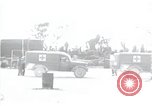
Survivors of USS Indianapolis (CA-35) are removed from ambulances and placed on a dock in Peleliu, Palau.
Survivors of USS Indianapolis at a naval base hospital in Peleliu, Palau towards the end of World War II. Navy ambulances lined up on a dock. Casualties on stretchers are placed on the dock. A doctor converses with a patient. Casualties on stretchers are removed from ambulances and placed on the dock.
Survivors of USS Indianapolis are carried on stretchers from a hospital ward and placed in ambulances in Peleliu, Palau.
U.S. Navy survivors of USS Indianapolis (CA-35) sinking in Peleliu, Palau towards the end of World War II. Entrance to a hospital ward at a naval base hospital. Ambulatory sailor patients exit from a building and climb into a waiting truck. Stretcher patients carried from the hospital ward and placed in waiting ambulances.
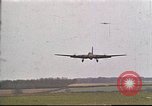
B-17 Flying Fortress bombers of U.S. 8th Army landing in succession on an airfield in England during World War 2.
B-17Fs of the 8th Bomber Command, 1st Bomb Division, 305th Bomb Group, 366th Bomb Squadron, landing at their base, RAF Chelveston, in Northamptonshire, England, during World War II. The first to land displays a dozen yellow bombs, for missions, painted under the pilot's cockpit window, and Squadron code KY, and L, on its fuselage. Its tail number is 42-5053. The second plane to land displays KY and D, on fuselage, and tail number 42-29553. The third, shows the squadron's KY, but other markings are not readable. The fourth to land displays some mission bombs below its cockpit window, the Squadron KY, and J on the fuselage. Its tail number is 41-21624. Bomb Group tail codes and nose art are not seen on any of the aircraft. But, researchers have identified names of three of them: Bloody Tangier Show (42-5053), Arkie II (42-29553),and Madame Betterfly (41-24624), and estimate the film to have been shot between 3/1/1943 and 5/19/1943.
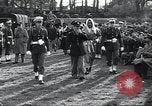
U.S. World Heavyweight Boxing Champion (US Army Staff Sgt. Joe Louis Barrow) in Army exhibition match
World Heavyweight Boxing Champion, U.S. Army Staff Sergeant Joe Louis(Barrow), escorted by Military Police, arrives for an exhibition bout and enters a ring at an Army base,in the United States during World War II. His opponent wearing a robe with "California Jackie" written on it, enters the ring, U.S. soldiers and WACs (Women's Army Corps) cheer for Louis as he arrives. Joe Louis holds a microphone and speaks to the crowd. The bout in progress. Louis' exhibition partner wears a protective helmet, as he boxes with the champion.
CRITICALPAST.COM: About Us | Contact Us | FAQs - How to Order | License Agreement | My Account | My Lightboxes | Shopping Cart | Advanced Search | Featured Collections | Website Terms & Conditions | Privacy Policy ©2026 CriticalPast LLC.
License Agreement |
Terms & Conditions |
Privacy Policy
©2026 CriticalPast LLC.