


 Francais
 Deutsch
 Italiano
Refine Your Search
Phu Cat Air Base Vietnam 1969 stock footage and images
- Showing 9589 to 9594 of 13374 results more
more Hide
Hide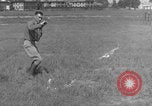
U.S. Army pre-World War II bayonet training film on the butt strokes attack sequence.
US Army training film features slow motion demonstration and description of the second butt stroke movement, a jab with the butt of the rifle. First and second moves then shown at full speed from a side and front camera view. Narrator discusses one common mistake made when performing this attack over footage of a soldier practicing the movement. Slow motion demonstration and description of the third move in the sequence, a slash with the blade of the bayonet. Third move then shown at full speed. Narrator discusses another common mistake made when performing the slash. Straw dummies with painted faces are seen beyond the demonstrating soldier, used for bayonet practice. Slow motion and full speed demonstration and description of the final move of the sequence, an optional over arm blow with the butt of the rifle. US Army base building seen in background.
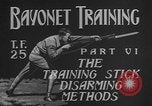
U.S. Army bayonet training film on the use of the training stick in bayonet practice.
Pre World War 2: U.S. Army description and demonstration of the use of the training stick in bayonet practice. The training stick is a long stick with a loop at the base end and padding at the far end. Footage of two soldiers practicing and switching roles by throwing the training stick and bayonet to one another, then practicing again. They practice on a large field, with suspended straw dummies behind them. Further in the distance, more soldiers can be seen walking in a line.
Vickers Wellington No. 149 Squadron RAF takes off during WW2
Period dramatization: British Royal Air Force (RAF) station groundcrew assist Vickers Wellington No. 149 Squadron RAF during taxiing and take off from RAF Mildenhall airfield during World War 2. A ground control crew member salutes to an officer, the air controller, entering the control room of a portable ground controlled approach radar equipment (GCA) room. Air controller stands on a wooden stool to look through a bubble window in the control room’s ceiling. Air controller tests his radio, saying, "ground control, are you receiving?" View of air direction indicator on air field. Engines running on Vickers Wellington bomber at sunset along with "OC" on fuselage. “You may taxi out and take off!” the air controller says after a pilot asks for clearance on the radio. A Vickers Wellington bomber taxiing. Evening view of lighted bubble window of air control trailer as air controller inside watches the Vickers Wellington bomber taking off. Vickers Wellington bomber flying over RAF Mildenhall airfield. “C for Charlie airborne sir! Nineteen hours thirty-five minutes!” a RAF officer says as he enters air control trailer. Air controller standing in control room dome relays information, saying, "C Charlie took off 19:35." Inside air control headquarters at RAF Mildenhall as RAF officer smokes a pipe while another RAF officer writes flight information on the blackboard. More Vickers Wellington bombers taxi and take off from the airfield one by one. Vickers Wellington OJ-F 'F for Freddie' kicking up dust as groundcrew watches. Vickers Wellington OJ-F 'F for Freddie' taking off as the last Vickers Wellington bombers in No. 149 Squadron departs for Germany at night. View of pilot in Vickers Wellington as he radios to crew, "OK chaps, here we go!" RAF officer writes down the last aircraft’s departure time as “19:51”.
Allies force German forces almost completely out of Tunisia, North Africa, during World War II
Opens with General Dwight D. Eisenhower, Supreme Commander of Allied forces conferring with his deputy for land forces, British Field Marshal Harold Alexander, his deputy for sea forces, British Admiral Andrew Browne Cunningham, and his deputy for air operations, British air marshal Arthur William Tedder, during North African campaign in World War 2 . Map illustrates Allies military plans as analogous to internal combustion engine. General Eisenhower on an airfield consulting with his British Deputy commanders. B-17 bomber in background. Eisenhower salutes the British officers as he walks away. Lieutenant General Carl Spatz, Commander of the North West African Air Force, confers with British air marshal Tedder. Major General Jimmy Doolittle briefs airmen and smiles for camera. Strategic bombers with nose art names Pluto, Yankee Doodle, Jersey Jackass, Alice the Goon, and Fancy Pants. Picture of British Air Vice Marshal, Sir H.P. Lloyd, chief of Coastal air Force. A British Avro Anson aircraft flying air cover over a convoy of Allied ships. Diagram shows how all British and American fighter aircraft and attack bombers were placed under the command of British Air Marshal Cunningham, who is seen stepping from an airplane. British Field Marshal Harold Alexander in command of all ground forces is also seen stepping from an aircraft. Both are seen at a small camp trailer that they shared in the Tunisian mountains, where they work together, at a planning table. Marshal Cunningham is seen briefing air crews in mid March, 1943. B-24 Liberator bombers fly in formation and drop bombs on German Mareth fortifications in Tunis. German anti-aircraft guns create many black flak clouds among bomber formation. View from B-24 aircraft of the bombs exploding on the ground. British Field Marshal Harold Alexander is seen walking with a member of his staff across the sands. Diagram shows planned advance of the British 8th Army. Numerous British heavy guns fire nighttime barrages against the German positions, as British infantry advance during battle. They use scaling ladders and sappers detonate charges. Soldiers carry sticks to line trenches and set up defensive fortifications. Tanks advance. Heavy rain creates problems and some armor bogs down in mud. The next morning British troops are seen in their trenches as smoke drifts across the area. British soldiers moving cautiously under fire. German Field Marshal Rommel looks through binoculars. Additional German armored units entering the area. British gunners firing field artillery and mortars. Map illustrates how 2nd New Zealand Division under Lieutenant-General Bernard C. Freyberg, swings around behind the German line. Formation of British B-26 Marauder aircraft flying over desert. British Vickers Wellington bomber in flight. Bombardier in aircraft pressing a release button and bombs fall away creating huge explosions on ground. British mosquito bomber flying low. Bomb explodes on ground and Mosquito aircraft pulls up and away. Another Mosquito aircraft flying low on a strafing run. Tanks of 2nd New Zealand Division welcomed into El-Hamma, Tunisia, in the Battle of the Mareth line. View of South African army engineers using caterpillar tractor to build roads for Allied forces. Glimpse from rear of three British warships underway in the Mediterranean sea. Front view of a British Queen Elizabeth Class battleship underway. The battleship firing her 15-inch guns. U.S. P-38 fighter planes in formation. Glimpse of pilot in cockpit wearing leather helmet and earphones. Formation of German Junkers Ju-52 aircraft flying low over sea, carrying German troops to reinforce those in Tunisia. View of German soldiers inside the cabin of a Ju-52. Closeup of three Ju-52 transports flying very low over water. Several U.S. P-38 fighter planes attacking the transports. Pilot in one, pressing button to fire his guns. Scenes of aerial dogfight combat between U.S. Army Air Force aircraft and German Luftwaffe aircraft. Gun camera images of P-38s shooting down German transport planes. Map shows American, British, and French forces pressing Eastward against Germans. Views of battle and U.S. Lieutenant General George Patton at the front as his forces move forward during Battle of Guettar. American patrols of light tanks meet up with British patrols from their 8th Army on April 7. Views of the U.S. and British soldiers happy to meet one another and sharing cigarettes. Map shows Allied forces pushing the Germans further. Allied infantry walking into town of Enfilaville. Local families returning to their homes with all their belongings, in carts pulled by donkeys and other animals. In the town, encouraged by British troops, a group of Jewish boys remove Jewish star of David emblems from their jackets that had been used by occupying Germans to identify them as Jewish. British army doctors tending to local women and children.
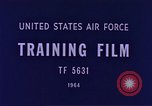
USAF training film exhorts AF personnel to pursue physical fitness
Opening scenes are paintings illustrating the physical rigors surmounted by earlier Americans, from the pioneers through World Wars I and II. View of Strategic Air Command B-52 bombers parked on a flight line. Ground crew makes adjustment on advanced cruise missile fastened under a wing. Air Force air traffic controllers in a control tower. An Air Force airman playing with his child. A forklift being employed to move heavy cargo from a flatbed truck. Air Force personnel seated at duty stations with few physical demands. An Airman seated at home passively watching television with a boy (his son) in the family living room. An Air Force Captain, Flight Surgeon, discusses deleterious effects of automation, etc. on physical fitness of service personnel. View of an Air Force male subject being tested on a treadmill, while his vital signs are being constantly monitored. Results from group studies show only 5% in excellent physical condition. The Flight surgeon is seen, again, exhorting Air Force personnel to pursue physical fitness, for themselves, and their country.
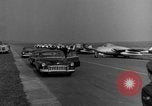
Lieutenant General Lauris Norstad inspects Italian and Amerian camp areas in Wiesbaden, Germany, during Exercise Cirrus.
Film opens with glimpse of an American 1950 Buick sedan and two cars behind it, parked on a flight line near a line of Italian de Havilland Vampire jet fighter planes. Scene changes to General Lauris Norstad, commander in chief, of USAFE (United states Air force in Europe) making a brief inspection of a tent camp of the Italian Air Force fliers who are participating in Exercise Cirrus, an air exercise for the Allied air forces in Central Europe. He and Italian Air Force officers walk back to his 1950 Buick sedan staff car, parked on the flight line. The officers and General Norstad exchange salutes and hand shakes, and Norstad enters the back seat of his car. The Italian officers enter another 1950 Buick sedan, that displays 4 stars on its bumper. Change of scene shows General Norstad and others near some large olive drab tents where American fliers in flight gear are standing about conversing. General Norstad enters one of the tents followed by a photographer. He is followed by an unidentified U.S. Air Force Major General Who exits soon after and walks away. As Norstad emerges from the tent, the U.S. fliers move out of his way and exchange salutes with him as he passes. Shift in scene shows Norstad exiting another tent and then being surrounded by American and Italian officers. A field ambulance is seen in the background. General Norstad moves to the head of the group, accompanied by a U.S. Air Force colonel. Others in the group follow.
CRITICALPAST.COM: About Us | Contact Us | FAQs - How to Order | License Agreement | My Account | My Lightboxes | Shopping Cart | Advanced Search | Featured Collections | Website Terms & Conditions | Privacy Policy ©2026 CriticalPast LLC.
License Agreement |
Terms & Conditions |
Privacy Policy
©2026 CriticalPast LLC.