


 Francais
 Deutsch
 Italiano
Refine Your Search
Phu Cat Air Base Vietnam 1969 stock footage and images
- Showing 9607 to 9612 of 13374 results more
more Hide
Hide
Normal operating procedures including start, take off, stall and landing of the U.S. Navy T2V-1 SeaStar.
Normal operating procedures including start, take off, stall and landing of the U.S. Navy T2V-1 SeaStar. Start: The plane on the runway. A crewman arrives with the air impingement car. He inserts the pipe into the air impingement inlet. The crewman gives a signal when the air impingement hole is secure. The pilot adjusts the battery operator switch and turns on the ignition. He moves the throttle to ignite and then to idle position. The exhaust gas temperature gauge. The pilot signals the crewman to disconnect the air impingement starter and adjusts the instrument power switch. Post-start Cockpit Check: The pilot checks the RMI for alignment, adjusts S2 compass controller, annunciator panel touch button, fire detector test switch, fuel quantity indicator button. He checks the communication, navigational, annunciator and left panel. He goes through the take off check list, moves the plane into position, advances throttle, inspects the tachometer, exhaust temperature, releases brake and taxis to the end of the runway. The plane taxis, pilot applies brake and rudder control and takes off. He raises the nose wheel, retracts the landing gear and flaps after take off. The plane in flight over clouds. Stall occurs. The attack angle gauge. Landing procedure: View of the runway. The pilot begins the let down, reduces power, extends the brake, lowers landing gear and flaps, and continues to reduce speed. Diagram of the runway depicting approach. The plane approaches the runway, touches down and lands.
Modern Soviet military equipment including the FROG-7 launcher, T-62 battle tank, MiG-27, MiG-23 and Su-17 Fitter.
United States Air Force Soviet Awareness Program depicts Soviet military equipment and its use in terms of purpose and jurisdiction. Soviet Army soldiers learn about weapons in a class. Soldiers advance in a field. Soviet soldiers prepare the FROG-7 erector launcher with a warhead. A Soviet T-62 standard main battle tank with infrared night driving equipment, a 115mm tank gun and a 12.7mm antiaircraft heavy machine gun. Modern Soviet hovercraft, armed vehicles, surface to air missiles, electronic equipment, and automated systems. Soviet weapons fired resulting in explosions and fire. Tanks advance through fields. Soviet amphibious crafts advance through a water body. Amphibious personnel carriers detect and neutralize mines during an operation in Bangladesh, Aisa. Soviet Navy sailors aboard the carrier. A Soviet Air Force MiG-27 Flogger prepared for take off. A ground crewman helps the pilot strap up into the cockpit. Soviet Air Force MiG-23 Flogger and Sukhoi Su-17 Fitter take off for combat. The avionics system and weapons specifications of the aircraft. The aircraft in flight, drop bombs and attack. Fire and explosions. Soviet Long Range Aviation bomber aircraft carrying bombs take off. The aircraft fleet in flight over mountains. Pilots in the cockpits. Aerial refueling under progress. Aircraft with lights on lands on a snow covered runway.
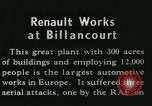
The Renault Works plant at Billancourt after three aerial attacks by the Allied forces during World War II.
Results of air assaults by the British Royal and U.S. Eighth Air Forces over industrial areas in and around German-occupied Paris during Wolrd War II. The Renault Works plant at Billancourt after one aerial attack by the Royal Air Force (March 3, 1943) and two by the U.S. Eighth Air Force (April 4 and September 15, 1943). Workers clear the plant interiors. The damaged plant, collapsed roof, rubble and debris on the floor. Workers clear the debris. Damaged steel structures, pillars and walls. Buildings at the plant. Damaged walls, wrecked equipment and material. Allied officers and workers at the plant.
Italian light tanks, motorcycle troops and motorized infantry advance across the Libyan desert during World War II.
The Italian infantry in Libya during World War 2. Italian light tanks, motorcycle troops and motorized infantry advance across the Libyan desert. Bersaglieri Motorcycle troops advance on a road before driving down a bank and going off-road. Two Italian CANT Z.1007 Alcione (Kingfisher) bombers fly through the air. Convoy of Lancia 3RO heavy trucks loaded with troops advance through the desert. Italian soldiers in a utility truck towing a howitzer. Soldiers in military trucks (Lancia 3RO 6-ton trucks). Bersaglieri on motorcycles speed through the desert. Italian M11/39 tanks driving, close-up of an M11/39 tank driving past the camera. Another shot of the Kingfisher bombers in flight. A fly-by shot of a village in the desert. A wall explodes. Smoke raises over a ruined building as another explosion kicks up a plume of black smoke. A building is blown up. Another building exploding, throwing debris into the air. A plume of smoke raising high into the air. A large explosion throwing lots of smoke, debris, and dust into the air. Burning building with little smoke. Burning building with lots of smoke. Panning shot of a ruined North African building. A sign board for the 'Telegraph Office' being pulled away to reveal a destroyed building..
Operation Tidal Wave, during World War II. U.S. B-24s attacking the Ploiesti oil fields and rail marshaling yards in Romania
Aerial views of Operation Tidal Wave, an air attack by B-24 heavy bombers of the United States Army Air Forces on oil refineries around Ploiesti or Ploesti, Romania. during World War II. The 98th and 376th Bomb Groups of 9th Air force and 44th, 93rd, and 389th Bomb Groups of 8th Air Force took part.. Fifty-three aircraft and 660 aircrew were lost in this raid. Views of bombers dropping bombs over the oil refineries,factories,railroad yards and oil fields. Aerial views of destroyed Ploesti oil fields and of the planes climbing out and leaving the area.
First blackout drill in Farmingdale New York, and mock bombing of aircraft factories early in World War II.
Aerial views of Mitchel Field in Hempstead Plains of Long Island, New York. Major General Frank Andrews of U.S. Army Air Corps, General Headquarters Air Force, and staff standing around a large plotting board, with models of airplanes, guns and boats on the plotting board. They are planning a test of the defense of aircraft factories in the region from air attack. Five PB-2As parked in a row at Mitchel Field. Crew operating range finder and aircraft sound detector. Soldiers turn searchlight to the right. Fireman opens switch box door on wall and pulling switch to notify power station staff of the drill, which was the first aerial bombardment blackout drill of its kind in the United States. Workman pulling main power switch in power station to create blackout conditions in city as protection from aerial bombing. Night time aerial views of City of Farmingdale in New York lit up and then going dark all at once as power is cut during blackout. Batteries of the 62nd anti aircraft post artillery swing into action operating searchlights directed at incoming bombers. The bombers drop flares during the test, as ground crews practice locating the "enemy" aircraft in search light beams.B-10, the all metal monoplane bomber in flight during night. Flares descending. In the mock test, the bombers prevail and the defenses fail to protect all of the aircraft factories. End of clip shows elevated night time views of New York City and Times Square area as seen from the air and from high up tall skyscraper buildings of Manhattan. Bright lights and lit signs of city seen from above as narrator suggests the threat against New York City from aerial bombardment by a foreign force (early in World War 2).
CRITICALPAST.COM: About Us | Contact Us | FAQs - How to Order | License Agreement | My Account | My Lightboxes | Shopping Cart | Advanced Search | Featured Collections | Website Terms & Conditions | Privacy Policy ©2026 CriticalPast LLC.
License Agreement |
Terms & Conditions |
Privacy Policy
©2026 CriticalPast LLC.