


 Francais
 Deutsch
 Italiano
Refine Your Search
Phu Cat Air Base Vietnam 1969 stock footage and images
- Showing 9667 to 9672 of 13374 results more
more Hide
Hide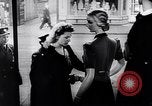
British women work in various war time jobs, British prepare for war, and people greet Winston Churchill
Contribution of British working women to the war effort in England during World War 2. British women prepare for German aerial warfare Battle of Britain. British women stand and talk. A woman reads from a paper. British women put up barrage balloons and man the antiaircraft guns. British women working jobs that are traditionally handled by men. They work on a train. Another woman cleans a wheel. Women fly and taxi planes. Women in war time drive ambulances and buses. They cook food and serve it to men. British men and women work overtime in a various factories, including war production factories on airplane production and operating various industrial equipment. A British woman welding with a mask. Workers yawn. Two British soldiers with guns walk. The Germans begin their bombing campaign in the Battle of Britain. A British soldier leaves a house. Soldiers walk with rifles on their shoulders. People greet British Prime Minister Winston Churchill. He waves to the people. British people listen to excerpt from Churchill speech on radio with his famous lines "We shall fight on beaches..." and "We shall never surrender." British Soldiers move up a hill. View of barbed wire defenses with Big Ben clock tower in distance behind. British civilian man covering a newly built Anderson Shelter (air raid shelter) with dirt. British civilians walking. Soldiers march and work. A man on a horse cart. An air raid by German aircraft begins and an alarm sounds. British boy and girl children look up in the sky and then run for shelter. Blitz Air attack on London by Nazi German Luftwaffe aircraft during Battle of Britain. A warden blows his whistle and runs, guiding citizens into an underground shelter. Parents are seen trying to fit gas masks onto young British children and an infant, as the children squirm and protest.
Recovery of photographic gondola and deflated balloon in United States.
Photographic gondola and deflated balloon falls in a desert. A USAF (United States Air Force) truck approaches the site. Men inspect the site then fold the deflated balloon and carry it to the Air force truck. Air force workers pick the gondola and keep it in the truck.

Night scenes in London during German blitzkrieg (blitz) of World War 2
Night time in London during German aerial bombardments during World War II, Battle of Britain. Citizens go home in the evening rush hour, crowded London Street and double decker bus is seen. Police and air raid wardens man their posts. Citizens in queue waiting to enter air raid shelters. British citizens bedding down in public air raid shelters. Search lights and anti aircraft units are activated. Fire fighters battle blazes in London following blitz raids.
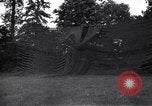
Captain Don M. Beerbower, 353rd Fighter Squadron, and his P-51,
U.S. Army Air Forces 354th Fighter Group in Normandy. Ground crew run to pull camouflage from P-51 at advance air strip Criqueville (A-2) in Normandy during World War 2. The P-51 prop turns,engine starts, and it taxis forward. The name "Bonnie B II" is painted on the fuselage, and 17 swastikas are painted below the cockpit. A Mustang is painted on the tail. It's serial number is 43-12375. The aircraft stops. The name, Captain Don M. Beerbower,is painted below the cockpit. He stands up and climbs out of the airplane, wearing his oxygen mask and helmet. Scene shifts to a loudspeaker in a control facility.A soldier is seen talking on the radio in a plexiglassed enclosure. A flight of P-51s approaches the field. They break off and proceed to buzz the field. (Note concerning Captain Beerbower,of Hill City, Minnesota, seen in this clip. He served as acting Commander of the 353rd Fighter Squadron and was later promoted to Major. He was Commander of the 353rd Fighter Squadron when killed in action, by ground fire while flying his P-51, Bonnie B II, leading an attack on a German airfield near Reims, France, on August 9, 1944. His decorations included: the DSC, Silver Star,DFC (3), Air Medal (26), British DFC, Purple Heart, Distinguished Unit Citation and Campaign Medals.)
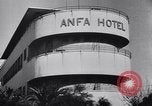
Allied leaders at the Casablanca Conference in Morocco during World War II. Allied forces battle Germans in Algeria and Tunisia
Film begins showing the Anfa Hotel in Casablanca, North Africa. Inside, Allied generals meet to plan further steps in World War 2, against the Axis powers. Charles de Gaulle and French General Henri Giraud are seen walking together at an airport. Closeup of the two. View of Allied General staff members around a table. U.S. principals include Army Chief of Staff, General George Marshall and Air Force Chief, Lieutenant General Henry H. Arnold. Views of General Dwight D. Eisenhower, Supreme Commander of Allied forces, His deputy for land forces, British Field Marshal Harold Alexander, his deputy for sea forces, British Admiral Andrew Browne Cunningham, and his deputy for air operations, British air marshal, Arthur William Tedder (1st Baron Tedder) Outdoors. President Franklin D. Roosevelt and Prime Minister Winston Churchill are seen seated, conversing. Churchill's airplane, named Commando, a very long range Consolidated Liberator II aircraft adapted for passenger transport is seen ready to take him to Tripoli to greet the victorious British 8th Army. Churchill greeting British Field Marshal Bernard Montgomery at Tripoli. Animated map shows battle lines and disposition of Allied forces along the Algiers-Tunisian front. View of German Field Marshal Erwin Rommel inspecting defenses at the Mareth line in Tunisia. Fifteen divisions of German, and 7 divisions of Italian troops entering the front lines. German Panzer IV aus d tanks moving on a dirt road. German infantry marching along a road. Seasoned German troops in camouflaged vehicles. Formation of German Focke Wulf 189 aircraft and view of one dropping bombs. General Rommel pointing to something at the front. Animated map showing the battlefront. (Narrator says German orders were to hold Tunisia at all costs.) View of Rommel, eating a sandwich as he studies document in a defensive position behind the Mareth line. German soldier using periscopic binoculars to view the front. German forces initiating an attack westward driving Allied forces back. Map show German forces advancing beyond the Kasserine pass. Rommel in a staff car, as he learns that the Allied forces have counter-attacked and are driving his forces back to the original battle lines. American infantry marching Eastward to reoccupy Kasserine Pass and beyond, past destroyed German tanks. Rommel's forces make an attack Southward toward the British 8th Army positions. View of new Tiger tank employed by the Germans. A British soldier removes the cover from their new 17 pounder anti-tank gun. View of burning Tiger tanks destroyed by the new British guns. (Narrator says 52 were left burning hulks.)
Funeral of United States General George Patton and key moments and accomplishments during his life.
On the life of U.S. General George S Patton Junior (with narration by Ronald Reagan). Fight at the Siegfried Line during World War 2. U.S. 3rd Army cross the Siegfried Line. General Patton with his officers. Patton's troops cross the Rhine. American soldiers in the streets of Germany. Patton presents the Medal of Honor to a soldier. Patton sees dead people at a concentration camp in Germany. Patton's army moves towards Denube Valley. Civilians in the streets. Patton with officers. Written on a wall 'Hitler is kaput'. Trucks loaded with soldiers. A gun thrown on a pile of guns on the ground. Patton in a barge. A welcome ceremony for General Patton on his return to US: A parade along Broadway in Los Angeles on June 9, 1945, as over 1 million citizens welcome General Patton home and cheer. Shops and offices on Broadway in Los Angeles. Patton waves at the people from an open jeep. Patton and General Doolittle in Los Angeles. General Doolittle makes a speech at a ceremony and introduces General Patton. Patton addresses the gathering and talks about the war and the accomplishments of the Third Army. He notes that from aerial view, Germany and Austria "look like hell from the top." And "that's what any place that the 8th Air Force and the Third Army worked on looks like." Also Patton says, "You must remember this. That from Brest, to various towns in southern Germany and Austria whose names I can't pronounce, but whose places I have removed," (laughter in crowd), "the trail of the Third Army and the 19th Tactical Air Command and the 8th Air Force is marked by more than forty thousand white crosses; forty thousand dead Americans." View of a military cemetery graveyard. General Patton lays flowers at the grave of one of his soldiers. Patton watches a race at Soldiers Field Academy. He shakes hands with the winners. Soldiers carry Patton's coffin wrapped in American flag. Patton's grave with flowers on it. Two soldiers stand beside it. Patton's statue at the West Point Military Academy.
CRITICALPAST.COM: About Us | Contact Us | FAQs - How to Order | License Agreement | My Account | My Lightboxes | Shopping Cart | Advanced Search | Featured Collections | Website Terms & Conditions | Privacy Policy ©2026 CriticalPast LLC.
License Agreement |
Terms & Conditions |
Privacy Policy
©2026 CriticalPast LLC.