


 Francais
 Deutsch
 Italiano
Refine Your Search
Phu Cat Air Base Vietnam 1969 stock footage and images
- Showing 9697 to 9702 of 13374 results more
more Hide
Hide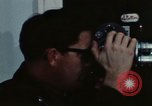
Bolex movie camera and still cameras photograph the United States Joint Chiefs of Staff
Closeup of a Bolex-type movie camera with turret lens selection as the United States Joint Chiefs of Staff pose for a formal portrait. The officers seated include from the left--- General Fred C. Weyand, United States Army ; General David C. Jones, United States Air Force ; General George S. Brown, United States Air Force ; Chairman Joint Chief of Staff Admiral James L. Holloway, United States Navy ; General Robert E. Cushman, United States Marine Corps. Operations deputies standing in the background include Lieutenant General Donald H. Cowles, United States Army ; Lieutenant Huyser, United States Air Force ; Vice Admiral Train, United States Navy ; Vice Admiral Tailey, United States Navy ; Lieutenant General Beckington, United States Marine Corps. Camera pans from officers to the bank of cameramen eager to take pictures.
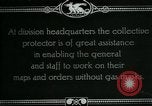
U.S. soldiers at Division Headquarters and in the field train for defense, disposal, and clean up of chemical warfare agents
A United States Army training film about defense against chemical warfare during World War I. The "Collective Protector" enables a general and the staff to work on their maps and orders without gas masks at the Division Headquarters. Two soldiers outside the headquarters wearing gas masks. They guard a low entrance doorway and enclosed tunnel with a heavy, flexible door designed to keep out gas. A soldier lifts the flap of the door and enters. Officers converse with each other while looking at a map on a wall. Soldier stands by rotating a handle on a device continuously. It has a long wide pipe connected to it, perhaps managing fresh air intake or air exchange. U.S. soldiers wearing gas masks load ammunition onto trucks. "Enemy" aircraft flies overhead throwing a cloud of poisonous gas that quickly envelops the area. A soldier wearing a gas mask fires his rifle into the air at the aircraft, through the heavy smoke screen. Gas sentries neutralize the gas around a dump. They dig in the ground with pick axes and mattocks, and then spread a white powder over the area. They then cover the area with a thin layer of the dirt they had dug up.
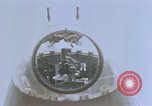
Bombardier adjusts bomb sight of Lancaster bomber in England.
Activities of RAF (Royal Air Force), air arm of the British Armed Forces in England. View of dome. Bombardier in nose adjusts bomb sight. Four motor engines of Lancaster bomber turn over. Men pull out chocks from Lancaster bomber and it moves out. RAF (Royal Air Force) roundel in Lancaster bomber. (World War II period).

Allied assaults against the German Gustav Line at Monte Cassino, Italy during World War II
Opening scene shows peaceful Italian mountains, including one snow-capped, in Spring, 1944, during World War 2. Camera focuses on the town of Monte Cassino and its historic Monastery, on a mountain above the town. (German forces held the Rapido-Gari, Liri and Garigliano valleys and some of the surrounding peaks and ridges that formed the heavily defended Gustav Line.) Animated relief map shows where, by mid January, 1944, American, Polish, and British forces had cleared the enemy from mountains east of Cassino and drawn up on the east side of the Rapido valley. Map shows progress of subsequent Allied attacks that finally reached Mount Castellone and then up Abbey Hill at Monte cassino, itself. Image of German soldier is superimposed on the scene, using binoculars on Abbey hilltop to observe Allied forces. (Narrator states: On February 9th, 75 yards from the abbey, we were stuck.") U.S. Army Air Forces Douglas A-20 Havoc aircraft are seen starting engines. Closeup of Fifth Army leaflet warning the local people to leave the Monte Cassino Abbey to avoid shelling and bombing. View of U.S. troops packing the leaflets into thin-skinned shells to deliver the warning by artillery fire. Next, 105 howitzer guns are seen under camouflage netting, firing bombardments of warning shells. Formation of A-20 aircraft taking off. Aerial view from high above, of B-25 bomber formation in flight. Formations of B-17s, B-24s, B-26s in flight enroute to bomb Monte Cassino. Bombs dropping from B-25 Mitchell bombers. Bombs exploding on Monte Cassino and the Abbey. Batteries of 155 mm guns firing. Formation of 6 B-25 bombers in formation. More bombs bursting on Monte Cassino. Animated map shows German forces taking up their earlier defenses again following the Allied artillery and air attacks. It also shows supplies streaming in to the German Green Devils Parachute Division (Luftwaffe’s 1st Fallschirmjaeger [Parachute-Hunter] division.) The map illustrates all the locations in the town that they occupied and would defend to the last man. Map also illustrates circling positions of Allied artillery batteries. Camera focuses on Polish troops and M4 Sherman tanks moving forward in an offensive. Glimpse of U.S. Army Air Forces mechanics working on a Douglas bomber engine. M4 prime movers towing 155mm howitzer guns. Gun crews camouflaging their positions with netting. Various views of A 240mm howitzer being put in place by a crane. Soldiers deploy detector microphones to locate enemy gunfire sources. They test them, and then enclose them in water-proof containers, bury and cover them. Sound from the microphones being recorded on film at a machine in the Command Post. The data being plotted on a map and corresponding grid locations phoned to Battalion headquarters. View of bombers resuming attacks again, on March 15, 1944. Formations of Douglas bombers, followed by B-25s, seen dropping bombs that explode in the town of Monte Cassino. Artillery firing. Formation of B-24 Liberator bombers in flight. Formation of B-17s dropping bombs. String of bombs exploding in a line on the town. More views of artillery barrages. More lines of bombs exploding. Allied forces storming the shattered town found German soldiers using destroyed structures as shelters to fire from and rubble obstructing the movements of Allied tanks, so the Allied advance was again stopped. Later, a newspaper headline reports resumption of Allied offensive.
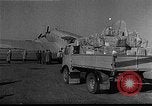
NATO relief efforts during disastrous floods in Netherlands.Supplies being airlifted and dropped over flood region
Contingents of North Atlantic Treaty Organization (NATO) forces collaborate to provide relief to towns suffering from disastrous floods in the Netherlands. Relief supplies are trucked to a waiting Italian Air Force Savoia-Marchetti SM.82 trimotor transport aircraft. Italian aviators stand beside the aircraft. The relief supplies are in flat wooden boxes. "Croce-Rossa-Italiana" is written on several of the boxes. Warehouse (hangar) filled with supplies and military personnel preparing them for airlift. Two American fliers consult with another NATO officer about relief airlift mission. A United States Air Force C-119 cargo plane taxis for takeoff. View from open rear cargo door as it lifts off from the runway. U.S. Air Force crewmen push relief supplies out the open rear cargo hatch. Supplies drop by parachute onto town and surroundings. Flooded areas seen in background.
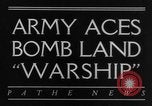
A-3's in formation flight and B-3A bombs on the ground beside the marked outline of a battleship in the United States.
Army aces bomb land warship during bombing practice in the United States. U.S. Army Air Corps Curtiss Falcon A-3's in formation flight over clouds. Wing of a B-3A in the foreground. Pilot and copilot of a U.S. Army Air Corps B-3A bombers. A B-3A bombardier releases a bomb. Bombs being released. Three bombs drop from a U.S. Army Air Corps B-3A, and pass out lower frame. Bombs dropping and exploding in a large circle on the ground. A-3s in flight and clouds in the background. A B-3A bombardier release bombs. Bomb drops from a B-3A, and descends out lower frame. Bombs descend and explode on the ground beside the marked outline of a battleship. Two B-3A's in flight. Bombs falling from a B-3A and a second B-3A in the background. Bombs drop and explode in the outline of a battleship marked on the ground.
CRITICALPAST.COM: About Us | Contact Us | FAQs - How to Order | License Agreement | My Account | My Lightboxes | Shopping Cart | Advanced Search | Featured Collections | Website Terms & Conditions | Privacy Policy ©2026 CriticalPast LLC.
License Agreement |
Terms & Conditions |
Privacy Policy
©2026 CriticalPast LLC.